Ergodic Secret Alignment
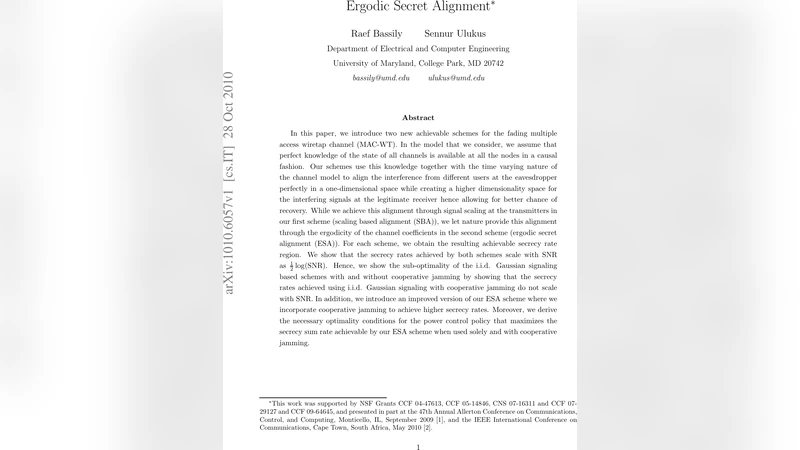
In this paper, we introduce two new achievable schemes for the fading multiple access wiretap channel (MAC-WT). In the model that we consider, we assume that perfect knowledge of the state of all channels is available at all the nodes in a causal fashion. Our schemes use this knowledge together with the time varying nature of the channel model to align the interference from different users at the eavesdropper perfectly in a one-dimensional space while creating a higher dimensionality space for the interfering signals at the legitimate receiver hence allowing for better chance of recovery. While we achieve this alignment through signal scaling at the transmitters in our first scheme (scaling based alignment (SBA)), we let nature provide this alignment through the ergodicity of the channel coefficients in the second scheme (ergodic secret alignment (ESA)). For each scheme, we obtain the resulting achievable secrecy rate region. We show that the secrecy rates achieved by both schemes scale with SNR as 1/2log(SNR). Hence, we show the sub-optimality of the i.i.d. Gaussian signaling based schemes with and without cooperative jamming by showing that the secrecy rates achieved using i.i.d. Gaussian signaling with cooperative jamming do not scale with SNR. In addition, we introduce an improved version of our ESA scheme where we incorporate cooperative jamming to achieve higher secrecy rates. Moreover, we derive the necessary optimality conditions for the power control policy that maximizes the secrecy sum rate achievable by our ESA scheme when used solely and with cooperative jamming.
💡 Research Summary
The paper addresses the fading two‑user multiple‑access wiretap channel (MAC‑WT), where two transmitters communicate with a legitimate receiver in the presence of a passive eavesdropper. All channel state information (CSI) – the complex fading coefficients from each transmitter to both the legitimate receiver (h₁, h₂) and the eavesdropper (g₁, g₂) – is assumed to be perfectly known at every node in a causal manner. Under the usual average‑power constraints, the authors propose two novel achievable schemes that exploit CSI and the time‑varying nature of the fading process to “align” interference at the eavesdropper while preserving a higher‑dimensional signal space at the legitimate receiver.
1. Scaling‑Based Alignment (SBA).
Each transmitter repeats its symbol over two consecutive time slots. By appropriately scaling the transmitted symbols (using factors that depend on the instantaneous channel gains), the effective 2×2 channel matrix seen by the legitimate receiver becomes full‑rank, whereas the matrix seen by the eavesdropper collapses to rank‑one. Consequently, the eavesdropper observes the two users’ signals aligned on a single line, making joint decoding impossible, while the legitimate receiver obtains two linearly independent observations and can recover both messages. The achievable secrecy rates are derived from the standard MAC secrecy region (equations (4)–(6)) after substituting the scaled inputs. The authors show that the resulting secrecy sum‑rate scales as (1/2)·log₂(SNR), i.e., each user obtains a half‑degree of freedom in the high‑SNR regime.
2. Ergodic Secret Alignment (ESA).
Instead of explicit scaling, ESA leverages the ergodicity of the fading process. The transmitters again repeat a symbol, but the second transmission is delayed until a favorable channel realization occurs: the legitimate‑receiver channel vector becomes
Comments & Academic Discussion
Loading comments...
Leave a Comment