On optimizing over lift-and-project closures
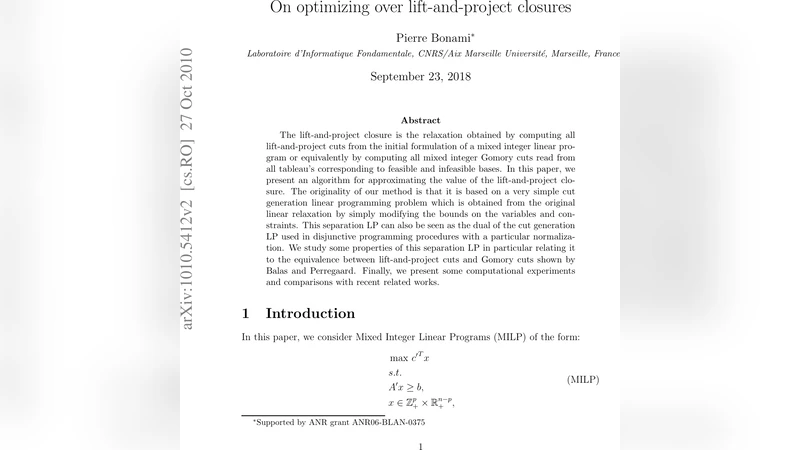
The lift-and-project closure is the relaxation obtained by computing all lift-and-project cuts from the initial formulation of a mixed integer linear program or equivalently by computing all mixed integer Gomory cuts read from all tableau’s corresponding to feasible and infeasible bases. In this paper, we present an algorithm for approximating the value of the lift-and-project closure. The originality of our method is that it is based on a very simple cut generation linear programming problem which is obtained from the original linear relaxation by simply modifying the bounds on the variables and constraints. This separation LP can also be seen as the dual of the cut generation LP used in disjunctive programming procedures with a particular normalization. We study some properties of this separation LP in particular relating it to the equivalence between lift-and-project cuts and Gomory cuts shown by Balas and Perregaard. Finally, we present some computational experiments and comparisons with recent related works.
💡 Research Summary
The paper addresses the long‑standing computational difficulty of exploiting the lift‑and‑project closure (LPC) of a mixed‑integer linear program (MILP). The LPC is defined as the strongest polyhedral relaxation that can be obtained by adding every lift‑and‑project cut derivable from the original formulation. While it is known—through the work of Balas and Perregaard—that lift‑and‑project cuts are equivalent to mixed‑integer Gomory cuts generated from all feasible and infeasible bases, enumerating these cuts is infeasible in practice because the number of bases grows exponentially.
The authors propose a radically simpler approach: instead of generating cuts one by one, they construct a single “separation linear program” (separation LP) that directly yields a point violating the LPC if such a point exists. The separation LP is obtained by taking the original linear relaxation and tightening the bounds on both variables and constraints. In effect, each variable x_i receives a modified interval
Comments & Academic Discussion
Loading comments...
Leave a Comment