Stone duality for topological theories
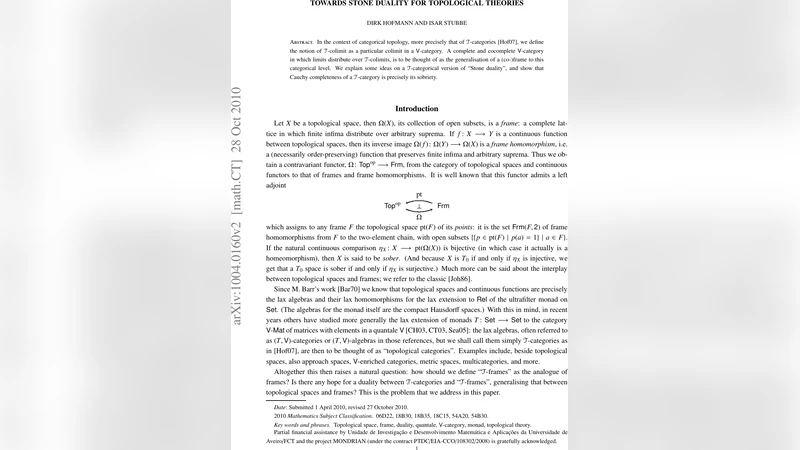
In the context of categorical topology, more precisely that of T-categories [Hofmann, 2007], we define the notion of T-colimit as a particular colimit in a V-category. A complete and cocomplete V-category in which limits distribute over T-colimits, is to be thought of as the generalisation of a (co-)frame to this categorical level. We explain some ideas on a T-categorical version of “Stone duality”, and show that Cauchy completeness of a T-category is precisely its sobriety.
💡 Research Summary
The paper develops a categorical generalisation of frame theory and Stone duality by working within the setting of T‑categories, as introduced by Hofmann (2007). The authors begin by recalling that a V‑category is a category enriched over a monoidal closed category V (typically a complete lattice or quantale) and that a T‑category is a V‑category equipped with an additional structure T, which can be thought of as a “theory” or “topology” imposed on the enrichment.
The central new notion is that of a T‑colimit. Given a diagram D in a V‑category 𝒞, a T‑colimit of D is a colimit that is preserved by the T‑structure in a precise sense: for every T‑continuous functor F: 𝒞 → 𝒟, the image F(colim_T D) is a colimit of F ∘ D. This definition mirrors the classical requirement that finite joins distribute over arbitrary meets in a frame, but now the “joins” are replaced by T‑colimits and the “meets” by ordinary limits in 𝒞.
A V‑category that is both complete and cocomplete and in which limits distribute over T‑colimits is called a T‑frame (or dually a T‑coframe). The authors prove that such categories enjoy many of the familiar properties of frames: they are closed under the formation of sub‑objects, products, and exponentials (when they exist in V), and they admit a notion of “open” and “closed” sub‑objects defined via the T‑colimit structure.
The paper then turns to sobriety. In classical topology a space is sober if every irreducible closed set is the closure of a unique point. The authors translate this into the categorical language by introducing Cauchy completeness for T‑categories: a T‑category 𝒞 is Cauchy complete if every idempotent T‑continuous endofunctor splits. They show that Cauchy completeness of a T‑category is equivalent to sobriety of the associated “space of points” obtained by taking the set of representable T‑continuous functors into the unit object of V. This result provides a clean categorical characterisation of sobriety and connects it to the well‑studied notion of Cauchy completeness in enriched category theory.
The final major contribution is a categorical Stone duality for T‑theories. The authors construct a contravariant equivalence between the category of T‑frames and a category of “T‑Stone spaces”. A T‑Stone space is defined as a T‑continuous functor from a T‑frame to the two‑element lattice 2 (viewed as a V‑object) that satisfies a separation condition analogous to the classical Stone separation axiom. The duality is established by assigning to each T‑frame F the space of its points Pt(F) (the set of T‑continuous morphisms F → 2) equipped with the topology generated by the preimages of the open element 1 ∈ 2, and conversely assigning to each T‑Stone space X the frame of its open sets Ω(X), which are precisely the T‑colimits of representable presheaves on X. The authors verify that the unit and counit of this adjunction are isomorphisms, thereby proving a full dual equivalence.
Throughout the paper, several illustrative examples are provided. For instance, when V = Set and T is the trivial theory, a T‑frame reduces to an ordinary frame of open sets, and the duality recovers the classical Stone duality between Boolean algebras and Stone spaces. When V is a quantale of truth values and T encodes a fuzzy topology, the duality yields a correspondence between fuzzy frames and fuzzy Stone spaces, extending known results in fuzzy topology.
In the concluding section, the authors discuss potential extensions. They suggest investigating internal logics of T‑frames, developing a theory of sheaves over T‑Stone spaces, and exploring connections with domain theory, where the T‑colimit condition mirrors directed completeness. They also propose applications to theoretical computer science, such as semantics of programming languages enriched over quantitative domains, and to quantum logic, where the monoidal structure V captures the non‑commutative nature of quantum propositions.
Overall, the paper offers a robust categorical framework that unifies frame theory, sobriety, and Stone duality under the umbrella of T‑categories, opening avenues for further research in enriched topology, logic, and applications beyond classical point‑set topology.
Comments & Academic Discussion
Loading comments...
Leave a Comment