Supersymmetric Reciprocal Transformation and Its Applications
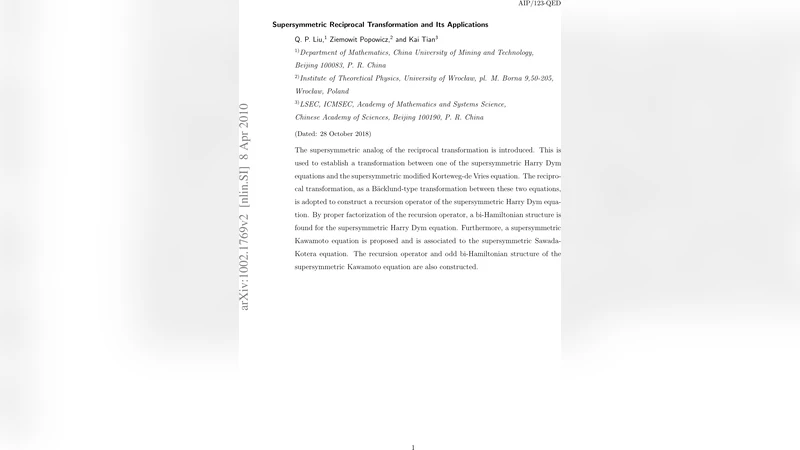
The supersymmetric analog of the reciprocal transformation is introduced. This is used to establish a transformation between one of the supersymmetric Harry Dym equations and the supersymmetric modified Korteweg-de Vries equation. The reciprocal transformation, as a B"{a}cklund-type transformation between these two equations, is adopted to construct a recursion operator of the supersymmetric Harry Dym equation. By proper factorization of the recursion operator, a bi-Hamiltonian structure is found for the supersymmetric Harry Dym equation. Furthermore, a supersymmetric Kawamoto equation is proposed and is associated to the supersymmetric Sawada-Kotera equation. The recursion operator and odd bi-Hamiltonian structure of the supersymmetric Kawamoto equation are also constructed.
💡 Research Summary
The paper introduces a supersymmetric (SUSY) version of the reciprocal transformation, a tool that has been highly effective in the theory of classical integrable systems for generating new equations and preserving conserved quantities. By extending the notion to superspace, where fields depend on both a bosonic coordinate (x) and a fermionic coordinate (\theta), the authors construct a mapping that intertwines the SUSY Harry‑Dym (sHD) equation and the SUSY modified Korteweg‑de Vries (sMKdV) equation.
The transformation is defined through a change of variables in superspace:
\
Comments & Academic Discussion
Loading comments...
Leave a Comment