4U 1909+07: a well-hidden pearl (Conf. Proc.)
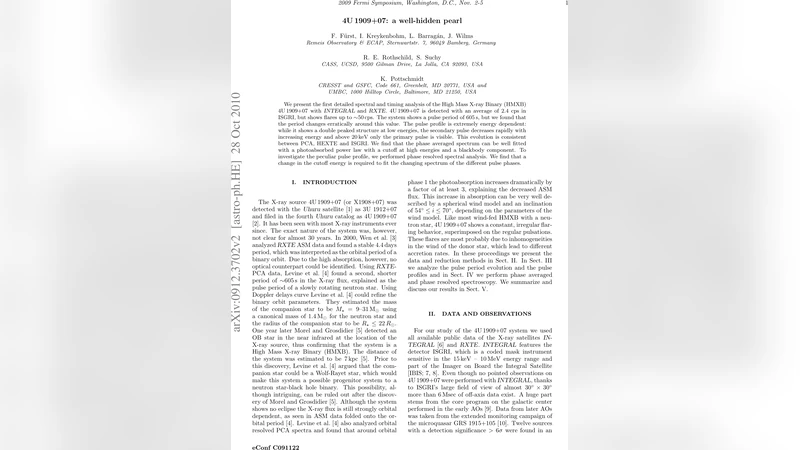
We present the first detailed spectral and timing analysis of the High Mass X-ray Binary (HMXB) 4U 1909+07 with INTEGRAL and RXTE. 4U 1909+07 is detected with an average of 2.4cps in ISGRI, but shows flares up to ~50cps. The system shows a pulse period of 605s, but we found that the period changes erratically around this value. The pulse profile is extremely energy dependent: while it shows a double peaked structure at low energies, the secondary pulse decreases rapidly with increasing energy and above 20keV only the primary pulse is visible. This evolution is consistent between PCA, HEXTE and ISGRI. We find that the phase averaged spectrum can be well fitted with a photoabsorbed power law with a cutoff at high energies and a blackbody component. To investigate the peculiar pulse profile, we performed phase resolved spectral analysis. We find that a change in the cutoff energy is required to fit the changing spectrum of the different pulse phases.
💡 Research Summary
This paper presents the first comprehensive spectral and timing study of the high‑mass X‑ray binary (HMXB) 4U 1909+07 using data from the INTEGRAL/ISGRI and RXTE/PCA‑HEXTE instruments. The source is detected by ISGRI with a modest average count rate of 2.4 counts s⁻¹, but it exhibits dramatic flares that can reach ≈50 counts s⁻¹, indicating highly variable accretion or episodic particle acceleration. Timing analysis confirms a pulse period of about 605 s, consistent with earlier reports, yet the period is not stable; it wanders erratically by several seconds on timescales of a few hundred seconds, suggesting torque fluctuations possibly linked to an irregular wind‑fed accretion flow or changes in the magnetospheric coupling.
A striking result is the strong energy dependence of the pulse profile. At low energies (≤10 keV) the profile is double‑peaked, while the secondary peak diminishes rapidly with increasing energy and disappears above ∼20 keV, leaving a single dominant peak. This evolution is reproduced independently by PCA, HEXTE, and ISGRI, ruling out instrumental artifacts. The authors interpret the low‑energy peak as being associated with a soft thermal component (a blackbody with kT≈0.8 keV) and the high‑energy peak with a non‑thermal, Compton‑ized power‑law component.
Spectral modelling of the phase‑averaged data is achieved with a photo‑absorbed cutoff power‑law plus a blackbody. The absorbing column density is high, N_H≈(1–2)×10²³ cm⁻², indicating dense circumstellar material. The power‑law photon index is ≈1.0, the cutoff energy E_cut≈12 keV, and the blackbody contributes roughly 5 % of the 2–30 keV flux.
Phase‑resolved spectroscopy reveals that the most significant variation across the pulse is in the cutoff energy. During the phase where the primary peak dominates (φ≈0.0–0.2) the cutoff shifts upward to 15–18 keV, whereas during the phase of the secondary peak (φ≈0.5–0.7) it drops to 8–10 keV. The photon index and blackbody parameters remain essentially constant with phase. This behaviour implies that the high‑energy emitting plasma changes its characteristic electron temperature or optical depth as the neutron star rotates, while the soft thermal region stays stable, perhaps anchored to the magnetic pole or a small hot spot on the neutron‑star surface.
The authors conclude that 4U 1909+07 is a “well‑hidden pearl” because its most interesting physical processes are concealed behind strong absorption and erratic variability. Its combination of strong, variable flares, a highly energy‑dependent pulse shape, and phase‑dependent high‑energy cutoff challenges standard HMXB models that often assume a relatively stable accretion column and magnetic geometry. The results call for more detailed investigations of the magnetic field topology, wind clumping, and the coupling between the neutron star’s magnetosphere and the donor’s stellar wind. Future observations with higher spectral resolution and broader energy coverage (e.g., NuSTAR, HXMT, or upcoming missions such as XRISM) will be essential to map the geometry of the emitting regions, to measure possible cyclotron resonance scattering features, and to refine our understanding of torque fluctuations in wind‑fed X‑ray pulsars.
Comments & Academic Discussion
Loading comments...
Leave a Comment