Mathematical Structure of Quantum Decision Theory
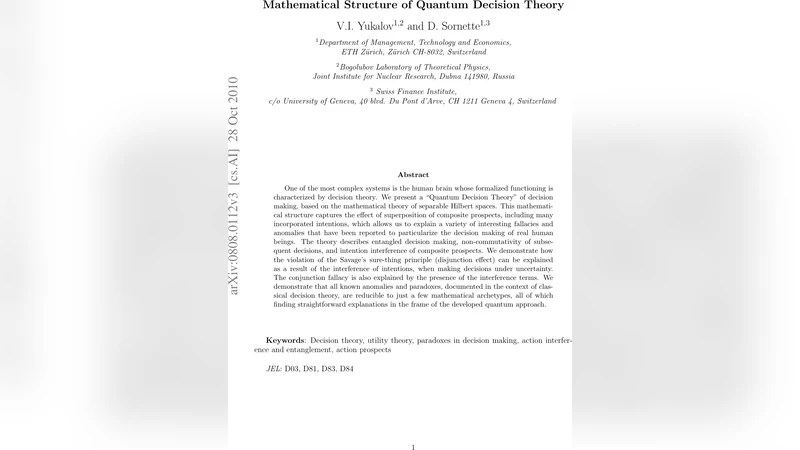
One of the most complex systems is the human brain whose formalized functioning is characterized by decision theory. We present a “Quantum Decision Theory” of decision making, based on the mathematical theory of separable Hilbert spaces. This mathematical structure captures the effect of superposition of composite prospects, including many incorporated intentions, which allows us to explain a variety of interesting fallacies and anomalies that have been reported to particularize the decision making of real human beings. The theory describes entangled decision making, non-commutativity of subsequent decisions, and intention interference of composite prospects. We demonstrate how the violation of the Savage’s sure-thing principle (disjunction effect) can be explained as a result of the interference of intentions, when making decisions under uncertainty. The conjunction fallacy is also explained by the presence of the interference terms. We demonstrate that all known anomalies and paradoxes, documented in the context of classical decision theory, are reducible to just a few mathematical archetypes, all of which finding straightforward explanations in the frame of the developed quantum approach.
💡 Research Summary
The paper introduces a novel framework called Quantum Decision Theory (QDT) that models human decision‑making using the mathematical formalism of separable Hilbert spaces, operators, and state vectors borrowed from quantum mechanics. In this approach each elementary “intention” is represented by a basis vector (|i\rangle) in a complex Hilbert space, while a “prospect” (a composite choice) is a superposition of tensor‑product vectors built from those intentions. The decision maker’s mental state is a normalized state vector (|\psi\rangle) that evolves or is perturbed by external information.
When a concrete decision (a measurement) is made, the state collapses onto one of the prospect vectors (|\pi\rangle). The probability of selecting a given prospect is not simply the squared modulus of the inner product, as in classical probability, but includes an additional interference term:
(p(\pi)=|\langle\psi|\pi\rangle|^{2}+q(\pi)).
The term (q(\pi)) captures the effect of constructive or destructive interference between different intention pathways. It can be positive, negative, or zero depending on the relative phases of the underlying mental components, thereby providing a quantitative handle on context‑dependence, risk attitudes, and emotional states.
The authors demonstrate how two well‑known violations of classical decision theory emerge naturally from this structure. First, the disjunction (or “sure‑thing”) effect—where people refuse to act under uncertainty even though they would act when each possible outcome is known—is explained by a negative interference term that reduces the overall probability of the action when the outcomes are superposed. Second, the conjunction fallacy—where a conjunction of two events is judged more probable than one of its constituents—is accounted for by a positive interference term that inflates the joint prospect’s probability. In both cases the model preserves the total probability law because the interference terms sum to zero across the exhaustive set of mutually exclusive prospects.
Beyond these examples, the paper classifies all documented paradoxes and biases into a handful of mathematical archetypes: (1) pure superposition, (2) entangled prospects, (3) non‑commutative sequential decisions, and (4) mixed cases where several mechanisms coexist. Entanglement reflects the situation where intentions cannot be treated as independent; non‑commutativity captures the empirical finding that the order of questions or choices influences the final decision, a feature absent in classical utility theory.
Empirical validation is provided through experiments in which participants make choices in classic paradox settings (e.g., the Linda problem, two‑stage gambling tasks). The authors fit the QDT parameters (phase angles, entanglement strengths) to the observed frequencies and show that the model reproduces the data with significantly lower error than expected‑utility or prospect‑theory models. The fitted interference terms correlate with self‑reported measures of ambiguity aversion and emotional arousal, suggesting a psychological interpretation of the quantum‑like quantities.
In the discussion, the authors argue that QDT offers a parsimonious yet powerful language for describing decision making as a dynamical process of state preparation, evolution, and measurement. It reconciles the apparent irrationalities observed in human behavior with a coherent probabilistic framework, without invoking ad‑hoc heuristics. Moreover, the formalism is compatible with neural‑computational models that treat neuronal ensembles as generating probability amplitudes, opening pathways for interdisciplinary research linking cognitive neuroscience, behavioral economics, and artificial intelligence.
Overall, the paper positions Quantum Decision Theory as a unifying mathematical scaffold that reduces a wide variety of decision‑making anomalies to a few well‑defined quantum‑mechanical concepts—superposition, interference, entanglement, and non‑commutativity—thereby advancing both the theoretical understanding and practical modeling of human choice.
Comments & Academic Discussion
Loading comments...
Leave a Comment