The Evolution of the Large-scale ISM: Bubbles, Superbubbles and Non-Equilibrium Ionization
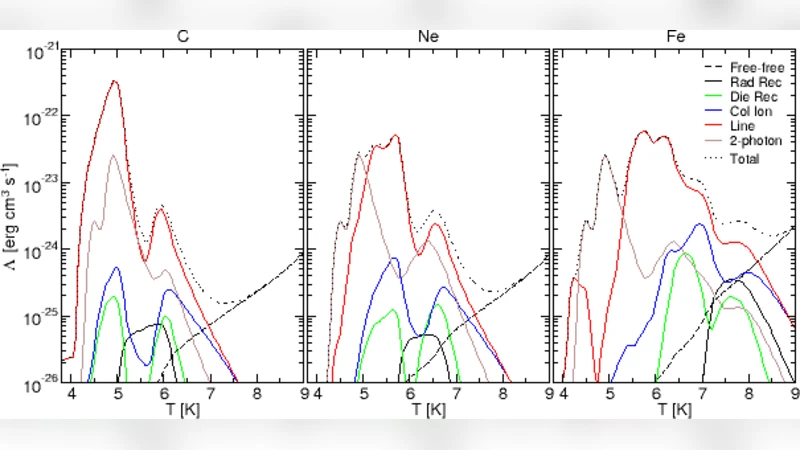
The ISM, powered by SNe, is turbulent and permeated by a magnetic field (with a mean and a turbulent component). It constitutes a frothy medium that is mostly out of equilibrium and is ram pressure dominated on most of the temperature ranges, except for T< 200 K and T> 1E6 K, where magnetic and thermal pressures dominate, respectively. Such lack of equilibrium is also imposed by the feedback of the radiative processes into the ISM flow. Many models of the ISM or isolated phenomena, such as bubbles, superbubbles, clouds evolution, etc., take for granted that the flow is in the so-called collisional ionization equilibrium (CIE). However, recombination time scales of most of the ions below 1E6 K are longer than the cooling time scale. This implies that the recombination lags behind and the plasma is overionized while it cools. As a consequence cooling deviates from CIE. This has severe implications on the evolution of the ISM flow and its ionization structure. Here, besides reviewing several models of the ISM, including bubbles and superbubbles, the validity of the CIE approximation is discussed, and a presentation of recent developments in modeling the ISM by taking into account the time-dependent ionization structure of the flow in a full-blown numerical 3D high resolution simulation is presented.
💡 Research Summary
The paper provides a comprehensive review of the interstellar medium (ISM) focusing on the interplay between supernova‑driven turbulence, magnetic fields, and the ionization state of the gas. It begins by outlining the traditional view that the ISM is often modeled under the assumption of collisional ionization equilibrium (CIE). The authors argue that this assumption breaks down for temperatures below about 10⁶ K because the recombination timescales of most ions exceed the cooling timescales. Consequently, the plasma remains over‑ionized as it cools, leading to a “recombination lag” that causes the cooling curve to deviate from the CIE prediction.
The study quantifies the pressure balance across temperature regimes: magnetic pressure dominates for T < 200 K, ram pressure (dynamic pressure) governs the bulk of the 200 K–10⁶ K range, and thermal pressure becomes dominant above 10⁶ K. This pressure hierarchy directly influences the evolution of bubbles and superbubbles, their expansion rates, and the interaction with surrounding clouds. Over‑ionized high‑ion species such as O VI and Ne VIII are predicted to be more abundant than CIE models would suggest, a result that aligns with ultraviolet and X‑ray observations from missions like FUSE, XMM‑Newton, and Chandra.
To capture these non‑equilibrium effects, the authors incorporate a full time‑dependent ionization network into three‑dimensional, high‑resolution magnetohydrodynamic (MHD) simulations. The simulations track electron density, temperature, and ion fractions simultaneously, allowing the model to reproduce several key phenomena: (1) delayed cooling inside superbubbles that maintains higher interior temperatures for longer periods, (2) enhanced emission from over‑ionized species that matches observed line strengths, and (3) increased anisotropy in pressure due to tangled magnetic fields, which modifies the ram‑magnetic pressure balance.
The results demonstrate that neglecting non‑equilibrium ionization leads to systematic errors in estimating cooling rates, pressure distributions, and feedback efficiencies. This has far‑reaching implications for cloud formation and destruction, metal enrichment patterns, and star‑formation regulation within galaxies. The authors conclude that future ISM modeling must abandon the CIE simplification and adopt integrated approaches that couple time‑dependent ionization chemistry with realistic turbulence and magnetic field dynamics.
Comments & Academic Discussion
Loading comments...
Leave a Comment