Variable-Basis Fuzzy Filters
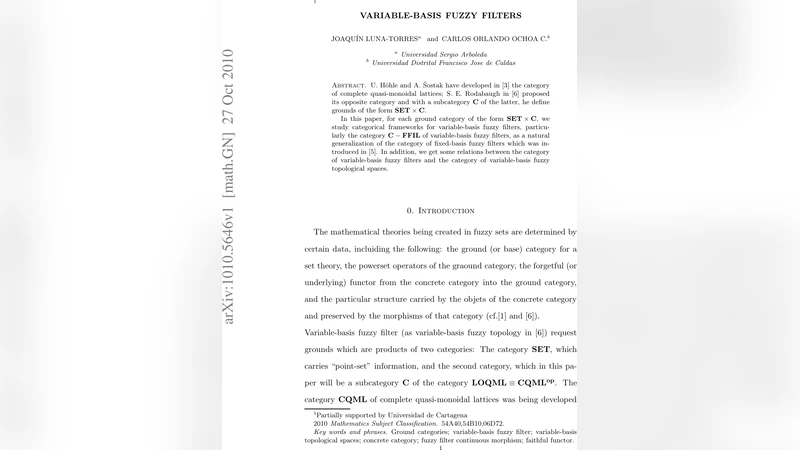
U. H{"o}hle and A. {\v{S}}ostak have developed in \cite{HS} the category of complete quasi-monoidal lattices; S. E. Rodabaugh in \cite{RO} proposed its opposite category and with a subcategory $\mathbf{C}$ of the latter, he define grounds of the form $\mathbf{SET\times C}$. In this paper, for each ground category of the form $\mathbf{SET\times C}$, we study categorical frameworks for variable-basis fuzzy filters, particularly the category $\mathbf{C-FFIL}$ of variable-basis fuzzy filters, as a natural generalization of the category of fixed-basis fuzzy filters which was introduced in \cite{LO}. In addition, we get some relations between the category of variable-basis fuzzy filters and the category of variable-basis fuzzy topological spaces.
💡 Research Summary
The paper develops a categorical framework for variable‑basis fuzzy filters and their relationship with variable‑basis fuzzy topological spaces. Starting from the category of complete quasi‑monoidal lattices (CQML) introduced by Hölle and Šostak, and the opposite category considered by Rodabaugh, the authors fix a subcategory C ⊆ LOQML and form the product category SET × C, which serves as the “ground” category. Objects are pairs (X, L) with X a set and L an object of C; morphisms are pairs (f, Φ) with f: X→Y in SET and Φ: L→M in C. The forward and backward power‑set operators (f, Φ)→ and (f, Φ)← are defined component‑wise and constitute a Galois adjunction that underlies all subsequent constructions.
Within this ground, the authors define the category C‑FFIL of variable‑basis fuzzy filters. An object is a triple (X, L, ℱ) where ℱ: L^X → L is a fuzzy filter satisfying four axioms: (i) ℱ(1_X)=⊤, (ii) ℱ(0_X)=⊥, (iii) monotonicity (f ≤ g ⇒ ℱ(f) ≤ ℱ(g)), and (iv) a weak preservation of the lattice product (ℱ(f)⊗ℱ(g) ≤ ℱ(f⊗g)). A morphism (f, φ): (X, L, ℱ)→(Y, M, Ω) must be a ground morphism together with the continuity condition φ^op ∘ Ω ≤ ℱ ∘ (f, φ)←. Using the adjunction φ^op ⊣ φ_, this condition is equivalent to Ω ≤ φ_ ∘ ℱ ∘ (f, φ)←, showing that continuity is precisely the preservation of filter values under the Galois connection induced by the lattice morphism φ.
The paper proves that C‑FFIL is a concrete category over SET × C; the forgetful functor is faithful, and composition of morphisms is component‑wise, preserving the continuity condition. It also shows that arbitrary joins of filters (pointwise supremum) are again filters, which via Zorn’s Lemma yields the existence of maximal elements—fuzzy ultrafilters. An ultrafilter U is characterized by the identity U(f)= (U(f→0_X))→⊥ for all f, and the authors demonstrate that the direct image φ→U of an ultrafilter under a map φ remains an ultrafilter.
Two central theorems treat initial and final filters. For a surjective ground morphism (f, Φ): (X, L)→(Y, M), the initial filter on X induced by a filter ℱ′ on Y is defined by ℱ_(f,Φ)=Φ^op ∘ ℱ′ ∘ (f, Φ)→. This construction satisfies the universal property of an initial object in the slice category of filters. Dually, for any ground morphism (f, Φ), the final filter on Y generated by a filter ℱ on X is ℱ_(f,Φ)=Φ_* ∘ ℱ ∘ (f, Φ)←. The authors verify that a filter ℱ₁ on Y satisfies ℱ₁ ≤ ℱ_(f,Φ) iff (f, Φ) is continuous with respect to ℱ₁, establishing the finality condition.
In the second part of the paper the category C‑FTOP of variable‑basis fuzzy topological spaces is introduced. Objects are triples (X, L, Υ) where Υ: L^X → L is a fuzzy topology satisfying (i) preservation of arbitrary meets, (ii) sub‑multiplicativity (Υ(f)⊗Υ(g) ≤ Υ(f⊗g)), and (iii) Υ(1_X)=⊤. Morphisms are again pairs (f, Φ) with the continuity condition Φ^op ∘ Γ ≤ Υ ∘ (f, Φ)←, mirroring the filter case but with additional topological axioms.
The authors then relate the two categories. Given a fuzzy topology Υ, the map ℱ_Υ(f)=Υ(f) defines a filter, turning (X, L, Υ) into an object of C‑FFIL. Conversely, from a filter ℱ one can construct a topology Υ_ℱ by setting Υ_ℱ(f)=⋂{g ∈ L^X | ℱ(g) ≤ f}, which satisfies the topological axioms. These constructions are shown to be adjoint in the categorical sense, preserving initial and final structures and ultrafilters. Consequently, the paper establishes a robust correspondence: filters encode closed‑set behavior, while topologies encode open‑set behavior, both within the same variable‑basis categorical environment.
Overall, the work provides a comprehensive, unified categorical treatment of fuzzy filters and fuzzy topologies when the underlying lattice varies with each object. By extending fixed‑basis results to the variable‑basis setting, introducing initial/final constructions, ultrafilters, and Galois‑based continuity, the paper lays a solid theoretical foundation for further developments in fuzzy set theory, variable‑basis data analysis, and applications where the lattice of truth values is not uniform across the system.
Comments & Academic Discussion
Loading comments...
Leave a Comment