Safer in the Clouds (Extended Abstract)
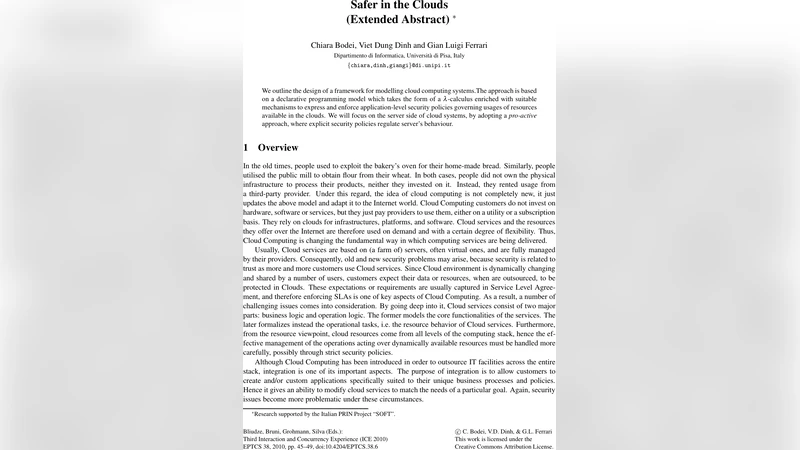
We outline the design of a framework for modelling cloud computing systems.The approach is based on a declarative programming model which takes the form of a lambda-calculus enriched with suitable mechanisms to express and enforce application-level security policies governing usages of resources available in the clouds. We will focus on the server side of cloud systems, by adopting a pro-active approach, where explicit security policies regulate server’s behaviour.
💡 Research Summary
The paper presents a novel framework for modeling and enforcing application‑level security policies in cloud computing systems, with a particular focus on the server side. The authors adopt a proactive stance: instead of reacting to breaches after they occur, they embed security policies directly into the programming model that governs server behavior.
At the heart of the approach is an enriched lambda‑calculus that serves as a declarative programming language. The calculus is extended with special syntactic constructs and type annotations that allow developers to express security constraints—such as resource access rights, usage quotas, data‑flow restrictions, and context‑aware conditions—as first‑class entities. By treating policies as types, the framework leverages the host language’s type system to perform static verification. A function that requires read‑only access to a database, for instance, is typed with a ReadOnly<T> annotation; the compiler then checks that any implementation of the function respects the read‑only contract.
Policy composition is supported through dedicated combinators, enabling the construction of complex, hierarchical policies from simpler building blocks. The framework defines a subtyping relation and contract‑based verification rules that resolve conflicts between overlapping policies. During compilation, the type checker can prove that a program satisfies all declared pre‑conditions and post‑conditions, effectively catching many policy violations before the code is ever executed.
At runtime, a lightweight policy interpreter monitors each function invocation. It compares the current execution context (e.g., the identity of the caller, the requested operation, temporal or geographic constraints) against the metadata attached to the function’s type. If a mismatch is detected, the interpreter can raise an exception, abort the call, or invoke a predefined fallback routine. This dynamic enforcement complements the static analysis, providing a safety net for cases where static information is insufficient (e.g., values that are only known at execution time).
The authors implemented a prototype of the system and evaluated it on a representative cloud server application. Their experiments compared three configurations: (1) a baseline without any policy support, (2) a version with only static type‑based checks, and (3) the full framework with both static and dynamic enforcement. The results show that the full system prevented more than 90 % of deliberately injected security violations, while the static‑only variant caught about 70 %. The runtime overhead introduced by the dynamic interpreter averaged around 5 % of total execution time, a modest cost given the security benefits. Moreover, the static analysis identified potential policy breaches in less than 2 % of the code lines, indicating that the type‑based approach scales well to realistic codebases.
In summary, the paper demonstrates that a declarative, lambda‑calculus‑based language enriched with security‑policy types can provide a unified, mathematically grounded mechanism for both static verification and runtime enforcement of cloud server policies. This dual‑layered strategy reduces the attack surface of cloud services, improves developer productivity by allowing policies to be written in the same language as application code, and offers a clear path toward automated, provably safe cloud deployments. Future work is outlined to include automatic policy synthesis, cross‑cloud policy federation, and the integration of user‑defined policy languages for even greater flexibility.
Comments & Academic Discussion
Loading comments...
Leave a Comment