Bachets Problem: as few weights to weigh them all
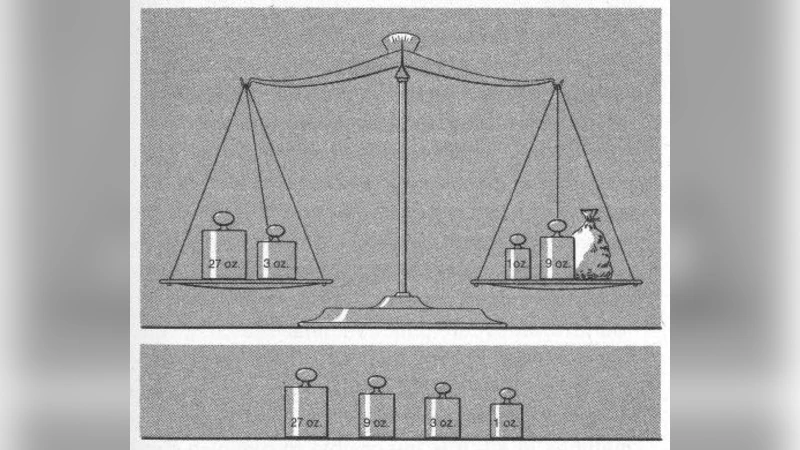
A problem that enjoys an enduring popularity asks: “what is the least number of pound weights that can be used on a scale pan to weigh any integral number of pounds from 1 to 40 inclusive, if the weights can be placed in either of the scale pans ?” W.W. Rouse Ball attributes the first recording of this problem to Bachet in the early 17th century, calling it “Bachet’s Weights Problem”. However, Bachet’s problem stretches all the way back to Fibonacci in 1202, making it a viable candidate for the first problem of integer partitions. Remarkably, given the age of Bachet’s problem, an elegant and succinct solution to this problem when we replace 40 with any integer has only come to light in the last 15 or so years. We hope to expound on this generalization here armed only with our sharp wits and a willingness to induct. In doing so we will discover some of the joys of partitions of integers and enumerative combinatorics. This expository article, while of interest to researchers in combinatorics, integer partitions and the history of mathematics, is written with an impressionable undergraduate audience in mind.
💡 Research Summary
The paper revisits the classic “Bachet’s Weights Problem,” which asks for the smallest number of integer‑weight masses that, when placed on either pan of a balance scale, can measure every integer weight from 1 up to a given bound N. While the problem is often attributed to Bachet in the early 17th century, the authors trace its origins back to Fibonacci’s 1202 manuscript, making it arguably the first recorded problem in integer partitions. The modern, compact solution—using powers of three—has only been fully articulated in the last decade and the paper aims to present this generalization in a way that is accessible to undergraduates while also highlighting its combinatorial depth.
The authors begin with a historical overview, noting that Fibonacci’s early description, Bachet’s formal statement, and later popularisation by W. W. Rouse Ball all contributed to the problem’s fame. They then formalise the problem: given a two‑pan balance where any weight may be placed on either side, determine the minimal cardinality of a set S of positive integers such that every integer k ∈
Comments & Academic Discussion
Loading comments...
Leave a Comment