Consequences of fluctuating group size for the evolution of cooperation
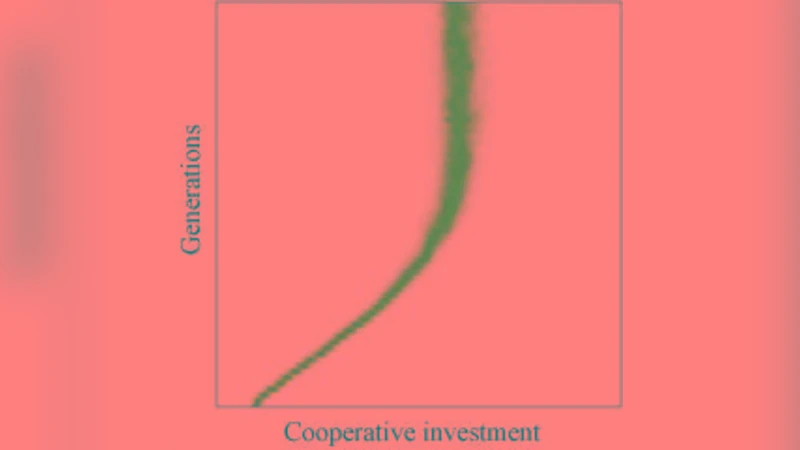
Studies of cooperation have traditionally focused on discrete games such as the well-known prisoner’s dilemma, in which players choose between two pure strategies: cooperation and defection. Increasingly, however, cooperation is being studied in continuous games that feature a continuum of strategies determining the level of cooperative investment. For the continuous snowdrift game, it has been shown that a gradually evolving monomorphic population may undergo evolutionary branching, resulting in the emergence of a defector strategy that coexists with a cooperator strategy. This phenomenon has been dubbed the ’tragedy of the commune’. Here we study the effects of fluctuating group size on the tragedy of the commune and derive analytical conditions for evolutionary branching. Our results show that the effects of fluctuating group size on evolutionary dynamics critically depend on the structure of payoff functions. For games with additively separable benefits and costs, fluctuations in group size make evolutionary branching less likely, and sufficiently large fluctuations in group size can always turn an evolutionary branching point into a locally evolutionarily stable strategy. For games with multiplicatively separable benefits and costs, fluctuations in group size can either prevent or induce the tragedy of the commune. For games with general interactions between benefits and costs, we derive a general classification scheme based on second derivatives of the payoff function, to elucidate when fluctuations in group size help or hinder cooperation.
💡 Research Summary
The paper investigates how fluctuations in group size influence the evolution of cooperation in continuous‐strategy games, focusing on the continuous snowdrift (or “public goods”) game. In the classic setting with a fixed group size N, a monomorphic population can evolve to a point where the fitness landscape’s curvature becomes negative, triggering evolutionary branching: a high‑investment “cooperator” and a low‑investment “defector” coexist, a phenomenon termed the “tragedy of the commune.” The authors extend this framework by allowing N to be a random variable drawn from a distribution p(N). They derive the expected fitness ⟨f⟩ as a weighted sum over possible group sizes and examine how the first and second derivatives of ⟨f⟩ with respect to an individual’s investment x change under different payoff structures.
Two canonical payoff architectures are analyzed. First, when benefits and costs are additively separable—benefits scale with a function b(N) multiplied by a function of the average investment, while costs depend only on the individual’s investment—the variance of N enters the second‑derivative term as Var(N)·b″·g″. Because this term is non‑negative, larger fluctuations raise the curvature of the fitness landscape, turning a previously negative curvature (branching condition) into a positive one. Consequently, sufficiently large group‑size variance can convert an evolutionary branching point into a locally evolutionarily stable strategy (ESS), suppressing the tragedy of the commune.
Second, when benefits and costs are multiplicatively separable—both are multiplied by functions of N—the situation reverses. Here, the covariance between N and the marginal benefit or cost terms appears in the curvature expression. Depending on whether the cost function is convex or concave in N, fluctuations can either amplify or diminish the negative curvature. In particular, if costs increase sharply with group size (convex), even modest variance can generate a negative curvature, inducing branching; if costs are concave, variance may instead stabilize the monomorphic state. Thus, multiplicative interactions allow group‑size fluctuations to both prevent and provoke the tragedy of the commune.
For the most general case, where benefits and costs interact in an arbitrary nonlinear fashion, the authors propose a classification based on the Hessian matrix of the payoff function. The sign of the determinant and the trace of this matrix, evaluated at the singular strategy, determines whether fluctuations are likely to promote or hinder cooperation. This curvature‑based taxonomy provides a systematic way to predict the evolutionary outcome for any specified payoff surface.
The paper concludes by discussing ecological and social implications. In animal societies where group size varies seasonally, additive payoff structures suggest that large fluctuations may stabilize cooperative behavior. In human collective actions where coordination costs rise with group size, multiplicative structures imply that variability could foster the emergence of specialized cooperators and free‑riders. Overall, the study offers a rigorous analytical toolkit for assessing how demographic stochasticity—embodied in fluctuating group sizes—shapes the evolutionary dynamics of cooperation across a broad spectrum of biological and socio‑economic systems.
Comments & Academic Discussion
Loading comments...
Leave a Comment