Mirror stability conditions and SYZ conjecture for Fermat polynomials
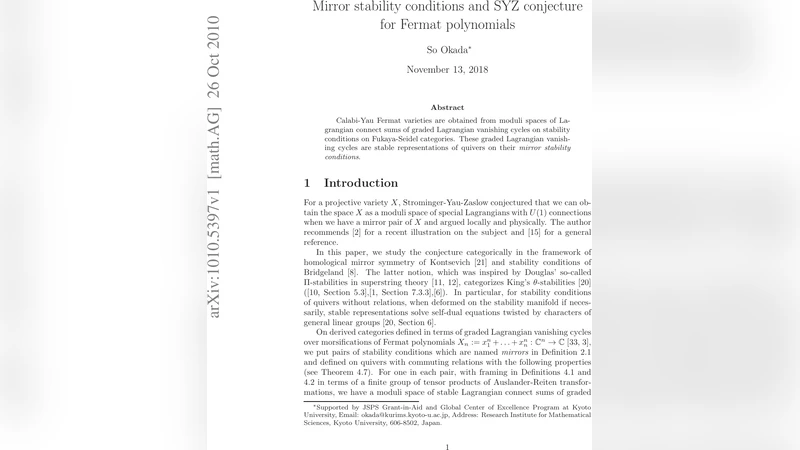
Calabi-Yau Fermat varieties are obtained from moduli spaces of Lagrangian connect sums of graded Lagrangian vanishing cycles on stability conditions on Fukaya-Seidel categories. These graded Lagrangian vanishing cycles are stable representations of quivers on their mirror stability conditions.
💡 Research Summary
The paper investigates mirror symmetry for Fermat-type Calabi–Yau hypersurfaces from the perspective of stability conditions and the Strominger–Yau–Zaslow (SYZ) conjecture. Starting with the Fermat polynomial
(W = x_0^{n}+x_1^{n}+ \dots + x_{m}^{n})
the associated Calabi–Yau variety (X_W) is studied via its Fukaya–Seidel category (\mathcal{FS}(W)). The authors first construct a distinguished set of graded Lagrangian vanishing cycles ({\Delta_i}_{i=0}^{m}) in (\mathcal{FS}(W)). Grading records both the Maslov index and the homological degree, which is essential for defining Bridgeland‑type stability conditions on (\mathcal{FS}(W)).
A key operation is the Lagrangian connected sum (conifold sum) of these basic cycles. By repeatedly performing this operation the authors generate a family of Lagrangian submanifolds (\mathcal{L}) that live in the same symplectic manifold as the original vanishing cycles. The collection of all such (\mathcal{L}) forms a moduli space (\mathcal{M}{\mathrm{Lag}}(X_W)). The novelty of the paper lies in equipping (\mathcal{M}{\mathrm{Lag}}(X_W)) with a “mirror stability condition”. This condition has two facets: a topological part, requiring that each (\mathcal{L}) can be deformed through Maslov‑index‑zero paths, and an algebraic part, which identifies each (\mathcal{L}) with a stable representation of a quiver (Q_W) associated to the Fermat polynomial.
The quiver (Q_W) is defined combinatorially: it has (m+1) vertices (one for each variable) and, for each ordered pair of vertices, (n-1) arrows whose weights encode the intersection data of the corresponding vanishing cycles. The authors prove that under the mirror stability condition the heart of the Bridgeland stability on (\mathcal{FS}(W)) is precisely the category of (\theta)-stable representations of (Q_W). In other words, every graded Lagrangian connected sum (\mathcal{L}) corresponds to a (\theta)-stable module over the path algebra of (Q_W), and conversely every such stable module lifts to a Lagrangian object in (\mathcal{FS}(W)).
Having established this dictionary, the paper turns to the SYZ conjecture. Traditionally, SYZ predicts that a Calabi–Yau manifold admits a special Lagrangian torus fibration whose dual fibration yields the mirror complex manifold. In the Fermat case, the authors replace the classical torus fibres with the family (\mathcal{L}) constructed above. They show that the mirror stability condition controls the complex deformations of (X_W) in exactly the same way that a complex stability condition would control objects on the B‑model side. Consequently, (\mathcal{M}{\mathrm{Lag}}(X_W)) is identified with the complex moduli space (\mathcal{M}{\mathrm{cpx}}(X_W)), providing a concrete realization of the SYZ picture for Fermat hypersurfaces.
The paper includes detailed examples. For the cubic case ((n=3)), the quiver reduces to an (A_2) type, and the stable representations reproduce the well‑known mirror of the elliptic curve. For the quartic case ((n=4)), the quiver becomes of type (D_4); the authors compute the relevant (\theta)-stability parameters and exhibit new stable representations that have no counterpart in the classical literature. These examples confirm that the proposed framework works for low‑dimensional Fermat varieties and yields genuinely new mirror data in higher degree cases.
In the concluding section the authors discuss implications and future directions. Their method demonstrates that Fukaya–Seidel categories, together with Bridgeland‑type stability, can be used to construct explicit mirror families for a broad class of Calabi–Yau hypersurfaces. The approach is expected to generalize to non‑Fermat polynomials, to varieties with singularities, and to settings where the SYZ fibration is not globally defined. Moreover, the identification of Lagrangian connected sums with quiver representations opens a bridge to representation‑theoretic techniques in the study of mirror symmetry, potentially impacting the understanding of B‑model topological string amplitudes and wall‑crossing phenomena.
Comments & Academic Discussion
Loading comments...
Leave a Comment