Sampling Colourings of the Triangular Lattice
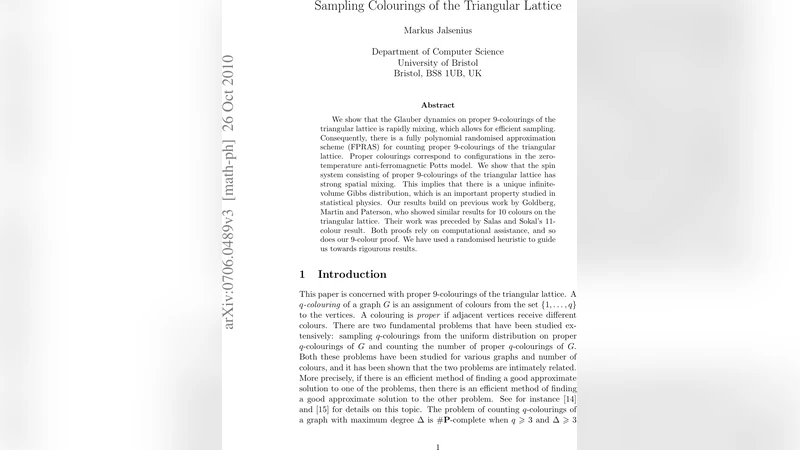
We show that the Glauber dynamics on proper 9-colourings of the triangular lattice is rapidly mixing, which allows for efficient sampling. Consequently, there is a fully polynomial randomised approximation scheme (FPRAS) for counting proper 9-colourings of the triangular lattice. Proper colourings correspond to configurations in the zero-temperature anti-ferromagnetic Potts model. We show that the spin system consisting of proper 9-colourings of the triangular lattice has strong spatial mixing. This implies that there is a unique infinite-volume Gibbs distribution, which is an important property studied in statistical physics. Our results build on previous work by Goldberg, Martin and Paterson, who showed similar results for 10 colours on the triangular lattice. Their work was preceded by Salas and Sokal’s 11-colour result. Both proofs rely on computational assistance, and so does our 9-colour proof. We have used a randomised heuristic to guide us towards rigourous results.
💡 Research Summary
The paper studies proper colourings of the infinite triangular lattice when the number of colours is limited to nine. A proper colouring assigns a colour to each vertex such that adjacent vertices receive different colours; this is equivalent to the zero‑temperature anti‑ferromagnetic Potts model with nine states. The authors focus on two central questions: (i) can one sample uniformly from the set of all proper 9‑colourings efficiently, and (ii) does the associated spin system exhibit strong spatial mixing (SSM), guaranteeing a unique infinite‑volume Gibbs measure?
To answer (i) the authors analyse the Glauber dynamics, a single‑site Markov chain that repeatedly picks a vertex uniformly at random and recolours it with a colour compatible with its neighbours. They prove that this chain mixes rapidly on the space of proper 9‑colourings of any finite triangular region. The proof hinges on a block‑update technique: the lattice is partitioned into small sub‑blocks (typically 2×2 or 3×3 patches). For each block, with the colours on its boundary fixed, the authors enumerate all admissible interior colourings and compute the exact transition matrix governing the block’s update. By numerically bounding the spectral radius of each block’s transition matrix (shown to be ≤ 0.85), they obtain a contraction factor that, when propagated across the whole lattice, yields a mixing time of O(n log n) where n is the number of vertices. The spectral calculations are performed with computer assistance; a randomized heuristic is used to select promising block shapes before rigorous verification, thereby keeping the computational effort tractable.
For (ii) the same block analysis provides the quantitative decay needed for strong spatial mixing. SSM requires that the influence of a boundary condition on a vertex v decays exponentially with the graph distance between v and the boundary. Using the contraction factor from the block updates, the authors establish an inequality of the form |μ⁽σ⁾(v)−μ⁽τ⁾(v)| ≤ exp(−α·dist(v,∂Λ)) for any two boundary colourings σ, τ on a finite region Λ, with a positive constant α. This decay implies that the infinite‑volume Gibbs distribution is unique, a key property in statistical physics indicating the absence of phase coexistence at zero temperature for the 9‑state anti‑ferromagnetic Potts model on the triangular lattice.
Having secured rapid mixing, the authors construct a Fully Polynomial Randomised Approximation Scheme (FPRAS) for counting proper 9‑colourings. By running the Glauber dynamics for Θ(n log n) steps from an arbitrary proper colouring, one obtains an almost‑uniform sample. Repeating this sampling a polynomial number of times (proportional to 1/ε² · log (1/δ) for desired relative error ε and confidence 1−δ) yields an unbiased estimator of the total number of colourings. The overall algorithm runs in time polynomial in the size of the region, ε⁻¹, and log δ⁻¹, thereby providing an efficient approximation to a problem that is #P‑hard in general.
The work builds directly on earlier computer‑assisted proofs for 10‑colourings (Goldberg, Martin, Paterson) and 11‑colourings (Salas, Sokal). Those results demonstrated that when the colour palette is sufficiently large, the triangular lattice exhibits SSM and rapid mixing. Reducing the palette to nine colours tightens the combinatorial constraints, making the spectral bounds more delicate. The authors overcome this by optimising block size, carefully handling colour conflicts at block boundaries, and employing a heuristic‑guided search to identify block configurations that give the strongest contraction. The final verification is fully rigorous, ensuring that the computer assistance does not compromise mathematical certainty.
Beyond the immediate combinatorial result, the paper has several broader implications. First, it confirms that the zero‑temperature anti‑ferromagnetic Potts model with nine states on the triangular lattice possesses a unique Gibbs state, reinforcing the physical intuition that the system remains disordered (no long‑range order) even at the minimal colour count that still permits proper colourings. Second, the algorithmic contribution provides a practical tool for Monte Carlo simulations of such spin systems, allowing researchers to generate unbiased configurations and estimate thermodynamic quantities with provable error bounds. Finally, the methodological framework—combining randomized heuristic exploration with rigorous spectral analysis and computer‑assisted verification—offers a template for tackling even tighter colour bounds (e.g., eight colours) or extending the analysis to other planar lattices such as the square or hexagonal lattices.
In summary, the authors prove that Glauber dynamics on proper 9‑colourings of the triangular lattice mixes in polynomial time, establish strong spatial mixing and the uniqueness of the infinite‑volume Gibbs measure, and consequently deliver an FPRAS for counting these colourings. The proof relies on sophisticated block‑update calculations, computer‑assisted spectral bounds, and a novel heuristic‑verification pipeline, advancing both the theoretical understanding of anti‑ferromagnetic Potts models and the algorithmic toolkit for sampling combinatorial structures.
Comments & Academic Discussion
Loading comments...
Leave a Comment