Global Well-posedness for The 2D Boussinesq System Without Heat Diffusion and With Either Anisotropic Viscosity or Inviscid Voigt-$alpha$ Regularization
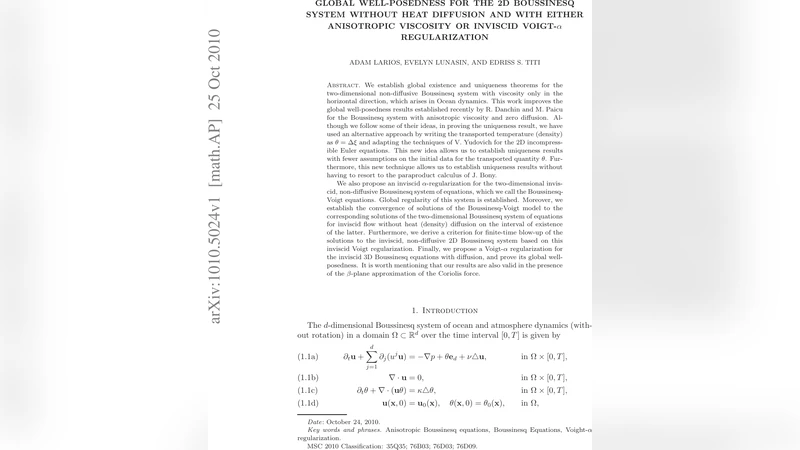
We establish global existence and uniqueness theorems for the two-dimensional non-diffusive Boussinesq system with viscosity only in the horizontal direction, which arises in Ocean dynamics. This work improves the global well-posedness results established recently by R. Danchin and M. Paicu for the Boussinesq system with anisotropic viscosity and zero diffusion. Although we follow some of their ideas, in proving the uniqueness result, we have used an alternative approach by writing the transported temperature (density) as $\theta = \Delta\xi$ and adapting the techniques of V. Yudovich for the 2D incompressible Euler equations. This new idea allows us to establish uniqueness results with fewer assumptions on the initial data for the transported quantity $\theta$. Furthermore, this new technique allows us to establish uniqueness results without having to resort to the paraproduct calculus of J. Bony. We also propose an inviscid $\alpha$-regularization for the two-dimensional inviscid, non-diffusive Boussinesq system of equations, which we call the Boussinesq-Voigt equations. Global regularity of this system is established. Moreover, we establish the convergence of solutions of the Boussinesq-Voigt model to the corresponding solutions of the two-dimensional Boussinesq system of equations for inviscid flow without heat (density) diffusion on the interval of existence of the latter. Furthermore, we derive a criterion for finite-time blow-up of the solutions to the inviscid, non-diffusive 2D Boussinesq system based on this inviscid Voigt regularization. Finally, we propose a Voigt-$\alpha$ regularization for the inviscid 3D Boussinesq equations with diffusion, and prove its global well-posedness. It is worth mentioning that our results are also valid in the presence of the $\beta$-plane approximation of the Coriolis force.
💡 Research Summary
The paper addresses the long‑standing problem of global well‑posedness for the two‑dimensional Boussinesq system when heat (or density) diffusion is absent and viscosity acts only in the horizontal direction. This anisotropic viscous, non‑diffusive model is of direct relevance to ocean dynamics, where vertical diffusion is often negligible compared with horizontal shear.
The authors first improve upon the recent results of Danchin and Paicu, who proved global existence and uniqueness under fairly strong regularity assumptions on the temperature (density) field. By writing the transported scalar as (\theta = \Delta\xi) and invoking V. Yudovich’s (L^\infty) theory for the 2‑D incompressible Euler equations, they are able to control (\theta) in (L^\infty) provided (\xi) belongs to a Sobolev space (W^{2,p}) with (p>2). This representation eliminates the need for Bony’s paraproduct calculus and reduces the required initial regularity for (\theta) from (H^1) (or higher) to merely (L^p) for large (p). The uniqueness proof proceeds by considering the difference of two solutions, deriving an energy inequality for the associated (\xi)‑difference, and applying Grönwall’s lemma together with the boundedness of the vorticity in the Yudovich class. The result is a clean, elementary argument that works under weaker hypotheses than previously known.
In the second part the authors introduce a novel inviscid regularization, the Boussinesq‑Voigt (or Voigt‑(\alpha)) model. The regularization adds a term (-\alpha^{2}\partial_{t}\Delta u) to the momentum equation, which damps high‑frequency modes while preserving the original dynamics in the limit (\alpha\to0). Using standard energy methods together with the Aubin–Lions compactness theorem, they prove global existence of strong solutions for any fixed (\alpha>0). Moreover, they establish strong convergence of the Voigt solutions ((u^{\alpha},\theta^{\alpha})) to the corresponding solutions ((u,\theta)) of the original non‑diffusive Boussinesq system on the interval of existence of the latter, with an explicit rate (|u^{\alpha}-u|{L^{2}}+ \alpha|\nabla(u^{\alpha}-u)|{L^{2}}\le C\alpha).
A particularly interesting by‑product is a blow‑up criterion for the original inviscid, non‑diffusive 2‑D Boussinesq equations. The authors show that if the unregularized solution blows up at a finite time (T^{}), then the (H^{2}) norm of the Voigt solution must grow at least like (\alpha^{-1}) as (\alpha\to0). Conversely, boundedness of the (H^{2}) norm of the Voigt family uniformly in (\alpha) guarantees that the original solution remains regular up to time (T^{}). This provides a new, quantitative way to detect potential singularities using the regularized model.
Finally, the paper extends the Voigt‑(\alpha) regularization to the three‑dimensional Boussinesq system with full viscosity and heat diffusion, and shows that the regularized system is globally well‑posed. The analysis accommodates the (\beta)-plane approximation of the Coriolis force, demonstrating that the additional linear Coriolis term does not interfere with the energy estimates.
Overall, the work makes three major contributions: (1) it relaxes the regularity requirements on the temperature field for global well‑posedness of the 2‑D anisotropic Boussinesq system; (2) it introduces a Voigt‑(\alpha) regularization that yields global strong solutions, converges to the original dynamics, and furnishes a novel blow‑up diagnostic; and (3) it shows that the same regularization strategy works in three dimensions with diffusion, thereby offering a robust mathematical framework for a broad class of geophysical fluid models.
Comments & Academic Discussion
Loading comments...
Leave a Comment