Talbot Workshop 2010 Talk 2: K-Theory and Index Theory
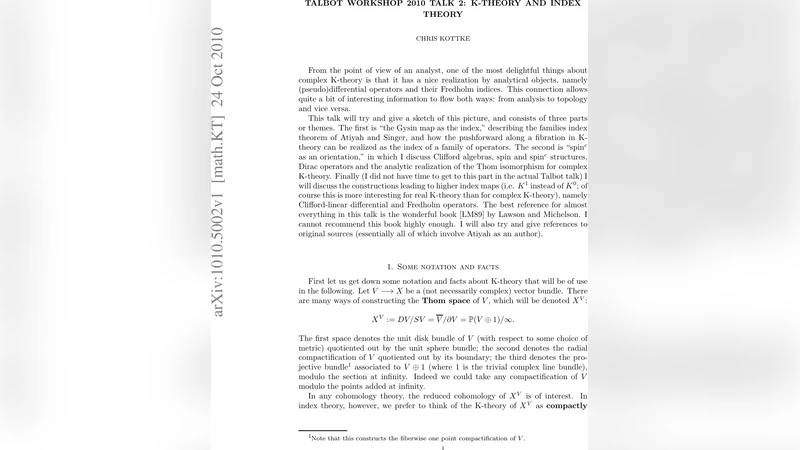
These are notes from a talk at the 2010 Talbot Workshop on Twisted K-theory and Loop Groups. This particular talk is an overview of index theory from the point of view of topological K-theory. Assuming little background in analysis, but some familiarity with complex K-theory, the talk covers the (families) Atiyah-Singer index theorem from the point of view of Gysin maps for fibrations, and orientations for complex K-theory in terms of spin^c structures, Clifford algebras and Dirac operators. Higher index theory is also discussed, in terms of Cl_k modules and Cl_k-linear operators. It is meant to be a readable introduction to the subject, with references to the literature.
💡 Research Summary
The talk “K‑Theory and Index Theory” delivered at the 2010 Talbot Workshop provides a self‑contained, topological‑K‑theory perspective on the Atiyah‑Singer index theorem and its families version, while requiring only minimal analytic background. The presentation is organized around three central ideas: Gysin (push‑forward) maps for fibrations, K‑theoretic orientations coming from Spinⁿc structures, and the role of Clifford algebras in both ordinary and higher index theory.
First, the speaker introduces the Gysin homomorphism π! : K⁎(E) → K^{*‑dim F}(B) associated to a proper submersion π : E → B with compact fibre F. The existence of π! hinges on a K‑orientation of the vertical tangent bundle, which in complex K‑theory is precisely a Spinⁿc structure. By constructing the canonical Spinⁿc line bundle and the associated Thom class u ∈ K^{dim F}(E), the speaker shows how π! is obtained by multiplying with u and then applying the usual push‑forward in K‑theory (integration over the fibre). This topological construction mirrors the analytic push‑forward defined by families of elliptic operators.
Next, the families Atiyah‑Singer theorem is recast in purely K‑theoretic language. Given a smooth family of Dirac‑type operators {D_b} parametrized by B, the symbol σ(D) defines a class in K⁰(T⁎E). The index bundle Ind(D) ∈ K⁰(B) is then shown to be exactly π!(σ(D)·u). In other words, the analytical index coincides with the Gysin image of the symbol class twisted by the Thom class. This formulation eliminates the need for functional‑analytic arguments about kernels and cokernels, replacing them with the algebraic machinery of K‑theory and Thom isomorphism.
The third segment moves beyond the classical case to higher index theory. Here the speaker replaces the complex K‑theory orientation by a Clifford‑module orientation. For each integer k, the real Clifford algebra Cl_k admits a canonical module, and a “Cl_k‑linear Dirac operator” can be defined on bundles equipped with such a module structure. The resulting index lives in K^{*‑k}(B), reflecting Bott periodicity: even k recovers complex K‑theory, odd k yields real K‑theory. The speaker demonstrates that the higher index is again given by a Gysin map, now built from the Cl_k‑Thom class. This unifies the ordinary Atiyah‑Singer theorem with its higher‑dimensional analogues and shows how Clifford algebras encode the periodicity inherent in K‑theory.
Throughout the talk, the speaker cites foundational references: the original Atiyah‑Singer papers, Lawson‑Michelsohn’s “Spin Geometry” for Spinⁿc structures, Baum‑Douglas’s work on K‑homology, and Karoubi’s classic text on K‑theory. Recent developments such as Freed‑Hopkins‑Teleman’s work on twisted K‑theory and loop groups are mentioned to indicate current research directions.
In summary, the presentation weaves together three strands—topological push‑forwards, Spinⁿc‑induced orientations, and Clifford‑module techniques—to give a coherent, accessible account of index theory from the viewpoint of complex K‑theory. By emphasizing the Gysin construction and its compatibility with Dirac symbols, the talk equips readers with a conceptual toolkit that bridges geometry, topology, and analysis, and prepares them for deeper study of twisted K‑theory, higher indices, and their applications in modern mathematical physics.
Comments & Academic Discussion
Loading comments...
Leave a Comment