Towards Constraint-based High Performance Cloud System in the Process of Cloud Computing Adoption in an Organization
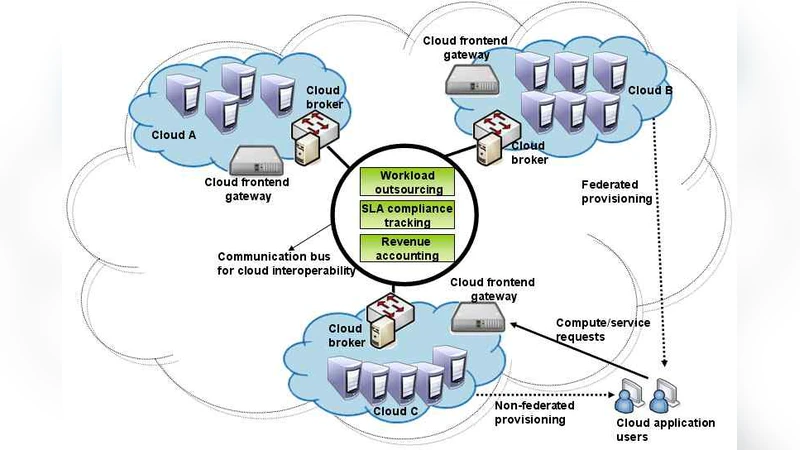
Cloud computing is penetrating into various domains and environments, from theoretical computer science to economy, from marketing hype to educational curriculum and from R&D lab to enterprise IT infrastructure. Yet, the currently developing state of cloud computing leaves several issues to address and also affects cloud computing adoption by organizations. In this paper, we explain how the transition into the cloud can occur in an organization and describe the mechanism for transforming legacy infrastructure into a virtual infrastructure-based cloud. We describe the state of the art of infrastructural cloud, which is essential in the decision making on cloud adoption, and highlight the challenges that can limit the scale and speed of the adoption. We then suggest a strategic framework for designing a high performance cloud system. This framework is applicable when transformation cloudbased deployment model collides with some constraints. We give an example of the implementation of the framework in a design of a budget-constrained high availability cloud system.
💡 Research Summary
The paper addresses the practical challenges that organizations face when transitioning from legacy IT infrastructures to cloud‑based environments. It begins by outlining the broad impact of cloud computing across technical, business, organizational, and regulatory dimensions, identifying specific obstacles such as technology selection (virtual machines versus containers, network and storage virtualization), cost‑benefit analysis, skill gaps, and compliance requirements. The authors then introduce the concept of “Infrastructure Cloud” (Infra‑Cloud) to categorize the current state of cloud‑based infrastructure and compare the four primary deployment models—public, private, hybrid, and community clouds—on criteria including CAPEX/OPEX balance, scalability, security, regulatory fit, and operational complexity.
The core contribution is a “Constraint‑Based Strategic Framework” for designing high‑performance, high‑availability cloud systems under real‑world constraints. The framework consists of six iterative steps: (1) define business objectives and key performance indicators (KPIs); (2) identify all constraints (budget, performance, security, regulatory, legacy dependencies, human resources); (3) prioritize constraints based on business impact; (4) map constraints to concrete design options (choice of hypervisor or container runtime, network function virtualization, storage tiering, multi‑AZ deployment, use of spot instances, etc.); (5) evaluate options through simulation tools such as CloudSim or iCanCloud, quantifying cost, latency, throughput, and SLA compliance; and (6) develop a phased implementation roadmap that includes pilot deployments, incremental migration, CI/CD automation, monitoring, and feedback loops.
A key insight is that budget constraints do not necessarily preclude high availability. The authors recommend a combination of multi‑Availability‑Zone (AZ) deployment, spot‑instance utilization for non‑critical workloads, and auto‑scaling policies to achieve 99.99 % availability while keeping expenses low. For legacy applications that cannot be containerized, a “hybrid virtualization” approach is suggested: retain VM‑based workloads on a private hypervisor while virtualizing the network and storage layers using software‑defined solutions, thereby gaining many cloud‑native benefits without a full rewrite.
To demonstrate applicability, the paper presents a case study of a financial services organization with an annual cloud budget of US $2 million. The organization’s goals were to reduce total cost of ownership by 30 % and achieve 99.99 % uptime. Using the framework, the design team selected a hybrid architecture: a private data center equipped with high‑performance SSD storage for mission‑critical transaction processing, and a public cloud for batch analytics, log processing, and other non‑core services. Spot instances were used for the public‑cloud workloads, achieving a 40 % cost reduction. Kubernetes was deployed as the orchestration layer, providing automated failover, rolling updates, and horizontal pod autoscaling. Centralized monitoring with Prometheus and Grafana enabled real‑time SLA tracking and triggered automated remediation workflows.
Simulation and post‑deployment measurements showed that the hybrid solution delivered the same performance as the legacy environment while cutting operational costs by roughly 35 % and improving availability by a factor of two. No SLA violations were recorded during the evaluation period, and the phased migration strategy eliminated service downtime. Additionally, the organization benefited from reduced operational overhead due to automation and upskilled staff, confirming the framework’s value in both technical and organizational dimensions.
In conclusion, the paper argues that a systematic, constraint‑driven design methodology is essential for successful cloud adoption. By explicitly modeling constraints and directly linking them to architectural choices, organizations can navigate the trade‑offs between cost, performance, security, and compliance. The proposed framework’s inclusion of simulation‑based validation and iterative feedback loops helps detect design flaws early and supports continuous optimization, making it a practical tool for enterprises seeking to build high‑performance, high‑availability cloud systems under real‑world limitations.
Comments & Academic Discussion
Loading comments...
Leave a Comment