Implicit and explicit communication in decentralized control
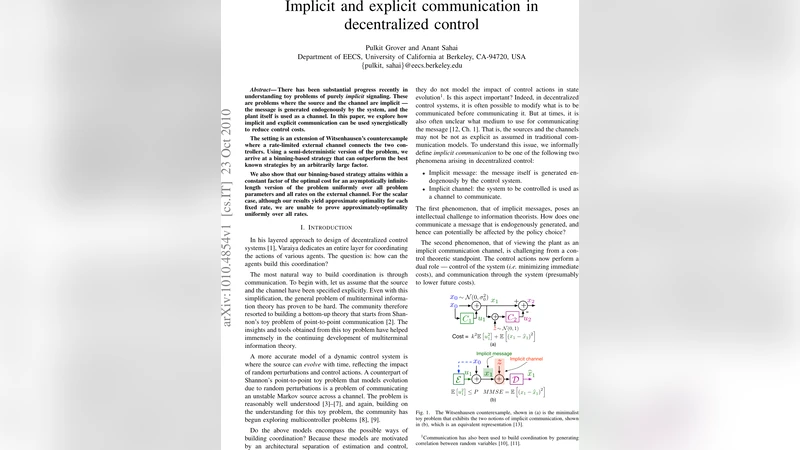
There has been substantial progress recently in understanding toy problems of purely implicit signaling. These are problems where the source and the channel are implicit – the message is generated endogenously by the system, and the plant itself is used as a channel. In this paper, we explore how implicit and explicit communication can be used synergistically to reduce control costs. The setting is an extension of Witsenhausen’s counterexample where a rate-limited external channel connects the two controllers. Using a semi-deterministic version of the problem, we arrive at a binning-based strategy that can outperform the best known strategies by an arbitrarily large factor. We also show that our binning-based strategy attains within a constant factor of the optimal cost for an asymptotically infinite-length version of the problem uniformly over all problem parameters and all rates on the external channel. For the scalar case, although our results yield approximate optimality for each fixed rate, we are unable to prove approximately-optimality uniformly over all rates.
💡 Research Summary
The paper studies a decentralized control problem that extends the classic Witsenhausen counterexample by adding a rate‑limited external communication channel between the two controllers. In the original Witsenhausen problem, the first controller’s action implicitly conveys information to the second controller through the plant dynamics, and the second controller must infer the state solely from this “implicit” signal. The authors ask how performance changes when a second, “explicit” channel is available, albeit with a finite data rate R.
To address this, they introduce a semi‑deterministic formulation: the initial state is Gaussian, the first controller observes a noisy measurement, and then simultaneously (i) chooses a control input u₁ that moves the state, and (ii) quantizes its observation into one of L bins and transmits the bin index over the external channel using a rate‑R code. The second controller receives the bin index, observes its own noisy measurement, and selects u₂. Crucially, the design of u₁ is coordinated with the binning: u₁ is chosen so that the post‑control state tends to lie near bin boundaries, making the bin index highly informative even when the explicit channel is absent. Thus the explicit message resolves coarse uncertainty, while the implicit signal (the plant’s response to u₁) refines the estimate.
The authors analyze the expected quadratic cost J = E
Comments & Academic Discussion
Loading comments...
Leave a Comment