Closure method for spatially averaged dynamics of particle chains
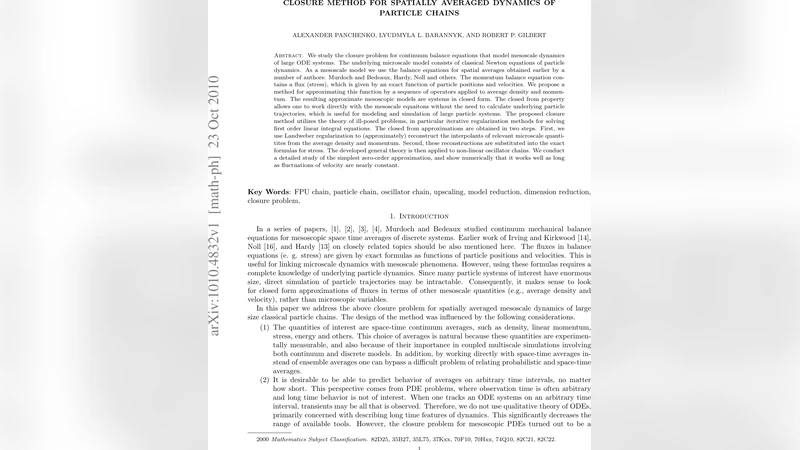
We study the closure problem for continuum balance equations that model mesoscale dynamics of large ODE systems. The underlying microscale model consists of classical Newton equations of particle dynamics. As a mesoscale model we use the balance equations for spatial averages obtained earlier by a number of authors: Murdoch and Bedeaux, Hardy, Noll and others. The momentum balance equation contains a flux (stress), which is given by an exact function of particle positions and velocities. We propose a method for approximating this function by a sequence of operators applied to average density and momentum. The resulting approximate mesoscopic models are systems in closed form. The closed from property allows one to work directly with the mesoscale equaitons without the need to calculate underlying particle trajectories, which is useful for modeling and simulation of large particle systems. The proposed closure method utilizes the theory of ill-posed problems, in particular iterative regularization methods for solving first order linear integral equations. The closed from approximations are obtained in two steps. First, we use Landweber regularization to (approximately) reconstruct the interpolants of relevant microscale quantitites from the average density and momentum. Second, these reconstructions are substituted into the exact formulas for stress. The developed general theory is then applied to non-linear oscillator chains. We conduct a detailed study of the simplest zero-order approximation, and show numerically that it works well as long as fluctuations of velocity are nearly constant.
💡 Research Summary
The paper tackles the longstanding closure problem that arises when one attempts to describe the mesoscale dynamics of a large particle system using continuum balance equations derived from microscopic Newtonian dynamics. While spatially averaged balance equations for mass and momentum have been known for decades (through the works of Murdoch‑Bedeaux, Hardy, Noll, and others), the momentum balance contains a stress term that is an exact functional of the underlying particle positions and velocities. In order to obtain a closed system that depends only on the averaged density and momentum, the authors develop a systematic approximation scheme based on the theory of ill‑posed inverse problems.
First, the authors rewrite the exact stress expression as a linear integral operator A acting on an unknown microscopic field f (the interpolant of particle positions and velocities) to produce the known averaged stress g. This yields the equation g = A f, which is severely ill‑posed because the kernel of A is smooth and the inverse operation amplifies measurement noise. To regularize this inversion, the authors adopt Landweber iteration, a classic iterative regularization method. Starting from an initial guess f⁰ equal to the coarse‑grained fields themselves, the iteration proceeds as
f^{k+1} = f^{k} + ω A^{}(g – A f^{k}),
where A^{} is the adjoint of A and ω is a relaxation parameter chosen in (0, 2/‖A‖²). The number of iterations k is selected either by a discrepancy principle or by early stopping to avoid noise amplification.
The reconstructed microscopic field f^{k} is then substituted back into the exact microscopic stress formula, producing a closed expression σ̄(ρ̄, ρ̄ v̄) that depends only on the averaged density ρ̄ and momentum ρ̄ v̄. This two‑step procedure—regularized reconstruction followed by substitution—yields a hierarchy of approximations. The simplest, “zero‑order” approximation corresponds to taking k = 0, i.e., using the coarse‑grained fields directly as the microscopic interpolants. Higher‑order approximations involve one or more Landweber iterations and thus capture finer fluctuations.
To demonstrate the practicality of the method, the authors apply it to a nonlinear oscillator chain, specifically a one‑dimensional Fermi‑Pasta‑Ulam‑Tsingou (FPUT) lattice with N particles interacting through a nonlinear spring potential V(r). They compute the spatial averages of density and momentum, then perform zero‑order, first‑order, and second‑order Landweber reconstructions of the microscopic fields. The resulting stress predictions are compared against a full molecular dynamics simulation that resolves every particle trajectory.
Numerical experiments reveal that the zero‑order approximation already provides remarkably accurate predictions when the velocity fluctuations are nearly uniform across the chain. In such regimes the relative error in the stress remains below 5 % over long integration times. Adding one or two Landweber iterations improves the capture of high‑frequency components of the stress but also introduces sensitivity to noise; excessive iterations can lead to divergence or amplified errors. The authors conduct a parameter study on the relaxation factor ω (finding optimal values around 0.5–0.8) and on the stopping criterion, showing that a modest number of iterations (typically 1–2) offers the best trade‑off between accuracy and stability.
The paper’s contributions are threefold: (1) it provides a rigorous regularization framework for reconstructing microscopic fields from coarse averages, (2) it translates the exact microscopic stress expression into a closed form that depends only on mesoscale variables, and (3) it validates the approach on a prototypical nonlinear lattice, demonstrating that the method can replace costly particle‑level simulations in many practical scenarios. The authors discuss extensions to higher‑dimensional systems, more complex interaction kernels, and alternative regularization strategies such as Tikhonov or total‑variation based methods. They conclude that the proposed closure technique opens a viable pathway for efficient, accurate mesoscale modeling of large particle ensembles without the need to resolve every microscopic degree of freedom.
Comments & Academic Discussion
Loading comments...
Leave a Comment