A Laboratory Study of Absorbing Capacity of Water Vapor at the Wavelengths from 6500 TO 10500 {AA}
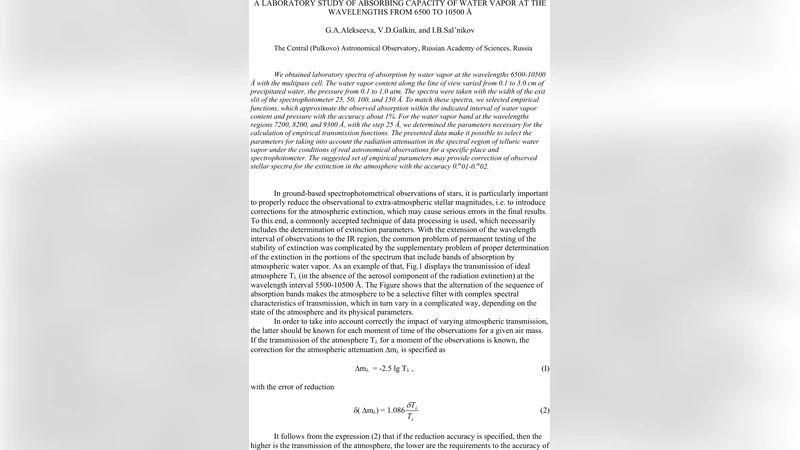
We obtained laboratory spectra of absorption by water vapor at the wavelengths 6500-10500 {\AA} with the multipass cell. The water vapor content along the line of view varied from 0.1 to 3.0 cm of precipitated water, the pressure from 0.1 to 1.0 atm. The spectra were taken with the width of the exit slit of the spectrophotometer 25, 50, 100, and 150 {\AA}. To match these spectra, we selected empirical functions, which approximate the observed absorption within the indicated interval of water vapor content and pressure with the accuracy about 1%. For the water vapor band at the wavelengths regions 7200, 8200, and 9300 {\AA}, with the step 25 {\AA}, we determined the parameters necessary for the calculation of empirical transmission functions. The presented data make it possible to select the parameters for taking into account the radiation attenuation in the spectral region of telluric water vapor under the conditions of real astronomical observations for a specific place and spectrophotometer. The suggested set of empirical parameters may provide correction of observed stellar spectra for the extinction in the atmosphere with the accuracy 0.m01-0.m02.
💡 Research Summary
The paper presents a comprehensive laboratory investigation of water‑vapor absorption in the optical range from 6500 Å to 10500 Å, a region that is heavily affected by telluric water bands in ground‑based astronomical observations. Using a multipass absorption cell, the authors simulated atmospheric paths with precipitable‑water contents ranging from 0.1 cm to 3.0 cm and total pressures from 0.1 atm to 1.0 atm, thereby reproducing a wide variety of real‑world observing conditions. Spectra were recorded with four different exit‑slit widths of the spectrophotometer—25 Å, 50 Å, 100 Å, and 150 Å—so that the influence of instrumental resolution on the measured absorption could be quantified.
The core of the study is the derivation of empirical transmission functions that describe the wavelength‑dependent attenuation as a function of water‑vapor column and pressure. The authors adopt a functional form T(λ) = exp
Comments & Academic Discussion
Loading comments...
Leave a Comment