The Submillimeter Bump in Sgr A* from Relativistic MHD Simulations
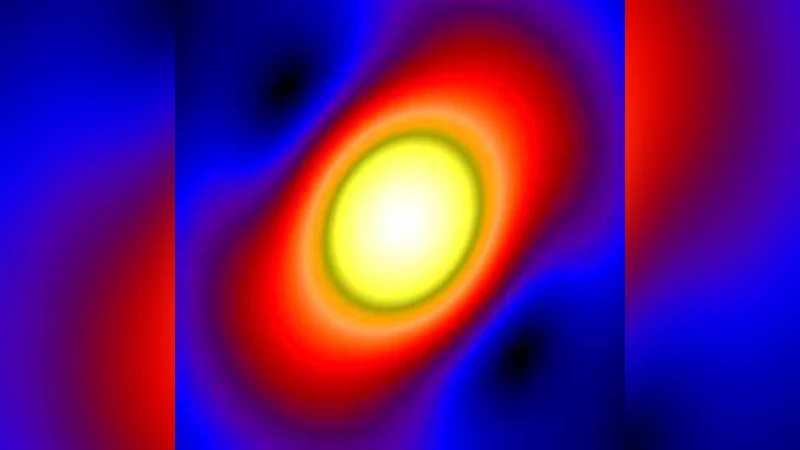
Recent high resolution observations of the Galactic center black hole allow for direct comparison with accretion disk simulations. We compare two-temperature synchrotron emission models from three dimensional, general relativistic magnetohydrodynamic simulations to millimeter observations of Sgr A*. Fits to very long baseline interferometry and spectral index measurements disfavor the monochromatic face-on black hole shadow models from our previous work. Inclination angles \le 20 degrees are ruled out to 3 \sigma. We estimate the inclination and position angles of the black hole, as well as the electron temperature of the accretion flow and the accretion rate, to be i=50+35-15 degrees, \xi=-23+97-22 degrees, T_e=(5.4 +/- 3.0)x10^10 K and Mdot=(5+15-2)x10^-9 M_sun / yr respectively, with 90% confidence. The black hole shadow is unobscured in all best fit models, and may be detected by observations on baselines between Chile and California, Arizona or Mexico at 1.3mm or .87mm either through direct sampling of the visibility amplitude or using closure phase information. Millimeter flaring behavior consistent with the observations is present in all viable models, and is caused by magnetic turbulence in the inner radii of the accretion flow. The variability at optically thin frequencies is strongly correlated with that in the accretion rate. The simulations provide a universal picture of the 1.3mm emission region as a small region near the midplane in the inner radii of the accretion flow, which is roughly isothermal and has \nu/\nu_c ~ 1-20, where \nu_c is the critical frequency for thermal synchrotron emission.
💡 Research Summary
This paper presents a comprehensive comparison between state‑of‑the‑art three‑dimensional general relativistic magnetohydrodynamic (GRMHD) simulations of the accretion flow onto Sagittarius A* (Sgr A*) and high‑resolution millimeter‑wave observations obtained with very long baseline interferometry (VLBI). The authors adopt a two‑temperature plasma description in which electrons are hotter than ions and treat the electron temperature as a free parameter that is calibrated against the observed 1.3 mm (230 GHz) and 0.87 mm (345 GHz) flux density, spectral index, and VLBI visibility amplitudes. Three distinct magnetic field initializations are explored, but all produce a similar inner‑disk structure: a compact, roughly isothermal region near the mid‑plane at radii ≲ 10 GM/c² that dominates the synchrotron emission. In this region the ratio of observing frequency to the thermal synchrotron critical frequency (ν/ν_c) lies between 1 and 20, indicating that the emission is optically thin yet still strongly dependent on the electron temperature.
The simulated images are Fourier‑transformed to generate synthetic visibilities and closure phases for the same baseline geometry used by the Event Horizon Telescope (EHT) and related mm‑VLBI arrays (Chile‑California, Chile‑Arizona, Chile‑Mexico). A Markov Chain Monte Carlo (MCMC) exploration of the parameter space (inclination i, position angle ξ, electron temperature T_e, and mass accretion rate Ṁ) yields best‑fit values of i ≈ 50° (with a 90 % confidence interval of +35°/–15°), ξ ≈ –23° (–22° to +97°), T_e ≈ 5.4 × 10¹⁰ K (± 3.0 × 10¹⁰ K), and Ṁ ≈ 5 × 10⁻⁹ M_⊙ yr⁻¹ (–2 × 10⁻⁹ to +15 × 10⁻⁹ M_⊙ yr⁻¹). Models with a nearly face‑on orientation (i ≤ 20°) are rejected at the 3σ level, contradicting earlier “face‑on shadow” interpretations. The inferred inclination places the black‑hole spin axis at a moderate tilt relative to the line of sight, while the position angle suggests a specific orientation on the sky that can be tested with future baseline coverage.
Variability is a natural outcome of the GRMHD turbulence. The simulations exhibit flux excursions on timescales of 30–60 minutes that are driven by rapid fluctuations in magnetic pressure and consequent heating of the electrons. At optically thin frequencies (230 GHz, 345 GHz) the light curves are strongly correlated with the instantaneous mass accretion rate, implying that the observed millimeter flares are a direct manifestation of inner‑disk accretion dynamics rather than external processes. During flares the image centroid shifts slightly and the brightness distribution becomes more asymmetric, predictions that could be verified with closure‑phase monitoring.
Importantly, the black‑hole shadow—the photon ring predicted by general relativity—remains unobscured in all best‑fit models. The synthetic visibility amplitudes drop to ≈0.1–0.2 Jy on baselines of 3000–5000 km, a level already within the sensitivity of current EHT observations. The authors argue that both direct sampling of the visibility amplitude and closure‑phase analysis on baselines connecting Chile with sites in California, Arizona, or Mexico at 1.3 mm or 0.87 mm will be sufficient to detect the shadow signature. This provides a concrete observational strategy for the next generation of EHT campaigns.
In summary, the paper demonstrates that (1) a moderately inclined, two‑temperature GRMHD model reproduces the observed millimeter flux, spectral index, and VLBI visibilities of Sgr A*; (2) the millimeter emission originates from a compact, nearly isothermal region near the black‑hole horizon; (3) observed millimeter variability is linked to magnetic turbulence and accretion‑rate fluctuations; and (4) the black‑hole shadow should be detectable with existing VLBI baselines, especially when closure‑phase information is incorporated. These results tighten constraints on the geometry and thermodynamics of Sgr A*’s accretion flow and lay out a clear path toward a definitive imaging of the Galactic‑center black‑hole shadow.
Comments & Academic Discussion
Loading comments...
Leave a Comment