Structures and Assumptions: Strategies to Harness Gene $times$ Gene and Gene $times$ Environment Interactions in GWAS
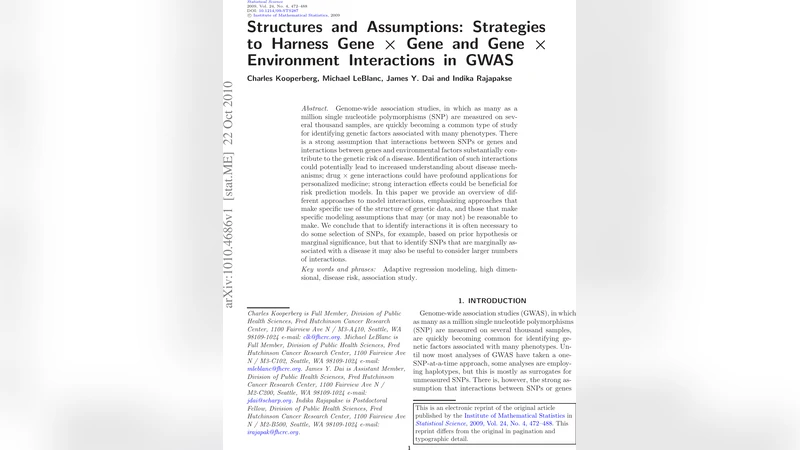
Genome-wide association studies, in which as many as a million single nucleotide polymorphisms (SNP) are measured on several thousand samples, are quickly becoming a common type of study for identifying genetic factors associated with many phenotypes. There is a strong assumption that interactions between SNPs or genes and interactions between genes and environmental factors substantially contribute to the genetic risk of a disease. Identification of such interactions could potentially lead to increased understanding about disease mechanisms; drug $\times$ gene interactions could have profound applications for personalized medicine; strong interaction effects could be beneficial for risk prediction models. In this paper we provide an overview of different approaches to model interactions, emphasizing approaches that make specific use of the structure of genetic data, and those that make specific modeling assumptions that may (or may not) be reasonable to make. We conclude that to identify interactions it is often necessary to do some selection of SNPs, for example, based on prior hypothesis or marginal significance, but that to identify SNPs that are marginally associated with a disease it may also be useful to consider larger numbers of interactions.
💡 Research Summary
Genome‑wide association studies (GWAS) have become a standard tool for identifying genetic variants linked to complex traits, often measuring up to a million single‑nucleotide polymorphisms (SNPs) in several thousand individuals. While most GWAS focus on marginal (main‑effect) associations, there is a growing consensus that interactions—both gene‑by‑gene (G×G) and gene‑by‑environment (G×E)—play a substantial role in disease risk. Detecting these interactions could (i) deepen our mechanistic understanding of disease pathways, (ii) enable drug‑gene interaction insights for personalized therapeutics, and (iii) improve the predictive performance of risk models.
The paper provides a comprehensive overview of methodological approaches for modeling interactions, organized around two central themes: (1) exploitation of the inherent structure of genetic data, and (2) reliance on specific statistical assumptions. Structural approaches leverage biological and statistical regularities such as linkage disequilibrium (LD) blocks, gene‑centric pathways, protein‑protein interaction networks, and functional annotations. By grouping SNPs into biologically meaningful sets, these methods reduce dimensionality, lower the multiple‑testing burden, and increase statistical power. Examples include pathway‑based set tests, block‑wise hierarchical testing, and network‑weighted regression.
Assumption‑driven methods range from classic linear regression models with interaction terms to more flexible frameworks such as hierarchical Bayesian models, penalized regression (e.g., LASSO, elastic net), and machine‑learning algorithms (random forests, gradient boosting, deep neural networks). Linear models are easy to interpret and computationally cheap but may miss non‑linear epistatic patterns. Bayesian approaches incorporate prior biological knowledge and can shrink noisy estimates, yet they are sensitive to prior specification. Machine‑learning techniques capture complex, non‑linear relationships but risk over‑fitting, require large sample sizes, and often produce results that are difficult to translate into biological insight.
A central practical challenge highlighted by the authors is the infeasibility of exhaustive interaction scans across all possible SNP pairs (or SNP‑environment pairs) because the number of tests grows quadratically with the number of markers. Consequently, the paper stresses the necessity of pre‑selection (screening) of SNPs before interaction testing. Three complementary screening strategies are discussed:
- Hypothesis‑driven selection – leveraging prior GWAS hits, functional annotations (e.g., regulatory regions, eQTLs), or known biological pathways to define a candidate pool.
- Marginal‑effect filtering – retaining SNPs that achieve a modest significance threshold in single‑SNP analyses; however, the authors caution that SNPs with weak marginal effects may still participate in strong interactions, so this filter should be applied judiciously.
- Two‑stage (or multi‑stage) screening – an initial rapid scan using computationally cheap interaction scores (e.g., variance‑heterogeneity tests, fast epistasis metrics) to shortlist pairs, followed by rigorous statistical testing (permutation, bootstrap, or Bayesian posterior inference) on the reduced set.
The authors also discuss statistical and biological obstacles that limit interaction discovery: (a) the severe multiple‑testing correction required for billions of pairwise tests, (b) limited statistical power due to modest effect sizes and typical GWAS sample sizes, (c) measurement error and heterogeneity in environmental variables, and (d) population stratification that can confound interaction signals. To mitigate these issues, they recommend (i) large, collaborative consortia that pool data across studies, (ii) simulation‑based power calculations tailored to specific interaction models, (iii) rigorous cross‑validation and replication in independent cohorts, and (iv) integration of multi‑omics data (transcriptomics, epigenomics, proteomics) to prioritize biologically plausible interactions.
In the concluding section, the paper proposes a pragmatic workflow for G×G and G×E discovery: start with biologically informed SNP selection, apply structural grouping to reduce dimensionality, choose an interaction model that balances interpretability and flexibility (e.g., hierarchical Bayesian set‑based tests for pathway‑level interactions, or penalized regression for genome‑wide scans), conduct a two‑stage screening to manage computational load, and finally validate findings in external datasets with complementary omics evidence. By combining structural exploitation with appropriate modeling assumptions and thoughtful SNP pre‑selection, researchers can substantially improve the detection of meaningful genetic interactions, thereby advancing our understanding of complex disease etiology and enhancing the translational potential of GWAS results.
Comments & Academic Discussion
Loading comments...
Leave a Comment