Methodological Issues in Multistage Genome-Wide Association Studies
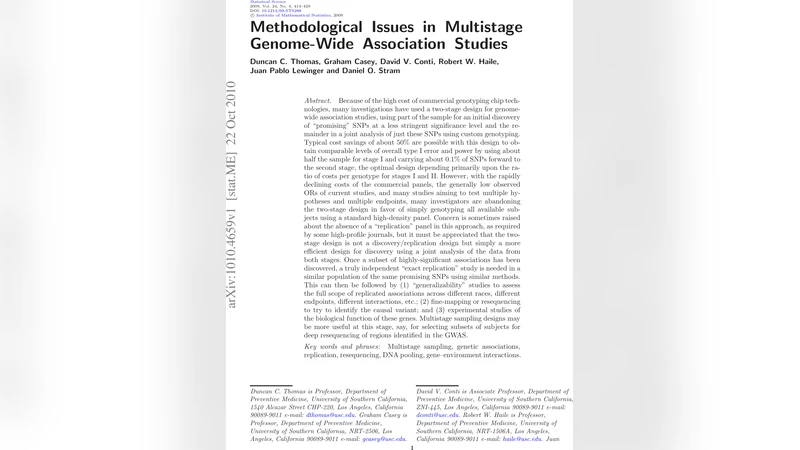
Because of the high cost of commercial genotyping chip technologies, many investigations have used a two-stage design for genome-wide association studies, using part of the sample for an initial discovery of promising'' SNPs at a less stringent significance level and the remainder in a joint analysis of just these SNPs using custom genotyping. Typical cost savings of about 50% are possible with this design to obtain comparable levels of overall type I error and power by using about half the sample for stage I and carrying about 0.1% of SNPs forward to the second stage, the optimal design depending primarily upon the ratio of costs per genotype for stages I and II. However, with the rapidly declining costs of the commercial panels, the generally low observed ORs of current studies, and many studies aiming to test multiple hypotheses and multiple endpoints, many investigators are abandoning the two-stage design in favor of simply genotyping all available subjects using a standard high-density panel. Concern is sometimes raised about the absence of a replication’’ panel in this approach, as required by some high-profile journals, but it must be appreciated that the two-stage design is not a discovery/replication design but simply a more efficient design for discovery using a joint analysis of the data from both stages. Once a subset of highly-significant associations has been discovered, a truly independent ``exact replication’’ study is needed in a similar population of the same promising SNPs using similar methods.
💡 Research Summary
The paper provides a thorough methodological examination of multistage genome‑wide association studies (GWAS), focusing on the classic two‑stage design that has been widely adopted to reduce genotyping costs while preserving statistical power. In the first stage, roughly half of the available subjects are genotyped on a commercial high‑density array; a relaxed significance threshold (often p≈10⁻⁴ to 10⁻⁵) is applied to identify a small subset of “promising” single‑nucleotide polymorphisms (SNPs). Typically only about 0.1 % of all SNPs are carried forward to the second stage, where a custom low‑density panel or targeted sequencing is used and the data from both stages are analyzed jointly.
Through analytical derivations and simulation studies, the authors show that the optimal allocation of resources depends primarily on the cost ratio between a genotype in stage I (C₁) and a genotype in stage II (C₂). When C₁ is substantially higher than C₂ (e.g., C₁/C₂ ≈ 2–3), the cost‑effective configuration is to split the total sample roughly 1:1 between stages and to forward only the top 0.1 % of SNPs. Under these conditions, the overall type I error rate can be held constant while achieving a power gain of 1.5–2 × relative to a single‑stage design, effectively halving the total expense.
The authors also discuss the impact of recent technological trends. The price of commercial high‑density chips has dropped dramatically, bringing the C₁/C₂ ratio close to unity. Simultaneously, most GWAS now report modest odds ratios (OR ≈ 1.1–1.3). In this new cost environment, a single‑stage, full‑sample genotyping approach becomes financially competitive, and many investigators are shifting toward it. Nevertheless, the paper stresses that the two‑stage design is not a “discovery‑replication” framework; rather, it is an efficiency‑driven discovery strategy that still requires a truly independent replication study of the final, highly significant SNPs in a comparable population using the same laboratory methods.
A further advantage of the multistage approach is its ability to mitigate the multiple‑testing burden inherent in modern GWAS that often test numerous phenotypes and hypotheses simultaneously. By filtering out the vast majority of SNPs after stage I, the total number of tests subjected to stringent correction in stage II is dramatically reduced, easing the control of the family‑wise error rate.
In conclusion, the authors argue that the choice between a two‑stage and a single‑stage GWAS should be guided by a combination of factors: the relative genotyping costs (C₁/C₂), the expected effect sizes, the desired overall type I error control, and the planned downstream replication strategy. While the declining cost of high‑density arrays makes single‑stage designs increasingly attractive, the two‑stage design remains valuable for its cost‑saving potential, its capacity to lessen multiple‑testing penalties, and its flexibility in selecting a manageable set of candidate variants for subsequent rigorous replication. Researchers are encouraged to evaluate these trade‑offs explicitly rather than defaulting to one design paradigm.
Comments & Academic Discussion
Loading comments...
Leave a Comment