Modeling the Non-linear Viscoelastic Response of High Temperature Polyimides
A constitutive model is developed to predict the viscoelastic response of polyimide resins that are used in high temperature applications. This model is based on a thermodynamic framework that uses th
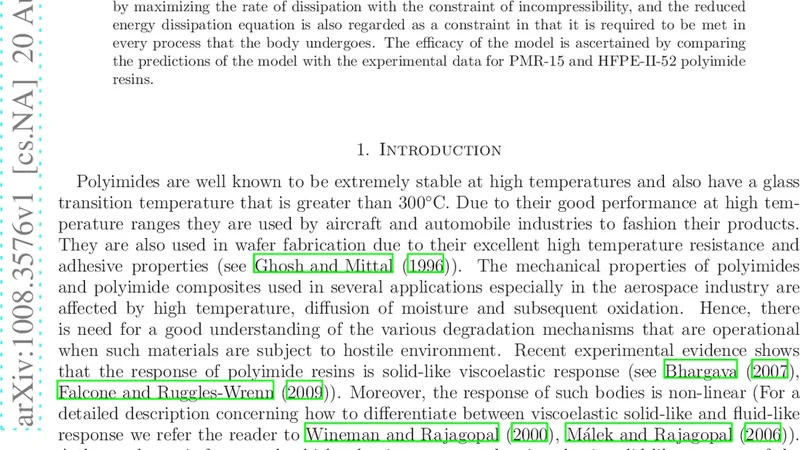
A constitutive model is developed to predict the viscoelastic response of polyimide resins that are used in high temperature applications. This model is based on a thermodynamic framework that uses the notion that the `natural configuration’ of a body evolves as the body undergoes a process and the evolution is determined by maximizing the rate of entropy production in general and the rate of dissipation within purely mechanical considerations. We constitutively prescribe forms for the specific Helmholtz potential and the rate of dissipation (which is the product of density, temperature and the rate of entropy production), and the model is derived by maximizing the rate of dissipation with the constraint of incompressibility, and the reduced energy dissipation equation is also regarded as a constraint in that it is required to be met in every process that the body undergoes. The efficacy of the model is ascertained by comparing the predictions of the model with the experimental data for PMR-15 and HFPE-II-52 polyimide resins.
💡 Research Summary
The paper presents a thermodynamically consistent constitutive framework for predicting the nonlinear visco‑elastic response of high‑temperature polyimide resins, specifically PMR‑15 and HFPE‑II‑52. The authors adopt the concept of a “natural configuration,” a stress‑free reference state that evolves as the material deforms. The evolution law is derived by maximizing the rate of entropy production, a principle that ensures the material dissipates the greatest possible amount of energy under purely mechanical considerations.
To construct the model, explicit forms are prescribed for the specific Helmholtz free energy (ψ) and the rate of dissipation (D). ψ is taken as a function of the right Cauchy‑Green deformation tensor and temperature, capturing the elastic storage of polymer chain stretch. D is defined as the product of density, temperature, and the entropy production rate, and is expressed in terms of the deformation‑rate tensor and internal variables that represent the visco‑elastic part of the deformation. The governing equations are obtained by maximizing D subject to two constraints: incompressibility (det F = 1) and the reduced energy‑dissipation inequality, which guarantees non‑negative dissipation for every admissible process. Using Lagrange multipliers, the authors derive a Cauchy stress expression that contains a pressure term, an elastic contribution from ψ, and a viscous contribution that depends on the internal variables and their evolution.
The internal‑variable evolution equation emerges directly from the dissipation‑maximization condition and takes the form Ȧ = ∂D/∂A − λ∂ψ/∂A, where A denotes the set of visco‑elastic internal variables and λ is a multiplier associated with the dissipation constraint. This formulation yields a fully coupled system: the stress depends on the current deformation and the internal variables, while the internal variables evolve according to the current stress state and temperature.
Experimental validation is carried out on two commercial high‑temperature polyimides. Tensile tests are performed over a temperature range of 200–350 °C and strain‑rate range of 10⁻⁴–10⁻¹ s⁻¹. The authors calibrate the material parameters by a nonlinear least‑squares fit to the measured stress‑stretch curves, stress‑relaxation data, and recovery curves. The calibrated model reproduces the experimental data with high fidelity across all test conditions. Notably, the model captures the pronounced temperature‑dependent stiffening, the rate‑sensitive hysteresis, and the long‑time relaxation characteristic of these resins, which are often missed by linear visco‑elastic or simple Prony‑series models.
Key contributions of the work include: (1) introducing a natural‑configuration‑based thermodynamic framework for nonlinear visco‑elasticity; (2) formulating the constitutive equations by a rigorous entropy‑production maximization principle, ensuring thermodynamic admissibility; (3) incorporating incompressibility and the reduced dissipation inequality as explicit constraints; (4) demonstrating the model’s predictive capability through extensive high‑temperature experimental data on two representative polyimides.
The authors also acknowledge limitations. The current formulation does not account for chemical degradation mechanisms such as thermal oxidation or cross‑link density evolution, which become significant in very long‑term high‑temperature service. The incompressibility assumption neglects the small volumetric changes that can occur under high pressure or during cure shrinkage. Moreover, parameter identification relies on a multi‑parameter nonlinear optimization that can be sensitive to initial guesses and data noise. Future research directions suggested include extending the framework to incorporate coupled chemo‑mechanical effects, relaxing the incompressibility constraint to allow for volumetric visco‑elasticity, and employing machine‑learning‑assisted parameter estimation to improve robustness.
In summary, the paper delivers a robust, physics‑based constitutive model that bridges the gap between thermodynamic rigor and practical predictive capability for high‑temperature polyimide resins, offering a valuable tool for designers of aerospace, electronics, and other high‑performance applications where accurate long‑term visco‑elastic predictions are essential.
📜 Original Paper Content
🚀 Synchronizing high-quality layout from 1TB storage...