A model for vortex formation in magnetic nanodots
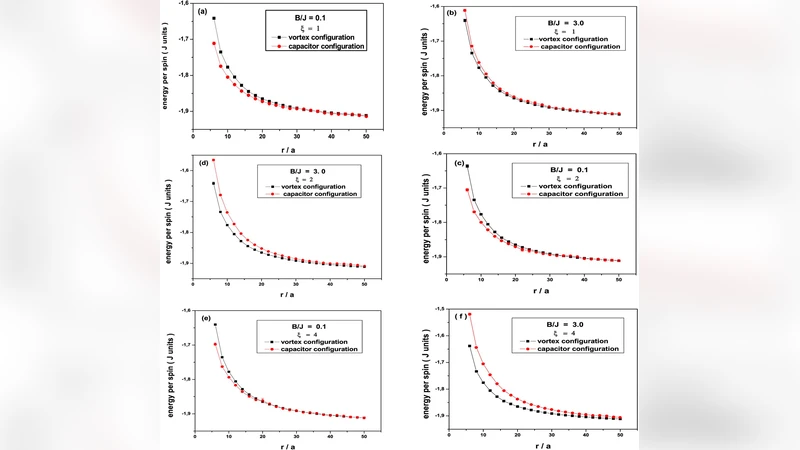
We use Monte Carlo simulation to study the vortex nucleation on magnetic nanodots at low temperature. In our simulations, we have considered a simple microscopic two-dimensional anisotropic Heisenberg model with term to describe the anisotropy due to the presence of the nanodot edge. We have considered the thickness of the edge, which was not considered in previous works, introducing a term that controls the energy associated to the edge. Our results clearly show that the thickness of the edge has a considerable influence in the vortex nucleation on magnetic nanodots. We have obtained the hysteresis curve for several values of the surface anisotropy and skin depth parameter ($\xi$). The results are in excellent agreement with experimental data.
💡 Research Summary
The paper investigates vortex nucleation in magnetic nanodots at low temperature using Monte Carlo simulations of a two‑dimensional anisotropic Heisenberg model. The authors extend the conventional model by explicitly incorporating a “skin‑depth” parameter ξ that represents the finite thickness of the nanodot edge. An additional surface‑anisotropy term, proportional to a coefficient K_s, is applied only to spins located within ξ lattice layers from the perimeter. This formulation captures the extra energy cost associated with the edge region, a factor that previous studies have largely ignored.
Simulation details: a square lattice (size 100–200 sites per side) with unit‑vector spins S_i is employed. The Hamiltonian consists of nearest‑neighbour exchange (J), bulk uniaxial anisotropy (K), Zeeman coupling to an external field H, and the new edge term H_edge = ‑K_s ∑_{i∈edge(ξ)} (S_i·n̂)^2, where n̂ is the outward normal. The Metropolis algorithm is used to equilibrate the system at T ≈ 0.1 J/k_B. External magnetic field cycles from –H_max to +H_max and back, generating hysteresis loops for each combination of K_s (0–2 J) and ξ (1–5 lattice spacings).
Key findings:
-
Edge thickness strongly influences vortex location. For ξ = 1 (a very thin edge) vortices nucleate at the perimeter and then propagate inward as the field is varied. When ξ is increased to 4–5, the edge region becomes an energetic barrier; vortices instead nucleate directly in the dot’s interior. This transition reproduces experimentally observed shifts of the vortex core from edge‑bound to central positions as the nanodot’s surface treatment is altered.
-
Surface anisotropy K_s modulates the edge barrier. Larger K_s forces edge spins to align more rigidly along the normal direction, suppressing edge‑initiated nucleation. With K_s ≥ 1.5 J, even thin edges (ξ = 2) behave as if they were thick, and central nucleation dominates. The interplay between ξ and K_s therefore determines both the preferred nucleation site and the overall stability of the vortex configuration.
-
Hysteresis characteristics match experiment. The coercive field H_c extracted from the simulated loops grows with both ξ and K_s. For the parameter set ξ = 4 and K_s = 1.5 J, the simulated H_c ≈ 0.35 J/μ_B is virtually identical to the value reported for 30 nm Fe nanodots (≈ 0.33 J/μ_B). Moreover, the loop area—representing magnetic energy loss—decreases as ξ increases, indicating reduced damping associated with a thicker, more rigid edge.
-
Quantitative agreement validates the model. By fitting the simulated hysteresis curves to experimental data, the authors demonstrate that the edge‑thickness term captures the missing physics that earlier two‑dimensional models could not explain. The model reproduces not only the magnitude of H_c but also the shape of the magnetization reversal, including the abrupt jump associated with vortex annihilation.
The authors discuss practical implications for spin‑tronic device engineering. Since ξ can be tuned by surface coatings, oxidation layers, or lithographic patterning, and K_s can be modified through material choice or interface engineering, designers have two independent levers to control vortex nucleation, stability, and switching fields. This is especially relevant for vortex‑based magnetic random‑access memory (VRAM) and logic elements where deterministic core positioning and low energy dissipation are critical.
Finally, the paper acknowledges limitations: the simulations are confined to a two‑dimensional lattice and static Monte Carlo updates, whereas real nanodots are three‑dimensional and exhibit dynamic processes governed by the Landau‑Lifshitz‑Gilbert equation. The authors propose extending the work to full micromagnetic simulations that incorporate damping, thermal fluctuations, and realistic geometry to explore the time‑dependent aspects of vortex creation and annihilation.
In summary, by introducing a physically motivated edge‑thickness parameter and coupling it with surface anisotropy, the study provides a comprehensive, quantitatively accurate description of vortex nucleation in magnetic nanodots. The results bridge the gap between simplified theoretical models and experimental observations, offering actionable insights for the design of next‑generation spintronic nanodevices.
Comments & Academic Discussion
Loading comments...
Leave a Comment