Diagram for vortex formation in quasi-two-dimensional magnetic dots
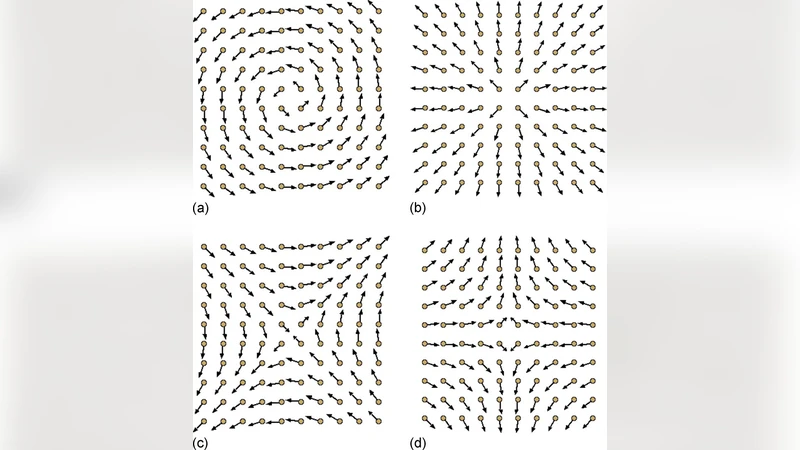
The existence of nonlinear objects of the vortex type in two-dimensional magnetic systems presents itself as one of the most promising candidates for the construction of nanodevices, useful for storing data, and for the construction of reading and writing magnetic heads. The vortex appears as the ground state of a magnetic nanodisk whose magnetic moments interact via dipole-dipole potential?. In this work it is investigated the conditions for the formation of vortices in nanodisks in triangular, square, and hexagonal lattices as a function of the size of the lattice and of the strength of the dipole interaction D. Our results show that there is a “transition” line separating the vortex state from a capacitor like state. This line has a finite size scaling form depending on the size, L, of the system as Dc=D0 +1/A(?1+B*L^2)?. This behavior is obeyed by the three types of lattices. Inside the vortex phase it is possible to identify two types of vortices separated by a constant, D=Dc, line: An in-plane and an out-of-plane vortex. We observed that the out-of-plane phase does not appear for the triangular lattice. In a two layer system the extra layer of dipoles works as an effective out-of-plane anisotropy inducing a large S^z component at the center of the vortex. Also, we analyzed the mechanism for switching the out-of-plane vortex component. Contrary to some reported results, we found evidences that the mechanism is not a creation-annihilation vortex anti-vortex process.
💡 Research Summary
The paper investigates the conditions under which magnetic vortices form in quasi‑two‑dimensional nanodisks composed of classical spins interacting via long‑range dipole‑dipole forces. Three lattice geometries—triangular, square, and hexagonal—are examined, and the authors systematically vary the dipolar coupling strength D and the linear size L (the number of spins along one edge) to map out the phase diagram. Their simulations (Monte‑Carlo annealing combined with energy‑minimization) reveal a clear boundary separating a vortex state from a “capacitor‑like” state in which the magnetization aligns predominantly along the disk edges, producing opposite magnetic charges at opposite ends. This boundary follows a finite‑size scaling law:
Dc(L) = D0 + 1/
Comments & Academic Discussion
Loading comments...
Leave a Comment