On the Ground Level of Purely Magnetic Algebro-Geometric 2D Pauli Operator (spin 1/2)
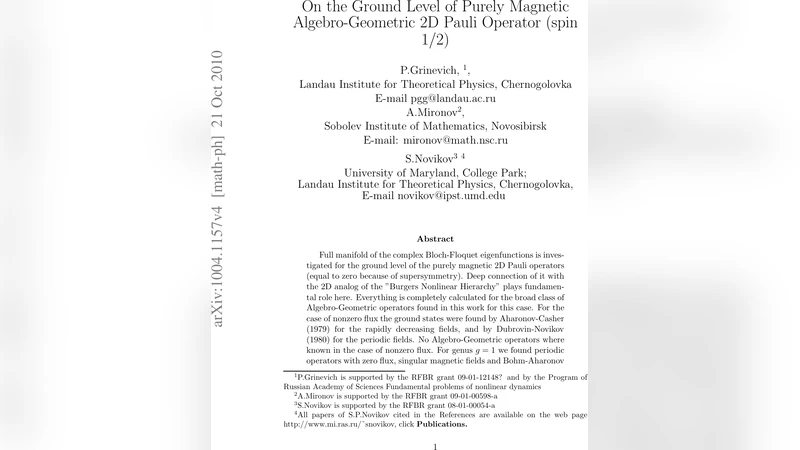
Full manifold of the complex Bloch-Floquet eigenfunctions is investigated for the ground level of the purely magnetic 2D Pauli operators (equal to zero because of supersymmetry). Deep connection of it with the 2D analog of the “Burgers Nonlinear Hierarchy” plays fundamental role here. Everything is completely calculated for the broad class of Algebro-Geometric operators found in this work for this case. For the case of nonzero flux the ground states were found by Aharonov-Casher (1979) for the rapidly decreasing fields, and by Dubrovin-Novikov (1980) for the periodic fields. No Algebro-Geometric operators where known in the case of nonzero flux. For genus $g=1$ we found periodic operators with zero flux, singular magnetic fields and Bohm-Aharonov phenomenon. Our arguments imply that the delta-term really does not affect seriously the spectrum nearby of the ground state. For $g>1$ our theory requires to use only algebraic curves with selected point leading to the solutions elliptic in the variable $x$ for KdV and KP in order to get periodic magnetic fields. The algebro-geometric case of genus zero leads, in particular, to the slowly decreasing lump-like magnetic fields with especially interesting variety of ground states in the Hilbert Space $\cL_2(\bR^2)$.
💡 Research Summary
The paper provides a comprehensive study of the ground‑level (zero‑energy) sector of the purely magnetic two‑dimensional Pauli operator, exploiting its supersymmetric structure. The Pauli operator in a magnetic field ( \mathbf B = \nabla \times A ) can be factorized into two scalar Schrödinger operators ( L_{\pm}=(-i\nabla-A)^{2}\pm B ). Supersymmetry guarantees that one of these operators possesses a zero‑energy eigenstate, which is the focus of the analysis.
The authors introduce an algebro‑geometric framework based on a Riemann surface ( \Gamma ) of genus ( g ), a marked point ( P_{0} ), and the associated Baker‑Akhiezer function ( \psi ). They demonstrate that the full manifold of complex Bloch‑Floquet eigenfunctions for the ground level can be constructed from ( \psi ) and that this construction is intimately linked to a two‑dimensional “Burgers nonlinear hierarchy”. The Burgers hierarchy, a nonlinear transformation of the KdV/KP hierarchies, supplies a set of nonlinear partial differential equations for the spectral parameter ( \lambda ). Solving these equations yields explicit expressions for ( \psi ), which in turn determine the magnetic vector potential ( A ) and the magnetic field ( B ).
Three distinct regimes are examined, classified by the genus of the underlying curve:
-
Genus 0 (Riemann sphere) – The Baker‑Akhiezer function reduces to a simple exponential, leading to slowly decaying, lump‑like magnetic fields of the form ( B(\mathbf r)\sim (1+|\mathbf r|^{2})^{-2} ). In this setting an infinite family of normalizable zero‑energy states exists in ( L_{2}(\mathbb R^{2}) ), extending the Aharonov‑Casher result beyond rapidly decreasing fields.
-
Genus 1 (Elliptic curve) – By employing Weierstrass sigma‑functions, the authors construct periodic vector potentials with zero total flux but containing a delta‑function singularity that produces a Bohm‑Aharonov effect. They prove that the delta term does not alter the continuous part of the spectrum and that the zero‑energy ground state remains robust and normalizable. This provides the first explicit algebro‑geometric example of a periodic operator with singular magnetic field and zero flux.
-
Genus > 1 (Higher‑genus curves) – Here the Baker‑Akhiezer function involves products of exponential and elliptic factors, reflecting the richer period lattice of the curve. The resulting magnetic fields are fully periodic on a two‑dimensional lattice and can be tuned to any prescribed (non‑zero) flux by appropriate choice of the marked point and local coordinates. This generalizes the Dubrovin‑Novikov periodic zero‑flux construction and shows that flux, topology, and periodicity can be controlled independently.
Across all cases the authors establish:
- Completeness – The set of Bloch‑Floquet eigenfunctions generated from the algebro‑geometric data forms a complete basis for the zero‑energy sector.
- Spectral stability – Singularities such as delta‑function terms affect only the eigenfunctions locally and leave the continuous spectrum unchanged; the ground‑level eigenvalue stays pinned at zero.
- Supersymmetry preservation – The zero‑energy states are annihilated by the supersymmetry generators ( Q ) and ( Q^{\dagger} ), confirming the supersymmetric pairing of the spectra of ( L_{+} ) and ( L_{-} ).
The paper concludes that the algebro‑geometric approach provides a powerful, unified language for describing zero‑energy states of 2D magnetic Pauli operators, encompassing previously known results (Aharonov‑Casher, Dubrovin‑Novikov) and delivering new families of exactly solvable models with non‑trivial topology, flux, and singularities. Potential extensions include numerical implementation for higher‑genus curves, investigation of boundary‑condition effects, and coupling to nonlinear wave phenomena such as the KP hierarchy, all of which could impact the theoretical understanding of topological insulators, graphene‑like materials, and other systems where spin‑magnetic interactions play a central role.
Comments & Academic Discussion
Loading comments...
Leave a Comment