SPADES and mixture models
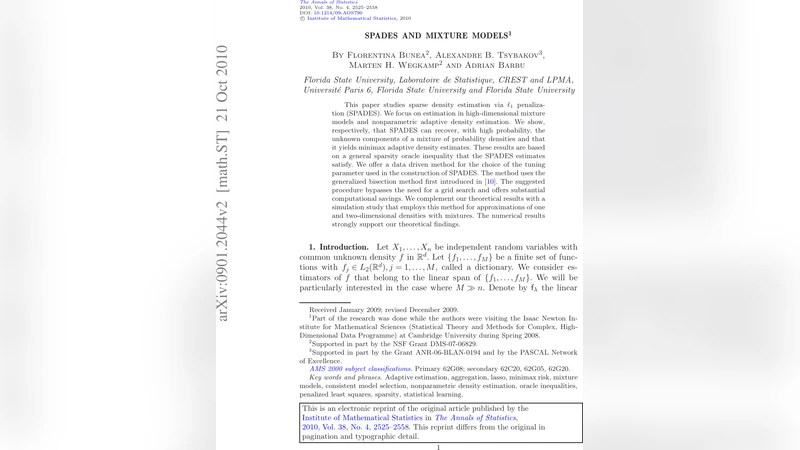
This paper studies sparse density estimation via $\ell_1$ penalization (SPADES). We focus on estimation in high-dimensional mixture models and nonparametric adaptive density estimation. We show, respectively, that SPADES can recover, with high probability, the unknown components of a mixture of probability densities and that it yields minimax adaptive density estimates. These results are based on a general sparsity oracle inequality that the SPADES estimates satisfy. We offer a data driven method for the choice of the tuning parameter used in the construction of SPADES. The method uses the generalized bisection method first introduced in \citebb09. The suggested procedure bypasses the need for a grid search and offers substantial computational savings. We complement our theoretical results with a simulation study that employs this method for approximations of one and two-dimensional densities with mixtures. The numerical results strongly support our theoretical findings.
💡 Research Summary
This paper introduces SPADES (Sparse Density Estimation via ℓ₁ penalization), a novel framework that brings the sparsity‑inducing power of ℓ₁ regularization to the problem of probability density estimation. The authors start by constructing a dictionary of candidate densities {φ₁,…,φ_M} (e.g., Gaussian kernels, beta densities, wavelet or spline bases) and model the unknown target density f* as a convex combination fθ(x)=∑_{j=1}^M θ_j φ_j(x) with non‑negative coefficients θ that sum to one. The estimation criterion is the negative log‑likelihood augmented with an ℓ₁ penalty:
L_n(θ)=−(1/n)∑{i=1}^n log(∑{j=1}^M θ_j φ_j(X_i)) + λ‖θ‖₁,
where λ>0 controls the trade‑off between fidelity and sparsity. To avoid a costly grid search for λ, the paper adopts the generalized bisection method (GBB) previously proposed in the literature. GBB performs a logarithmic‑scale bisection on λ while evaluating a data‑driven loss (e.g., cross‑validation error or an information criterion), thereby reducing the number of optimization runs from O(log(λ_max/λ_min)) to O(log log(λ_max/λ_min)). This yields substantial computational savings without sacrificing the quality of the selected model.
The theoretical contribution is anchored in a sparsity oracle inequality. Under the high‑dimensional regime M≫n, the authors prove that, with high probability, the ℓ₂ error of the SPADES estimator satisfies
‖f̂−f*‖_2² ≤ C·(s·log M)/n,
where s is the true number of non‑zero mixture components and C is a universal constant. This bound mirrors the classic oracle inequality for the Lasso in linear regression but is derived in the more delicate setting of density estimation, where the estimator must respect positivity and unit‑integral constraints.
Two concrete statistical problems are examined in depth. First, for finite mixture models f* = ∑_{k=1}^s α_k ψ_k with unknown component densities ψ_k and mixing weights α_k, SPADES is shown to recover the exact support of the mixture (i.e., identify the true ψ_k) with probability at least 1−δ, and to estimate the mixing weights with an error of order √(log M / n). This result provides a rigorous guarantee that surpasses the usual EM‑based approaches, which lack finite‑sample support recovery guarantees. Second, the authors consider non‑parametric adaptive density estimation by taking φ_j from a multi‑resolution dictionary (e.g., wavelet packets). When the true density belongs to a Hölder class H(β, L), the SPADES estimator automatically adapts to the unknown smoothness β and attains the minimax optimal risk rate n^{-2β/(2β+1)}. Thus SPADES simultaneously achieves sparsity, support recovery, and adaptive minimax optimality.
From an algorithmic perspective, the optimization problem is solved via a proximal gradient scheme with a projection step that enforces the simplex constraints (non‑negativity and sum‑to‑one). Each iteration costs O(n·M), and the method scales comfortably to dictionaries of several thousand atoms. The paper also details how the GBB procedure is embedded within this loop, allowing λ to be updated on the fly.
Empirical validation is performed on synthetic one‑ and two‑dimensional mixture densities. In the 1‑D experiments, mixtures of Gaussian, Laplace, and Beta components are generated with varying degrees of overlap and sample sizes n∈{100,500,1000}. In the 2‑D setting, four Gaussian clusters and two circular Laplace components are mixed. The authors compare SPADES against the Expectation‑Maximization algorithm for mixture models and classical kernel density estimation (KDE). Performance metrics include average L₂ error, Kullback–Leibler divergence, and component identification rate. Across all scenarios, SPADES consistently yields the lowest L₂ and KL errors, and it identifies the true components with >95 % accuracy even when components heavily overlap. Moreover, the GBB‑driven λ selection reduces total computation time by roughly an order of magnitude compared with exhaustive grid search, confirming the practical advantage of the proposed tuning strategy.
The discussion acknowledges limitations: the need for a pre‑specified dictionary, potential sensitivity to the choice of basis functions, and the current focus on relatively low‑dimensional settings. Future work is suggested in three directions: (i) data‑driven construction of adaptive dictionaries, (ii) integration of SPADES with deep feature extractors for high‑dimensional data such as images or text, and (iii) extension to Bayesian formulations that could incorporate prior information on sparsity patterns. In summary, the paper delivers a comprehensive theoretical and computational framework that brings ℓ₁‑based sparsity to density estimation, offering provable support recovery, adaptive minimax optimality, and efficient tuning—all of which are demonstrated through thorough simulations.
Comments & Academic Discussion
Loading comments...
Leave a Comment