$O(alpha_s^3 T_F^2 N_F)$ Contributions to the Heavy Flavor Wilson Coefficients of the Structure Function $F_2(x,Q^2)$ at $Q^2 gg m^2$
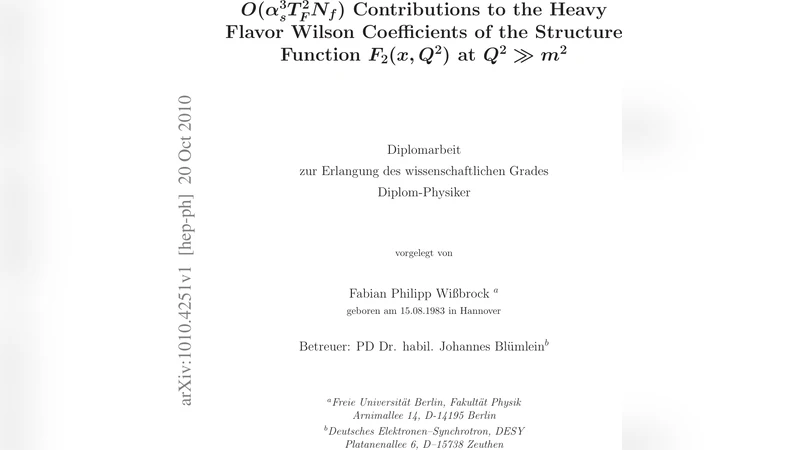
The massive 3-loop fermion-loop corrections $\propto C_A N_f T_F^2$ and $C_F N_f T_F^2$ to the massive operator matrix elements $A_{Qg}$, $A_{Qq}^{\rm{PS}}$, $A_{qq,Q}^{\rm{PS}}$, $A_{qq,Q}^{\rm{NS}}$ and $A_{qq,Q}^{\rm{NS,TR}} have been obtained for general values of $N$. Thereby the corresponding contributions to the asymptotic heavy flavor Wilson coefficients of the structure function $F_2(x,Q^2)$ and of transversity in the region $Q^2 \geq 10 \cdot m^2$ are known. Our method is based on direct integration, avoiding the integration-by-parts technique, which is advantageous due to the compactness of the intermediate and final results. We also obtain the corresponding contributions to the 3-loop anomalous dimensions and confirm results in the literature.
💡 Research Summary
The paper presents a comprehensive calculation of the three‑loop fermion‑loop contributions proportional to (C_A N_f T_F^2) and (C_F N_f T_F^2) to the massive operator matrix elements (OMEs) that enter the heavy‑flavor Wilson coefficients of the deep‑inelastic scattering structure function (F_2(x,Q^2)). The authors focus on the terms of order (\alpha_s^3 T_F^2 N_f), which are the leading three‑loop corrections containing two closed fermion loops (the (T_F^2) factor) and a single power of the number of light flavours (N_f). These corrections affect the OMEs (A_{Qg}), (A_{Qq}^{\rm PS}), (A_{qq,Q}^{\rm PS}), (A_{qq,Q}^{\rm NS}) and the transversity‑related OME (A_{qq,Q}^{\rm NS,TR}).
A distinctive feature of the work is the use of a direct integration method rather than the conventional integration‑by‑parts (IBP) reduction. After generating the three‑loop Feynman diagrams, the authors apply Feynman‑parameterisation and Mellin‑space techniques to rewrite the momentum integrals as parametric integrals over simple rational functions, logarithms and polylogarithms. By performing the parametric integrals analytically, they obtain compact expressions for the OMEs that are valid for general (complex) Mellin variable (N). This approach avoids the large intermediate algebraic expressions typical of IBP reductions and yields results that are both analytically transparent and numerically efficient.
The computed OMEs are then combined with the known massless Wilson coefficients to construct the asymptotic heavy‑flavor Wilson coefficients for (F_2) in the region (Q^2 \ge 10,m^2). In this kinematic regime the power‑suppressed terms ((m^2/Q^2)^k) are negligible, and the Wilson coefficients can be expressed as a series in (\alpha_s) with the newly derived three‑loop pieces providing the first genuine (\alpha_s^3) mass‑dependent contributions. The authors also extract the corresponding three‑loop anomalous dimensions from the pole structure of the OMEs. Their results agree exactly with previously published anomalous dimensions, thereby confirming the correctness of both the direct‑integration technique and the earlier IBP‑based calculations.
From a phenomenological perspective, the inclusion of the (C_A N_f T_F^2) and (C_F N_f T_F^2) terms significantly improves the theoretical description of heavy‑flavor production in DIS at high scales. The new contributions affect the small‑(x) behaviour (through enhanced logarithmic terms) and the large‑(x) region (through threshold logarithms), leading to a more accurate matching between fixed‑order perturbation theory and resummed calculations. Moreover, the transversity OME results provide the first three‑loop heavy‑flavor corrections to the transversity Wilson coefficient, an essential ingredient for forthcoming spin‑dependent global analyses.
In summary, the paper delivers:
- Analytic, compact expressions for the three‑loop fermion‑loop OMEs with two closed fermion loops, valid for arbitrary Mellin moment (N).
- The corresponding heavy‑flavor Wilson coefficients for (F_2) and for the transversity structure function in the asymptotic region (Q^2 \ge 10,m^2).
- The three‑loop anomalous dimensions associated with these OMEs, confirming existing literature.
The methodological advance—direct parametric integration—demonstrates that high‑order massive QCD calculations can be performed without resorting to large‑scale IBP reductions, opening the door to future extensions at four loops or to other processes involving multiple mass scales. The results are directly applicable to precision determinations of parton distribution functions, especially the heavy‑flavor components, and to the interpretation of upcoming high‑luminosity DIS experiments such as the Electron‑Ion Collider.
Comments & Academic Discussion
Loading comments...
Leave a Comment