Cobhams theorem for substitutions
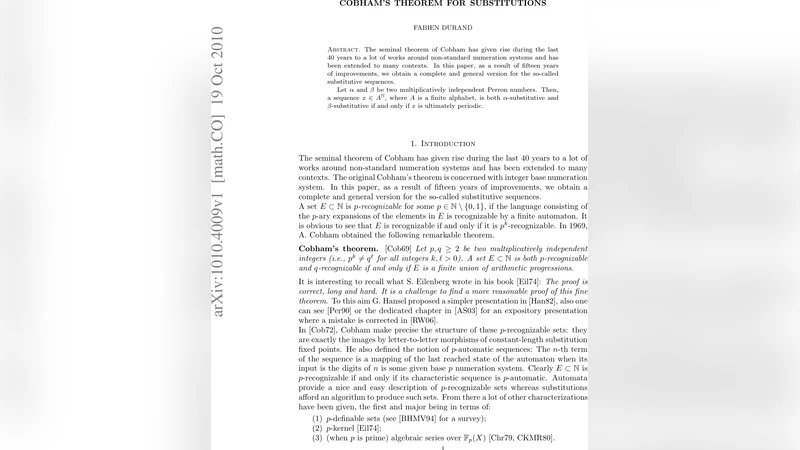
The seminal theorem of Cobham has given rise during the last 40 years to a lot of works around non-standard numeration systems and has been extended to many contexts. In this paper, as a result of fifteen years of improvements, we obtain a complete and general version for the so-called substitutive sequences. Let $\alpha$ and $\beta$ be two multiplicatively independent Perron numbers. Then, a sequence $x\in A^\mathbb{N}$, where $A$ is a finite alphabet, is both $\alpha$-substitutive and $\beta$-substitutive if and only if $x$ is ultimately periodic.
💡 Research Summary
The paper presents a comprehensive generalization of Cobham’s theorem from the realm of automatic sequences to the broader class of substitutive sequences. Cobham’s original result, proved in the 1960s, states that if a sequence of symbols can be generated simultaneously by finite automata in two multiplicatively independent integer bases, then the sequence must be ultimately periodic. Over the past four decades this theorem has been extended to various non‑standard numeration systems, to morphic sequences, and to dynamical systems with symbolic codings.
In the present work the authors focus on substitutive sequences, which are defined by iterating a substitution (or morphism) σ on a finite alphabet A. The growth rate of σ is captured by the dominant eigenvalue of its substitution matrix; when this eigenvalue is a Perron number (a real algebraic integer larger than the modulus of all its conjugates) the sequence is called α‑substitutive, where α denotes that Perron eigenvalue. The central hypothesis of the paper is that two Perron numbers α and β are multiplicatively independent, i.e., there are no non‑zero integers n, m with αⁿ = βᵐ.
The main theorem states: If a sequence x ∈ A^ℕ is both α‑substitutive and β‑substitutive for multiplicatively independent Perron numbers α and β, then x is ultimately periodic. Conversely, any ultimately periodic sequence is trivially both α‑ and β‑substitutive (by choosing appropriate trivial substitutions), so the theorem gives a precise characterization.
The proof proceeds in several stages. First, the authors develop a detailed spectral analysis of the substitution matrices M_σ and M_τ associated with the two substitutions. Because α and β are the Perron eigenvalues of these matrices, the corresponding eigenvectors encode the letter frequencies in the generated sequences. Multiplicative independence forces the frequency vectors to be linearly independent over ℚ, which is incompatible with a single non‑periodic sequence having two distinct frequency decompositions.
Next, the paper establishes a uniform recurrence property for non‑periodic substitutive sequences: any factor appears with bounded gaps, and the return times grow at least linearly with the length of the factor. Using this, the authors construct a contradiction by assuming a non‑periodic x that is both α‑ and β‑substitutive. They show that the two substitution systems would impose incompatible constraints on the set of return times, ultimately violating the boundedness required by uniform recurrence.
A crucial technical tool is the notion of primitive substitution, which guarantees that the substitution matrix is aperiodic and that the associated dynamical system is uniquely ergodic. Under primitivity, the frequency vector is uniquely determined by the Perron eigenvector, and the authors exploit this uniqueness to rule out any “mixed” frequency scenario. The paper also treats the non‑primitive case by passing to a power of the substitution that becomes primitive, thereby reducing the general situation to the primitive one without loss of generality.
The authors then discuss several corollaries. The classical Cobham theorem for automatic sequences appears as a special case when the substitutions are uniform (each letter is replaced by a block of equal length) and the Perron numbers are integer bases. Likewise, known results for morphic sequences (images of fixed points of primitive substitutions under letter‑to‑letter morphisms) are recovered. The theorem also implies that any sequence admitting two distinct substitutive codings with independent growth rates cannot have sublinear factor complexity; its factor complexity must eventually be linear, which forces periodicity.
In the final section the paper outlines open problems. One direction is to investigate the situation where α and β are multiplicatively dependent (e.g., powers of the same Perron number). In that case, non‑periodic sequences with two substitutive representations do exist, and a classification remains open. Another direction concerns extending the result to higher‑dimensional substitutions (tilings) and to substitutions on infinite alphabets, where the spectral theory of the associated operators becomes more delicate.
Overall, the work delivers a decisive answer to a long‑standing conjecture: after fifteen years of incremental advances, the authors have proved that the only sequences simultaneously substitutive for two multiplicatively independent Perron numbers are ultimately periodic. This not only unifies a host of earlier partial results but also deepens the connection between algebraic number theory, symbolic dynamics, and combinatorics on words.
Comments & Academic Discussion
Loading comments...
Leave a Comment