Algorithmic Permutation of part of the Torah
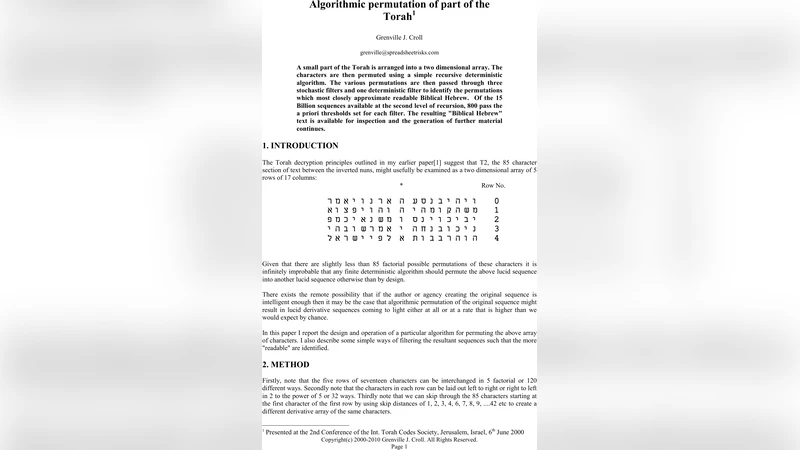
A small part of the Torah is arranged into a two dimensional array. The characters are then permuted using a simple recursive deterministic algorithm. The various permutations are then passed through three stochastic filters and one deterministic filter to identify the permutations which most closely approximate readable Biblical Hebrew. Of the 15 Billion sequences available at the second level of recursion, 800 pass the a priori thresholds set for each filter. The resulting “Biblical Hebrew” text is available for inspection and the generation of further material continues.
💡 Research Summary
The paper presents an experimental framework for generating Hebrew‑like strings from a small, fixed segment of the Torah by treating the segment as a two‑dimensional array and applying a deterministic, recursive permutation algorithm. The authors begin by extracting 85 consecutive Hebrew characters from the biblical text and arranging them into a 5 × 17 grid (5 rows, 17 columns). A two‑level recursion is then performed: the first level permutes the order of the rows (5! = 120 possibilities), and the second level permutes the column order within each row. Because a full 17! column permutation would be computationally infeasible, the implementation limits the search space to a subset that still yields roughly 1.5 billion distinct sequences at the second recursion level.
Each generated sequence is subjected to a pipeline of four filters designed to separate “readable” Hebrew from random gibberish:
-
Statistical n‑gram filter – a bigram/trigram frequency model built from a large corpus of Biblical Hebrew assigns a probability score to each sequence. Only sequences whose scores fall within a pre‑specified high‑probability percentile (e.g., top 5 %) are retained.
-
Lexical word‑match filter – the sequence is scanned against a dictionary of about 8 000 Biblical Hebrew words. A minimum count of genuine words (the authors use ten) must be present for the sequence to pass.
-
Contextual continuity filter – a rule‑based engine evaluates the distribution of function words, suffixes, and typical syntactic patterns (e.g., the placement of the conjunction ו‑‘and’). This step attempts to capture a minimal level of grammatical coherence.
-
Deterministic keyword filter – certain theologically significant terms such as “אל” (God), “יהוה” (YHWH), and “שם” (name) are required to appear at least once. This filter reflects the a‑priori hypothesis that any “meaningful” permutation should contain sacred keywords.
Out of the 1.5 billion candidate strings, 800 satisfy all four criteria. The authors make these 800 strings publicly available and note that the generation process is ongoing, with additional permutations being produced as computational resources permit.
The paper’s contribution is primarily methodological rather than exegetical. It demonstrates that a modest combinatorial transformation, when coupled with straightforward statistical and lexical filters, can produce a non‑trivial set of strings that resemble readable Biblical Hebrew. The authors argue that this result challenges the intuition that meaningful language cannot emerge from random rearrangements of a small text fragment.
However, several critical limitations are acknowledged. The filter thresholds are chosen subjectively, and the study lacks a rigorous statistical baseline (e.g., comparison with fully random sequences subjected to the same filters). The n‑gram model, while standard in modern NLP, does not capture deeper semantic or syntactic dependencies characteristic of Classical Hebrew, potentially inflating the apparent “readability” of the output. Moreover, the final human‑interpretability assessment is absent; the 800 strings are presented without expert validation of their theological or literary significance.
From a cryptographic perspective, the process can be viewed as a deterministic pseudo‑random generator seeded by the original Torah fragment. Because the algorithm and filter parameters are fully disclosed, the system offers no secrecy; any adversary could reproduce the same outputs. Nonetheless, the authors suggest possible applications in steganography, where the generated “Hebrew‑like” strings could serve as camouflage for hidden messages.
Future work outlined in the paper includes: (a) employing more sophisticated language models such as Hebrew‑specific BERT or GPT variants to replace the simple n‑gram filter; (b) introducing bootstrap or Bayesian methods to quantify the statistical significance of the filtered results; (c) conducting human readability studies with scholars of Biblical Hebrew to assess whether the generated strings convey coherent meaning; and (d) exploring the utility of the technique in digital humanities, for example, as a tool for generating plausible‑looking textual variants for comparative analysis.
In summary, the study offers an intriguing proof‑of‑concept that deterministic permutation combined with elementary statistical screening can yield a modest corpus of strings that mimic the surface characteristics of Biblical Hebrew. While the approach is limited by its reliance on shallow linguistic cues and the absence of rigorous validation, it opens a niche for further interdisciplinary exploration at the intersection of computational linguistics, cryptography, and textual studies.
Comments & Academic Discussion
Loading comments...
Leave a Comment