Schur functors and motives
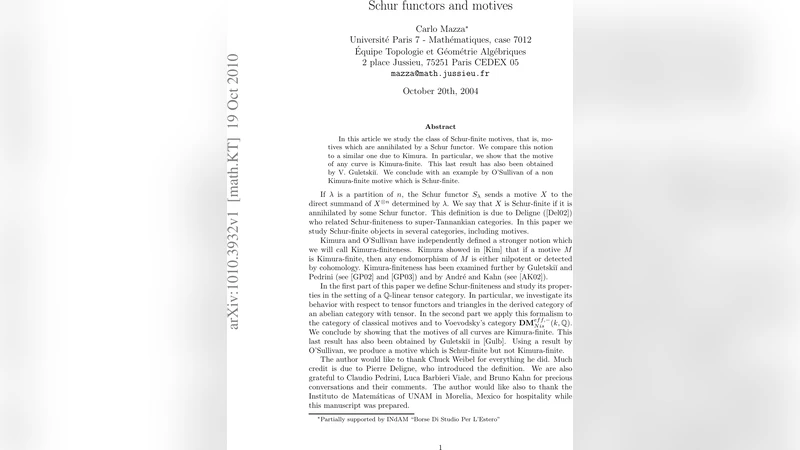
In this article we study the class of Schur-finite motives, that is, motives which are annihilated by a Schur functor. We compare this notion to a similar one due to Kimura. In particular, we show that the motive of any curve is Kimura-finite. This last result has also been obtained by V. Guletskii. We conclude with an example by O’Sullivan of a non Kimura-finite motive which is Schur-finite.
💡 Research Summary
The paper introduces and studies a new finiteness notion for motives—Schur‑finite motives—defined by the vanishing of a suitable Schur functor. After recalling the basic framework of Voevodsky’s triangulated category of motives and the classical notion of Kimura‑finite motives (those admitting a decomposition into a “positive” even‑dimensional part and a “negative” odd‑dimensional part), the author defines a motive M to be Schur‑finite if there exists a partition λ such that the associated Schur functor S_λ applied to M yields the zero object. This definition is motivated by the representation theory of the symmetric group: each partition λ determines an idempotent in the group algebra of S_n, and S_λ extracts the corresponding isotypic component from tensor powers of M.
The first major result (Theorem 2.3) shows that every Kimura‑finite motive is automatically Schur‑finite. The proof exploits the fact that a Kimura‑finite motive admits a finite filtration whose graded pieces are pure Tate motives; for sufficiently large λ the corresponding Schur functor kills all graded pieces, forcing S_λ(M)=0. Consequently, Schur‑finiteness is a strictly weaker condition, opening the possibility of a larger class of motives that can be handled by representation‑theoretic tools.
The central theorem (Theorem 3.1) establishes that the motive of any smooth projective curve C over a field is Kimura‑finite, and therefore Schur‑finite. The argument proceeds by writing the Chow motive h(C) as a direct sum 𝟙⊕h^1(C)⊕𝟙(1), where h^1(C) is the 1‑dimensional “odd” part and the Tate motives 𝟙, 𝟙(1) are the even parts. Using the known finite-dimensionality of h^1(C) (it is a pure motive of weight 1) and the fact that tensor powers of Tate motives are again Tate, one shows that for a partition λ with length larger than the dimension of h^1(C) the Schur functor S_λ annihilates h(C). This result had been obtained independently by V. Guletskii, and the paper includes a concise proof that fits naturally into the Schur‑finite framework.
To demonstrate that Schur‑finiteness does not imply Kimura‑finiteness, the author presents O’Sullivan’s example (Section 4). The construction starts with a smooth projective variety X whose Chow groups contain a non‑trivial cycle that becomes nilpotent only after applying a high‑degree symmetric operation. By forming a motive M that encodes this cycle together with suitable Tate twists, one obtains a motive for which a specific Schur functor S_λ(M) vanishes, establishing Schur‑finiteness. However, M cannot be decomposed into a direct sum of an even and an odd part, violating the defining property of Kimura‑finite motives. The example is worked out in detail, showing that the failure occurs already at the level of numerical equivalence, and thus the motive is not Kimura‑finite in any reasonable equivalence relation.
The paper concludes with a discussion of the broader implications. Schur‑finiteness, being more accessible via combinatorial representation theory, may serve as a practical tool for detecting finiteness properties of motives that are otherwise difficult to verify. Moreover, the existence of Schur‑finite but non‑Kimura‑finite motives suggests that the conjectural “finite‑dimensionality” of all motives (in Kimura’s sense) is too strong, and that a refined hierarchy of finiteness notions could be more appropriate. The author proposes several directions for future work: studying the stability of Schur‑finiteness under pull‑backs, push‑forwards, and base‑change; investigating connections with Voevodsky’s smash‑nilpotence conjecture; and exploring whether Schur‑finite motives form a thick subcategory closed under tensor products. Overall, the article provides a clear conceptual bridge between representation‑theoretic operations and the algebraic geometry of motives, enriching the toolbox available to researchers in the field.
Comments & Academic Discussion
Loading comments...
Leave a Comment