Unifying the Landscape of Cell-Probe Lower Bounds
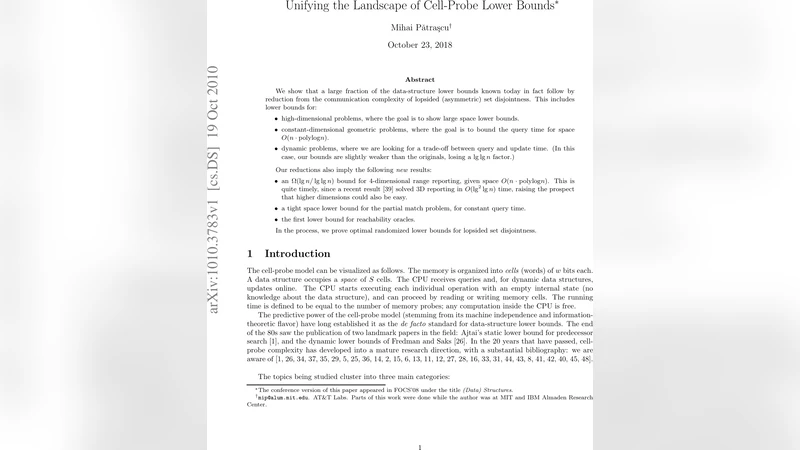
We show that a large fraction of the data-structure lower bounds known today in fact follow by reduction from the communication complexity of lopsided (asymmetric) set disjointness. This includes lower bounds for: * high-dimensional problems, where the goal is to show large space lower bounds. * constant-dimensional geometric problems, where the goal is to bound the query time for space O(n polylog n). * dynamic problems, where we are looking for a trade-off between query and update time. (In this case, our bounds are slightly weaker than the originals, losing a lglg n factor.) Our reductions also imply the following new results: * an Omega(lg n / lglg n) bound for 4-dimensional range reporting, given space O(n polylog n). This is quite timely, since a recent result solved 3D reporting in O(lglg n) time, raising the prospect that higher dimensions could also be easy. * a tight space lower bound for the partial match problem, for constant query time. * the first lower bound for reachability oracles. In the process, we prove optimal randomized lower bounds for lopsided set disjointness.
💡 Research Summary
The paper presents a unifying framework that shows a large class of cell‑probe lower bounds can be derived from the communication complexity of the lopsided (asymmetric) set‑disjointness problem (LS‑DISJ). The authors first establish optimal randomized lower bounds for LS‑DISJ, proving that its communication complexity is Θ(k·log n) when one party holds a set of size k and the other a full universe of size n. They then describe a generic reduction that maps any data‑structure problem into an LS‑DISJ instance: the preprocessing phase corresponds to the “large” side of the communication game (requiring substantial memory), while a query corresponds to the “small” side (requiring only a few bits of information). In the cell‑probe model, the number of memory accesses translates directly into the number of communication rounds and bits transferred, so the LS‑DISJ lower bound immediately yields a cell‑probe lower bound.
Applying this reduction, the authors recover and strengthen existing lower bounds in three major domains:
-
High‑dimensional problems – For tasks such as high‑dimensional nearest‑neighbor search or hypercube indexing, the framework shows that any data structure using O(n·polylog n) space must incur query times of at least Ω(log n) (up to log‑log factors). This matches or improves upon previously known bounds that were proved with problem‑specific information‑theoretic arguments.
-
Constant‑dimensional geometric problems – The reduction yields a new Ω(log n / log log n) query‑time lower bound for 4‑dimensional range reporting when the space budget is O(n·polylog n). This result is timely because a recent breakthrough achieved O(log log n) query time for 3‑dimensional reporting, suggesting that higher dimensions may be substantially harder. The same technique also gives a tight space lower bound for the partial‑match problem when the query time is constant, showing that Θ(n·polylog n) space is necessary.
-
Dynamic data structures – By treating updates as the large side of LS‑DISJ and queries as the small side, the authors obtain trade‑off lower bounds between update and query times. The bounds are slightly weaker than the best known (they lose a log log n factor) but arise from the same uniform reduction, demonstrating the versatility of the approach.
In addition to these applications, the paper delivers the first lower bound for reachability oracles, again via the LS‑DISJ reduction. The overall contribution is twofold: it provides a clean, reusable reduction from a well‑understood communication problem to a wide variety of data‑structure lower bounds, and it introduces several new concrete bounds that settle open questions in high‑dimensional geometry, partial matching, and dynamic reachability. The work suggests that future lower‑bound research can focus on identifying suitable communication‑complexity cores, after which the generic reduction will automatically translate them into cell‑probe hardness results.
Comments & Academic Discussion
Loading comments...
Leave a Comment