The Picard Group of a Noncommutative Algebraic Torus
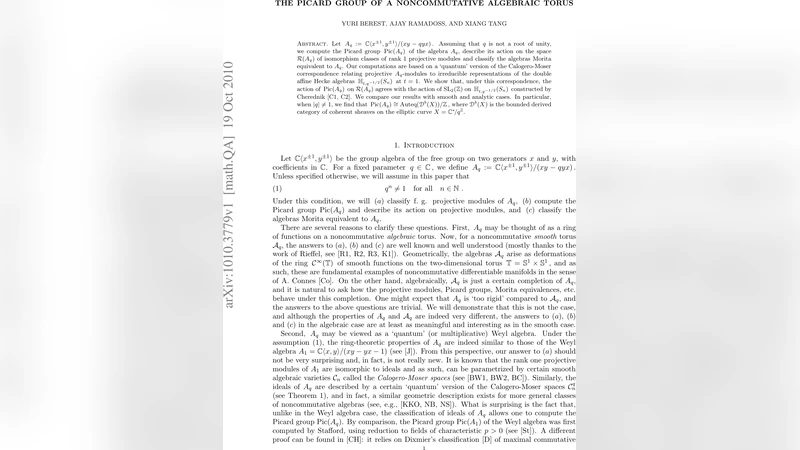
We compute the Picard group $ Pic(A_q) $ of the noncommutative algebraic 2-torus $A_q$, describe its action on the space $ R(A_q) $ of isomorphism classes of rk 1 projective modules and classify the algebras Morita equivalent to $ A_q $. Our computations are based on a quantum version of the Calogero-Moser correspondence relating projective $A_q$-modules to irreducible representations of the double affine Hecke algebras (DAHA) $ H_{t, q^{-1/2}}(S_n) $ at $ t = 1 $. We show that, under this correspondence, the action of $ Pic(A_q) $ on $ R(A_q) $ agrees with the action of $ SL_2(Z) $ on $ H_{t, q^{-1/2}}(S_n) $ constructed by I.Cherednik. We compare our results with smooth and analytic cases. In particular, when $ |q| \not= 1 $, we find that $ Pic(A_q) $ is isomorphic to the group of auto-equivalences $ Auteq(D^b(X))/Z $ of the bounded derived category of coherent sheaves on the elliptic curve $ X = C*/Z $ modulo translations.
💡 Research Summary
The paper investigates the Picard group of the non‑commutative algebraic 2‑torus (A_q) and its action on rank‑one projective modules. The algebra (A_q) is defined as the quotient (\mathbb C\langle x^{\pm1},y^{\pm1}\rangle/(xy-qyx)) with a deformation parameter (q\neq1). The authors first describe the internal structure of (A_q), emphasizing that its centre is trivial and that the non‑commutativity is governed solely by the scalar (q).
The Picard group (Pic(A_q)) is then identified as a semi‑direct product of the group of algebra automorphisms (Aut(A_q)) and the group of outer auto‑equivalences acting on the set (R(A_q)) of isomorphism classes of rank‑one projective modules. To analyse (R(A_q)) the authors employ a quantum version of the Calogero‑Moser correspondence. They prove that every rank‑one projective (A_q)‑module corresponds uniquely to an irreducible representation of the double affine Hecke algebra (DAHA) (H_{t,q^{-1/2}}(S_n)) at the specialization (t=1). In this setting the DAHA reduces to the rational Cherednik algebra attached to the symmetric group, and its irreducible modules are parametrised by partitions of (n).
Using this correspondence, the paper shows that the natural action of (Pic(A_q)) on (R(A_q)) coincides with the well‑known (SL_2(\mathbb Z)) action on the DAHA constructed by I. Cherednik. The generators (S) and (T) of (SL_2(\mathbb Z)) act by the transformations (q\mapsto q^{-1}) and (q\mapsto q) respectively, which translate into explicit changes of the DAHA parameters and hence of the associated projective modules. Consequently, the orbit decomposition of (R(A_q)) under (Pic(A_q)) is exactly the orbit decomposition under (SL_2(\mathbb Z)).
A major consequence is the classification of algebras Morita‑equivalent to (A_q). The authors prove that another torus (A_{q’}) is Morita equivalent to (A_q) if and only if the parameters are related by a modular transformation \
Comments & Academic Discussion
Loading comments...
Leave a Comment