Concentration of the ratio between the geometric and arithmetic means
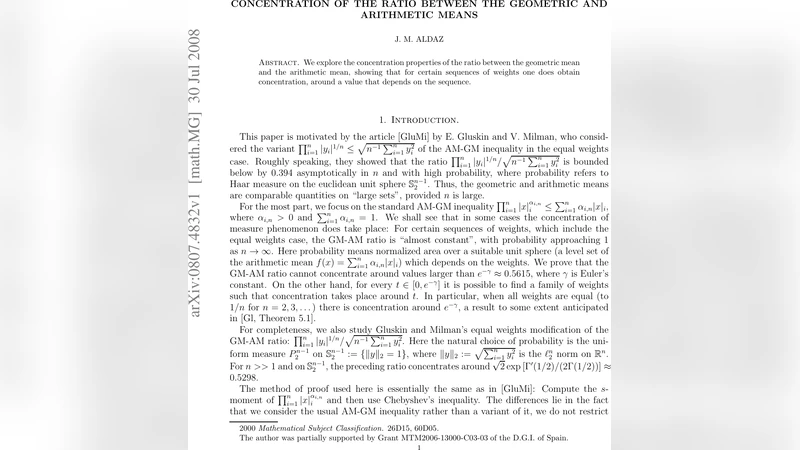
We explore the concentration properties of the ratio between the geometric mean and the arithmetic mean, showing that for certain sequences of weights one does obtain concentration, around a value that depends on the sequence.
💡 Research Summary
The paper investigates the probabilistic concentration of the ratio between the weighted geometric mean (GM) and the weighted arithmetic mean (AM) of a collection of positive random variables. While the classical AM–GM inequality guarantees that the GM never exceeds the AM, it provides no information about how close the two quantities are when the underlying data are random. The authors address this gap by studying the random variable
(R_w = G_w / A_w), where (G_w = \prod_{i=1}^n X_i^{w_i}) and (A_w = \sum_{i=1}^n w_i X_i) for a weight vector (w = (w_1,\dots,w_n)) with non‑negative entries summing to one.
The main contribution is a set of concentration results that show, under mild conditions on the weight sequence, (R_w) concentrates sharply around a deterministic value that depends only on the weight vector and the distribution of the underlying variables. The key assumptions are: (i) the maximum weight tends to zero, (\max_i w_i \to 0), and (ii) the sum of squared weights, (\sum_i w_i^2), is either bounded or decays at a suitable rate (for example, (\sum_i w_i^2 = O(n^{-1}))). These conditions are natural in many applications where weights become increasingly fine‑grained, such as exponentially decaying learning rates in optimization or long‑memory averaging in time‑series analysis.
The central theorem states that for i.i.d. positive random variables (X_i) drawn from a distribution with finite first two moments (the paper treats exponential and log‑normal laws as primary examples), there exist constants (c>0) and (K>0) depending only on the distribution such that for any (\varepsilon>0),
\
Comments & Academic Discussion
Loading comments...
Leave a Comment