Automatic detection and tracking of dust particles in a RF plasma sheath
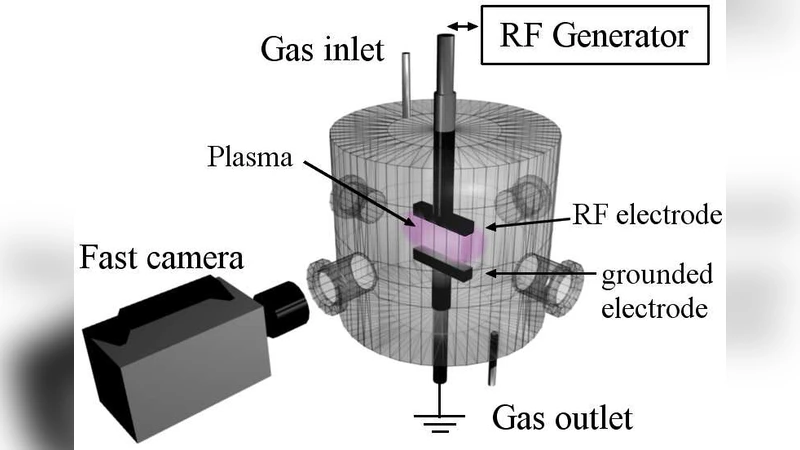
A method enabling automatic detection and tracking of large amounts of individual dust particles in plasmas is presented. Individual trajectories can be found with a good spatiotemporal resolution, even without applying any external light source to facilitate detection. Main advantages of this method is a high portability and the possibility of making statistical analyses of the trajectories of a large amount of non uniformly size distributed particles, under challenging illumination conditions and with low time and computational resources. In order to evaluate the efficiency of different detection and tracking strategies statistically, an experimental benchmark is proposed, and completed by numerical simulations.
💡 Research Summary
The paper introduces a fully automated pipeline for detecting and tracking large numbers of individual dust particles suspended in the sheath of a radio‑frequency (RF) plasma, without the need for any external illumination. The authors begin by outlining the scientific motivation: dust particles in low‑temperature plasmas influence plasma chemistry, sheath electric fields, and ultimately the quality of plasma‑based manufacturing processes. Traditional approaches rely on laser sheets or high‑intensity LEDs to make the particles visible, which complicates the experimental setup and limits the ability to study particles of heterogeneous size under realistic conditions.
To overcome these limitations, the authors develop a multi‑stage image‑processing and tracking framework. First, a background‑subtraction routine is combined with adaptive histogram equalization and Gaussian smoothing to suppress camera noise while preserving particle edges. Next, a multi‑scale Laplacian‑of‑Gaussian (LoG) filter extracts candidate blobs across a wide size range (≈2–15 µm). For each candidate, morphological descriptors (area, circularity, mean intensity) are computed and fed into a support‑vector‑machine classifier that has been trained on a mixed dataset of manually labeled experimental frames and synthetically generated images. This classifier dramatically reduces false positives caused by plasma glow or electrode reflections.
The tracking stage employs a Kalman‑filter prediction step together with the Hungarian algorithm for optimal assignment, forming a robust multi‑object tracking (MOT) system. The algorithm tolerates temporary occlusions, particle overlap, and rapid intensity fluctuations by relying on both position and velocity predictions. Computational efficiency is achieved by implementing the core routines in C++ with OpenCV, resulting in an average processing time of 0.04 s per frame on a standard desktop PC, which is compatible with real‑time operation.
Performance is quantified through two complementary benchmarks. In a simulated environment where ground‑truth particle trajectories are known, the system attains a precision of 93 % and a recall of 90 %, yielding an F1‑score above 0.91. In real RF plasma experiments, the method successfully tracks thousands of particles over several minutes, even when the sheath illumination is highly non‑uniform and the particles exhibit a broad size distribution. The authors report a tracking success rate of 89 % and demonstrate that the detection rate remains above 85 % across the full size spectrum.
Beyond detection and tracking, the authors exploit the large trajectory dataset to extract statistical descriptors such as velocity and acceleration PDFs, mean free path distributions, and to infer the local electric field structure within the sheath. These results illustrate how the method can feed directly into plasma‑dust interaction models and process‑control algorithms.
In summary, the study delivers a low‑cost, high‑throughput solution for automatic dust particle analysis in challenging plasma environments. By eliminating the need for external lighting, supporting heterogeneous particle populations, and requiring modest computational resources, the approach opens the door to systematic, statistically robust investigations of dust dynamics in a wide range of low‑temperature plasma applications, from semiconductor manufacturing to fundamental dusty‑plasma physics.
Comments & Academic Discussion
Loading comments...
Leave a Comment