Topological classification of affine operators on unitary and Euclidean spaces
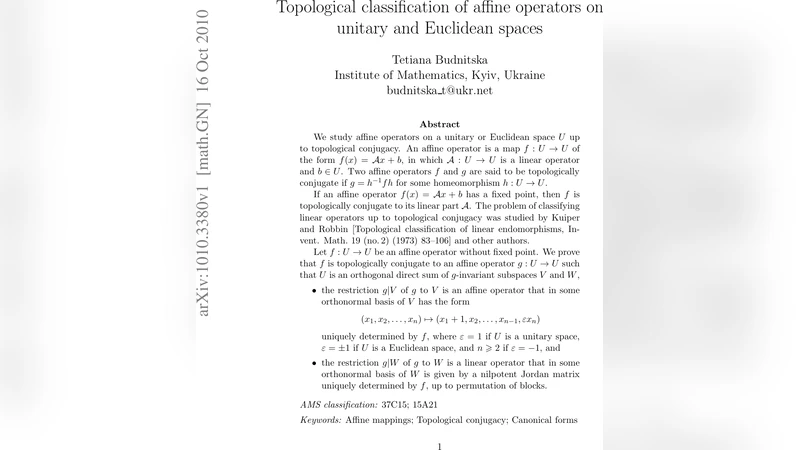
We classify affine operators on a unitary or Euclidean space U up to topological conjugacy. An affine operator is a map f: U–>U of the form f(x)=Ax+b, in which A: U–>U is a linear operator and b in U. Two affine operators f and g are said to be topologically conjugate if hg=fh for some homeomorphism h: U–>U.
💡 Research Summary
The paper addresses the problem of classifying affine maps f on a unitary (complex inner‑product) space or a Euclidean (real) space up to topological conjugacy. An affine map is written as f(x)=Ax+b, where A is a linear operator and b a translation vector. Two affine maps f and g are said to be topologically conjugate if there exists a homeomorphism h such that h∘g = f∘h. The authors show that the conjugacy problem reduces to two independent ingredients: the topological classification of the linear parts A and C, and the position of the translation vectors b and d relative to the image of (I−A) and (I−C).
First, the paper recalls the known topological classification of linear operators. In both the complex unitary and real Euclidean settings, the spectrum of A splits into three qualitatively different parts: (i) hyperbolic eigenvalues with |λ|≠1 (expanding or contracting directions), (ii) unit‑modulus eigenvalues (pure rotations or reflections), and (iii) the eigenvalue λ=1, which creates a fixed‑point subspace. For each part the Jordan structure (size of blocks) is a topological invariant: two linear maps are topologically conjugate iff they have the same number of Jordan blocks of each size for each eigenvalue, and the moduli of the eigenvalues match.
The novel contribution concerns the translation vector b. The key observation is that b is topologically irrelevant precisely when it lies in the image of (I−A). In that case there exists a linear map S with (I−A)S = b, and the affine map f(x)=Ax+b is topologically conjugate to the pure linear map A. Conversely, if b∉Im(I−A) the affine map has a different fixed‑point structure: either it has no fixed points at all (when 1∉σ(A)) or its set of fixed points is an affine subspace that is not a linear subspace (when 1∈σ(A)). This distinction becomes a decisive invariant.
The authors formulate three main theorems.
Theorem 1 (Hyperbolic case). If all eigenvalues of A satisfy |λ|≠1, then two affine maps f(x)=Ax+b and g(x)=Cx+d are topologically conjugate iff (i) A and C are topologically conjugate as linear maps, and (ii) b∈Im(I−A) iff d∈Im(I−C). In this regime the translation vectors can be “absorbed” by a suitable change of coordinates, so they do not affect the conjugacy class.
Theorem 2 (Unit‑modulus eigenvalues). When the spectrum contains eigenvalues on the unit circle, additional invariants appear. For eigenvalues λ with |λ|=1 but λ≠1, the rotation angles must match up to a continuous deformation; for λ=1 the dimension of the fixed‑point subspace (i.e., the nullity of I−A) is invariant, and the component of b projected onto this nullspace must either belong to Im(I−A) or not, in parallel with the hyperbolic case.
Theorem 3 (Non‑invertible case). If A is singular, the dimensions of the kernel and image, together with the sizes of nilpotent Jordan blocks, are topological invariants. The translation vector’s projection onto the kernel must satisfy the same image condition as above.
Proofs combine linear algebra (Jordan canonical form, spectral decomposition) with elementary topological arguments (preservation of connectedness, dimension, compactness). The authors construct explicit conjugating homeomorphisms: first a linear homeomorphism h₀ that conjugates A to C, then a translation correction that aligns the affine parts when the image condition holds. When the condition fails, they show that any attempted conjugacy would force a contradiction in the structure of fixed‑point sets.
The paper includes illustrative low‑dimensional examples. In ℝ², a rotation by angle θ with a translation vector not lying in Im(I−R_θ) produces a map without a fixed point, which cannot be conjugate to the pure rotation (which fixes the origin). In ℝ³, an affine map with a nilpotent linear part and a translation vector outside the image of (I−A) has a one‑dimensional affine fixed‑point set, distinguishing it from the case where the translation lies inside the image.
Finally, the authors discuss implications for dynamical systems and control theory. Many discrete‑time linear systems can be written as affine maps; the classification tells precisely when two such systems are topologically equivalent, i.e., have the same qualitative behavior up to a continuous change of coordinates. The results also suggest extensions to infinite‑dimensional Hilbert spaces, to non‑linear perturbations, and to the study of robustness of conjugacy under small perturbations.
In summary, the paper establishes that affine operators on unitary or Euclidean spaces are completely classified by (1) the topological conjugacy class of their linear part (spectral data and Jordan block sizes) and (2) the membership of the translation vector in the image of (I−A). This provides a clean, exhaustive description of the conjugacy classes and bridges a gap between linear operator theory and the broader study of affine dynamical systems.
Comments & Academic Discussion
Loading comments...
Leave a Comment