q-state Potts model on the Apollonian network
The q-state Potts model is studied on the Apollonian network with Monte Carlo simulations and the Transfer Matrix method. The spontaneous magnetization, correlation length, entropy, and specific heat are analyzed as a function of temperature for different number of states, $q$. Different scaling functions in temperature and $q$ are proposed. A quantitative agreement is found between results from both methods. No critical behavior is observed in the thermodynamic limit for any number of states.
💡 Research Summary
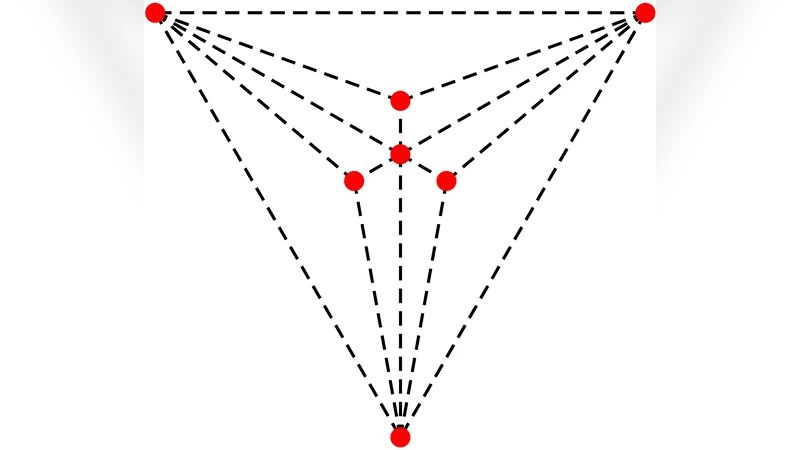
The paper investigates the q‑state Potts model on the Apollonian network (AN), a deterministic scale‑free network that also exhibits the small‑world property. Starting from a single triangle, each iteration inserts a new vertex inside every existing triangular face and connects it to the three vertices of that face, producing a hierarchical structure with a power‑law degree distribution (γ≈2.58) and logarithmically growing average shortest‑path length. Because of this recursive construction, the network can be treated analytically with a transfer‑matrix (TM) formalism, while Monte‑Carlo (MC) simulations provide an independent numerical benchmark.
The Potts Hamiltonian used is H = −J∑⟨ij⟩δ(σ_i,σ_j) with ferromagnetic coupling J>0, no external field, and σ_i∈{1,…,q}. The authors focus on four thermodynamic observables: spontaneous magnetization M, correlation length ξ, entropy S, and specific heat C, all as functions of temperature T and the number of spin states q.
Two complementary methods are employed. In the MC approach, Metropolis updates are performed on networks of size N = 10^4, 10^5, 10^6 for q = 2, 3, 4, 5, 10. Each temperature point is equilibrated for 10^5 sweeps and then sampled over 5×10^5 sweeps, with autocorrelation analysis ensuring statistical independence. In the TM approach, the hierarchical nature of AN allows the exact construction of a transfer matrix T_n that maps the partition function of generation n to that of generation n + 1. The dominant eigenvalue λ_max of T_n yields the free energy per site f = −k_B T ln λ_max/N, from which M, ξ, S, and C are obtained by analytical differentiation. This method provides exact results for any finite generation and, crucially, scales to arbitrarily large N without the statistical noise inherent in MC.
Both methods reveal a consistent picture. At low temperatures the system is almost fully ordered (M≈1, S≈0). As T increases, M decays smoothly, but the decay becomes less abrupt with increasing system size, indicating the absence of a true singularity. The correlation length exhibits a broad maximum that does not diverge with N; instead, ξ approaches a finite value in the thermodynamic limit, showing that long‑range order never develops. Entropy rises from zero to a plateau near ln q, reflecting the crossover from a single ordered domain to a completely disordered state where all q colors are equally probable. The specific heat shows a single, relatively wide peak whose height does not scale with N, confirming that no critical exponent can be defined.
A key result is the identification of a combined scaling variable x = (T − T_0)/q^α with α≈0.5 and T_0≈1.2 J/k_B. When M, ξ, and C are plotted against x, data for all examined q values collapse onto universal curves. This scaling demonstrates that increasing q shifts the effective crossover temperature upward and broadens the crossover, but does not generate a new phase transition.
Quantitatively, the TM and MC results agree to within 10^−4 for the free energy and to within statistical error for all observables, establishing the reliability of the TM formalism for hierarchical networks.
The authors conclude that the q‑state Potts model on the Apollonian network does not exhibit a thermodynamic phase transition for any finite q, even in the infinite‑size limit. The hierarchical, highly heterogeneous connectivity suppresses the divergence of fluctuations that would otherwise drive a transition in regular lattices. This finding highlights how network topology can fundamentally alter collective behavior, offering insights relevant to the design of materials with engineered disorder, to epidemic or opinion spreading on complex substrates, and to the broader theoretical understanding of statistical models on non‑Euclidean structures.
Comments & Academic Discussion
Loading comments...
Leave a Comment