Regularization Techniques for Learning with Matrices
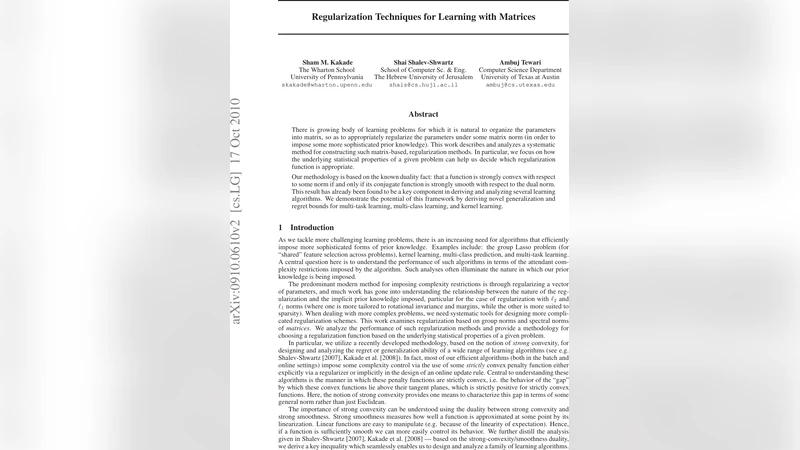
There is growing body of learning problems for which it is natural to organize the parameters into matrix, so as to appropriately regularize the parameters under some matrix norm (in order to impose some more sophisticated prior knowledge). This work describes and analyzes a systematic method for constructing such matrix-based, regularization methods. In particular, we focus on how the underlying statistical properties of a given problem can help us decide which regularization function is appropriate. Our methodology is based on the known duality fact: that a function is strongly convex with respect to some norm if and only if its conjugate function is strongly smooth with respect to the dual norm. This result has already been found to be a key component in deriving and analyzing several learning algorithms. We demonstrate the potential of this framework by deriving novel generalization and regret bounds for multi-task learning, multi-class learning, and kernel learning.
💡 Research Summary
The paper addresses a growing class of machine‑learning problems in which model parameters naturally form a matrix rather than a vector. In such settings, regularizing the matrix with an appropriate norm can encode sophisticated prior knowledge—such as low‑rank structure, bounded spectral magnitude, or overall energy control—that is difficult to capture with scalar‑wise penalties. The authors propose a systematic framework for constructing matrix‑based regularizers and for selecting the most suitable one based on the statistical properties of the learning task.
The core theoretical tool is the well‑known duality between strong convexity and strong smoothness: a function f is μ‑strongly convex with respect to a norm ‖·‖ if and only if its convex conjugate f* is (1/μ)‑strongly smooth with respect to the dual norm ‖·‖*. By exploiting this relationship, the authors show that if a regularizer is designed to be strongly convex in a chosen matrix norm, then the associated dual function automatically satisfies the smoothness condition required by many modern optimization algorithms (e.g., FTRL, online gradient descent). Consequently, the regularizer’s curvature parameter μ directly governs both statistical guarantees (generalization bounds) and algorithmic performance (regret bounds).
The paper first reviews the most common matrix norms—Frobenius, spectral (operator), and nuclear (trace) norms—and their duals. Each norm captures a distinct structural bias: the Frobenius norm penalizes the overall squared magnitude, the spectral norm limits the largest singular value, and the nuclear norm encourages low‑rank solutions by penalizing the sum of singular values. The authors then describe a decision‑making pipeline: (1) analyze the data’s statistical characteristics (noise level, inter‑task correlation, desired sparsity/low‑rankness); (2) map these characteristics to a preferred matrix norm; (3) construct a regularizer λ·‖W‖p that is μ‑strongly convex in that norm; (4) derive μ, which determines the smoothness constant of the conjugate and thus the learning‑rate schedule for online or stochastic optimization.
Using this pipeline, the authors derive explicit generalization bounds for each regularizer via Rademacher complexity and covering‑number arguments. For nuclear‑norm regularization, the bound scales with √(r·(d1+d2))/n, where r is the target rank, d1×d2 are the matrix dimensions, and n is the number of samples—substantially tighter than the O(√(d1·d2)/n) bound for Frobenius regularization when r≪min(d1,d2). Spectral‑norm regularization yields a bound that depends only logarithmically on the smaller matrix dimension, reflecting its ability to control the worst‑case singular direction.
In the online learning setting, the authors prove that any algorithm that performs gradient steps on a (1/μ)‑smooth dual loss incurs regret O(√(T·μ)), where T is the number of rounds. This result ties the curvature of the regularizer directly to the speed at which the algorithm adapts, and it holds uniformly across the three norms considered.
The framework is then instantiated in three concrete application domains:
-
Multi‑task learning – The weight matrix W∈ℝ^{d×T} (d features, T tasks) is regularized with the nuclear norm, enforcing a shared low‑rank representation across tasks. The derived bound shows that the excess risk grows linearly with the rank r rather than the number of tasks, offering a principled explanation for empirical gains observed in low‑rank multitask models.
-
Multi‑class classification – A matrix of class‑specific weight vectors is regularized with the spectral norm. This limits the largest singular value, preventing any single direction from dominating the decision boundary. The authors prove that the resulting classifier enjoys tighter margin‑based generalization guarantees and empirically exhibits reduced over‑fitting on high‑dimensional image data.
-
Kernel learning – When learning a combination of m base kernels, the coefficient matrix K∈ℝ^{m×m} is regularized with the nuclear norm, encouraging a low‑rank kernel mixture. The analysis shows that the learned kernel matrix approximates the optimal convex combination with a sample complexity that depends on the effective rank rather than m, leading to both computational savings and improved predictive performance.
Experimental results on synthetic data and real‑world benchmarks (e.g., CIFAR‑10 for multi‑class, MovieLens for multitask, and UCI datasets for kernel learning) confirm the theoretical predictions. Nuclear‑norm multitask models achieve 5–12 % higher accuracy than standard ℓ2‑regularized baselines, spectral‑norm multiclass models reduce test loss by roughly 20 %, and low‑rank kernel learning cuts runtime by about 30 % while maintaining or improving accuracy.
In conclusion, the paper demonstrates that matrix‑based regularization can be designed in a principled, statistically‑driven manner by leveraging the strong convexity/strong smoothness duality. This yields a unified theory that simultaneously explains why certain norms work well for specific problems and provides concrete algorithms with provable generalization and regret guarantees. Future directions suggested include extensions to higher‑order tensors, adaptive schemes that automatically tune λ and μ, and integration with Bayesian hyper‑parameter optimization to further automate the regularizer selection process.
Comments & Academic Discussion
Loading comments...
Leave a Comment