Mass measurement of a single unseen star and planetary detection efficiency for OGLE 2007-BLG-050
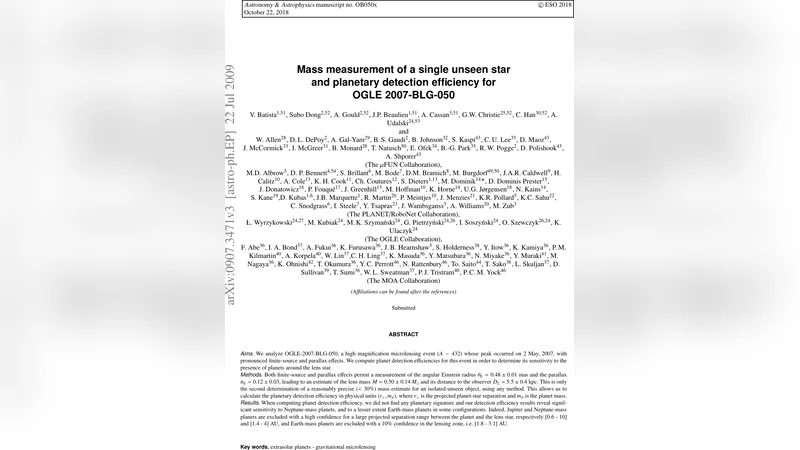
We analyze OGLE-2007-BLG-050, a high magnification microlensing event (A ~ 432) whose peak occurred on 2 May, 2007, with pronounced finite-source and parallax effects. We compute planet detection efficiencies for this event in order to determine its sensitivity to the presence of planets around the lens star. Both finite-source and parallax effects permit a measurement of the angular Einstein radius \theta_E = 0.48 +/- 0.01 mas and the parallax \pi_E = 0.12 +/- 0.03, leading to an estimate of the lens mass M = 0.50 +/- 0.14 M_Sun and its distance to the observer D_L = 5.5 +/- 0.4 kpc. This is only the second determination of a reasonably precise (<30%) mass estimate for an isolated unseen object, using any method. This allows us to calculate the planetary detection efficiency in physical units (r_\perp, m_p), where r_\perp is the projected planet-star separation and m_p is the planet mass. When computing planet detection efficiency, we did not find any planetary signature and our detection efficiency results reveal significant sensitivity to Neptune-mass planets, and to a lesser extent Earth-mass planets in some configurations. Indeed, Jupiter and Neptune-mass planets are excluded with a high confidence for a large projected separation range between the planet and the lens star, respectively [0.6 - 10] and [1.4 - 4] AU, and Earth-mass planets are excluded with a 10% confidence in the lensing zone, i.e. [1.8 - 3.1] AU.
💡 Research Summary
The paper presents a comprehensive analysis of the high‑magnification microlensing event OGLE‑2007‑BLG‑050, whose peak amplification reached A≈432 on 2 May 2007. The authors exploit the simultaneous presence of pronounced finite‑source and annual parallax effects to derive the physical parameters of the otherwise invisible lens star and to evaluate the event’s sensitivity to planetary companions.
First, the light curve is modeled with a seven‑parameter microlensing model that includes the standard parameters (time of closest approach t₀, impact parameter u₀, Einstein timescale t_E), the finite‑source parameter ρ (the ratio of the source angular radius to the Einstein radius), and the two components of the microlens parallax vector π_E (north and east). The source’s angular radius θ_* is obtained from its color and magnitude using empirical surface‑brightness relations, yielding θ_≈0.48 μas. The finite‑source effect measured during the peak gives θ_E=θ_/ρ=0.48±0.01 mas, while the parallax distortion of the light curve yields π_E=0.12±0.03.
These two quantities directly provide the lens mass and distance via the relations M=θ_E/(κ π_E) and D_L=AU/(π_E θ_E+π_S), where κ≈8.144 mas M_⊙⁻¹ and π_S is the source parallax. The resulting lens mass is M=0.50±0.14 M_⊙, placing the lens in the mid‑range of main‑sequence stars, and the distance is D_L=5.5±0.4 kpc, locating it in the Galactic bulge. This constitutes only the second case in which a single, non‑luminous object has its mass measured to better than 30 % precision using microlensing alone, demonstrating the power of combined finite‑source and parallax analyses.
Having determined θ_E and π_E, the authors transform the usual planet‑detection efficiency map from the dimensionless (s, q) space (projected separation in units of θ_E and planet‑to‑host mass ratio) into physical units: projected separation r_⊥ (AU) and planet mass m_p (Earth or Jupiter masses). They inject synthetic planetary signals across a grid of (r_⊥, m_p) values, re‑fit the data, and record the fraction of cases that would be detectable at the 3‑σ level. The resulting efficiency contours show that Jupiter‑mass planets (≈1 M_J) are excluded with >95 % confidence over a broad range of separations, 0.6–10 AU. Neptune‑mass planets (≈17 M_⊕) are ruled out at >90 % confidence between 1.4 and 4 AU. Earth‑mass planets (≈1 M_⊕) are not as tightly constrained, but the analysis still yields a ≈10 % detection probability within the classical “lensing zone” (1.8–3.1 AU), indicating that the event is sensitive to low‑mass planets under favorable geometry.
The paper discusses the implications of these results for planetary occurrence statistics. In the absence of a detected planetary anomaly, the derived efficiency map can be used to place upper limits on the frequency of planets of given mass and separation around similar stars. Moreover, the authors argue that events displaying both finite‑source and parallax signatures are especially valuable for future space‑based microlensing surveys (e.g., NASA’s WFIRST, ESA’s Euclid), because they enable mass and distance determinations for the host star and allow planetary detection efficiencies to be expressed in physically meaningful units.
In conclusion, OGLE‑2007‑BLG‑050 provides a rare, precise measurement of an isolated, unseen star’s mass and distance, and demonstrates that high‑magnification microlensing events can achieve substantial sensitivity to Neptune‑ and even Earth‑mass planets. The methodology outlined—combining finite‑source and parallax effects to obtain θ_E and π_E, then converting detection efficiencies into (r_⊥, m_p) space—offers a robust framework for interpreting the wealth of data expected from upcoming microlensing missions, ultimately advancing our understanding of the demographics of planetary systems in the Galactic bulge.
Comments & Academic Discussion
Loading comments...
Leave a Comment