On weakly convex star-shaped polyhedra
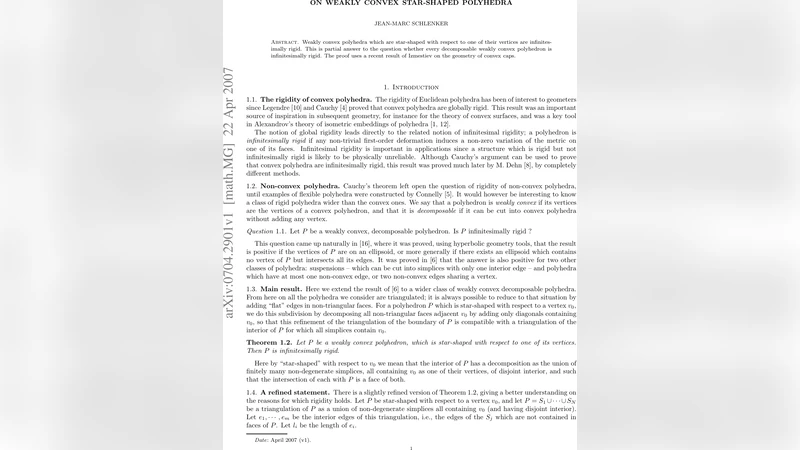
Weakly convex polyhedra which are star-shaped with respect to one of their vertices are infinitesimally rigid. This is a partial answer to the question whether every decomposable weakly convex polyhedron is infinitesimally rigid. The proof uses a recent result of Izmestiev on the geometry of convex caps.
💡 Research Summary
The paper addresses a long‑standing open problem in rigidity theory: whether every decomposable weakly convex polyhedron is infinitesimally rigid. While classical results such as Cauchy’s rigidity theorem and Dehn’s theorem guarantee rigidity for strictly convex polyhedra, the situation for weakly convex polyhedra—those whose faces are planar but whose global shape may not be convex—remains largely unresolved. The authors focus on a particular subclass: weakly convex polyhedra that are star‑shaped with respect to one of their vertices. A polyhedron is star‑shaped with respect to a vertex (v_0) if every point of the polyhedron can be connected to (v_0) by a straight segment that stays entirely inside the polyhedron. This geometric condition allows the polyhedron to be decomposed into a collection of pyramids having (v_0) as a common apex and each face of the original polyhedron as a base.
The central contribution is the theorem that any weakly convex polyhedron that is star‑shaped with respect to a vertex is infinitesimally rigid. In other words, the only first‑order (infinitesimal) motions preserving edge lengths are trivial rigid motions (translations and rotations). The proof proceeds by translating the geometric configuration into an algebraic system of linear constraints on the “heights” of the pyramidal components. For each pyramid the height is the distance from the apex (v_0) to its base plane. Adjacent pyramids share an edge, and the dihedral angle along that edge imposes a linear relation among the heights of the two pyramids. Collecting all such relations yields a linear system whose unknowns are the height variables.
At this point the authors invoke a recent result by Izmestiev concerning convex caps. Izmestiev proved that if several convex caps share the same boundary curve, the function assigning to each cap its height over the boundary is strictly convex. This strict convexity implies that the Jacobian matrix of the height function is positive definite, which in turn guarantees that the only solution to the homogeneous linear system derived from the dihedral constraints is the trivial one. Consequently, any infinitesimal deformation of the original polyhedron must keep all heights unchanged, forcing the deformation to be a rigid motion. Hence the polyhedron is infinitesimally rigid.
The paper also discusses the broader implications of this result. It provides a partial affirmative answer to the conjecture that every decomposable weakly convex polyhedron is infinitesimally rigid: the additional star‑shaped condition is sufficient, though it is not yet known whether the condition can be removed. The authors suggest several avenues for future research, including (i) weakening the star‑shaped hypothesis, perhaps by allowing a set of vertices that jointly see the whole polyhedron, (ii) extending Izmestiev’s convex‑cap theory to more general configurations that arise in non‑star‑shaped weakly convex polyhedra, and (iii) developing a systematic classification of decomposable weakly convex polyhedra based on their rigidity properties.
In summary, the paper combines a clever geometric decomposition with a powerful recent convex‑cap theorem to establish infinitesimal rigidity for a non‑trivial class of weakly convex polyhedra. This work not only advances our understanding of rigidity beyond the strictly convex regime but also opens up new methodological pathways for tackling the full conjecture on decomposable weakly convex polyhedra.
Comments & Academic Discussion
Loading comments...
Leave a Comment