Interval total colorings of graphs
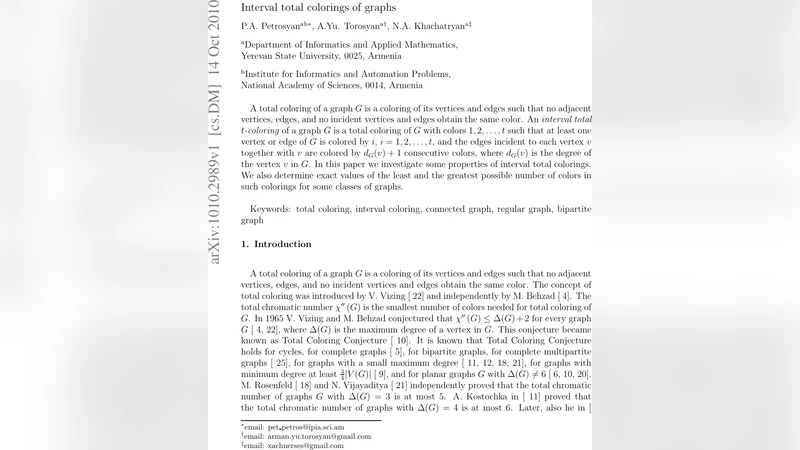
A total coloring of a graph $G$ is a coloring of its vertices and edges such that no adjacent vertices, edges, and no incident vertices and edges obtain the same color. An \emph{interval total $t$-coloring} of a graph $G$ is a total coloring of $G$ with colors $1,2,...,t$ such that at least one vertex or edge of $G$ is colored by $i$, $i=1,2,...,t$, and the edges incident to each vertex $v$ together with $v$ are colored by $d_{G}(v)+1$ consecutive colors, where $d_{G}(v)$ is the degree of the vertex $v$ in $G$. In this paper we investigate some properties of interval total colorings. We also determine exact values of the least and the greatest possible number of colors in such colorings for some classes of graphs.
💡 Research Summary
The paper introduces a new variant of total coloring called an “interval total t‑coloring.” In a total coloring, vertices and edges receive colors such that adjacent or incident elements receive distinct colors. The interval version adds two constraints: (i) the set of colors assigned to a vertex v together with all edges incident to v must consist of exactly d_G(v)+1 consecutive integers, where d_G(v) is the degree of v; (ii) every color from 1 to t must appear at least once somewhere in the graph. The authors denote by w_t(G) the smallest t for which an interval total t‑coloring exists, and by W_t(G) the largest such t.
The study begins with general bounds. Because each vertex needs a distinct block of d_G(v)+1 colors, any feasible t must satisfy t ≥ Δ(G)+1, where Δ(G) is the maximum degree. Conversely, assigning a different color to every vertex and every edge yields the trivial upper bound t ≤ |V(G)| + |E(G)|. These bounds already improve the classic total‑coloring bounds by incorporating the continuity requirement.
The core of the paper is a collection of exact values for several fundamental graph families:
-
Complete graphs K_n. The authors prove w_t(K_n)=n+1 and W_t(K_n)=2n−1. The construction uses a cyclic labeling of vertices and assigns edge colors as the sum (or difference) of endpoint labels, guaranteeing that each vertex’s incident colors form a block of length n+1.
-
Complete bipartite graphs K_{m,n}. When m≠n, the minimum number of colors is max{m,n}+1, while the maximum is m+n−1. In the balanced case m=n, the formulas simplify to w_t(K_{n,n})=2n and W_t(K_{n,n})=3n−1. The proof relies on arranging the two partite sets in parallel sequences and matching edges to preserve consecutive blocks.
-
Cycles C_n. Since every vertex has degree 2, each vertex requires three consecutive colors. The authors show that three colors already suffice (w_t(C_n)=3) and that one can stretch the palette up to n+1 colors (W_t(C_n)=n+1) by rotating the color blocks around the cycle.
-
Paths P_n. End vertices need only two colors, interior vertices three. Consequently w_t(P_n)=2 and W_t(P_n)=n+1. The construction proceeds by assigning alternating two‑color blocks at the ends and expanding the interval as the path grows.
-
Stars S_n (K_{1,n}). The central vertex of degree n forces a block of size n+1, giving w_t(S_n)=n+1, while the maximum attainable palette is 2n−1, matching the trivial upper bound for complete graphs of comparable size.
-
General trees. For any tree T, the authors prove w_t(T)=Δ(T)+1. Moreover, they establish an upper bound W_t(T)≤|V(T)|+Δ(T)−1, and demonstrate that this bound is tight for balanced binary trees and certain caterpillars. The proof uses induction on the number of vertices, carefully extending interval blocks when attaching leaves.
-
Cartesian products G□H. A significant structural result is that the class of graphs admitting interval total colorings is closed under Cartesian product. If G and H admit such colorings with parameters (w_t(G),W_t(G)) and (w_t(H),W_t(H)), then G□H admits an interval total coloring with parameters satisfying
w_t(G□H) ≥ w_t(G)+w_t(H)−1 and
W_t(G□H) ≤ W_t(G)+W_t(H)−1.
The construction aligns the color intervals of the factor graphs along each dimension, preserving the consecutive‑block property.
Beyond these exact results, the paper discusses several broader observations. The interval requirement typically forces the minimum palette to be larger than in ordinary total coloring, often by exactly one or by a factor related to the maximum degree. However, the maximum palette can be substantially larger, providing flexibility for applications where a wide range of resources (time slots, frequencies) is available but must be used continuously.
The authors also outline future research directions: (i) the computational complexity of deciding whether a given graph admits an interval total t‑coloring for a prescribed t; (ii) approximation algorithms for estimating w_t(G) and W_t(G) in general graphs; (iii) practical implementations in scheduling, frequency assignment, and other domains where resources must be allocated in contiguous blocks. By establishing foundational exact values and structural properties, the paper sets the stage for both deeper theoretical investigations and real‑world applications of interval total colorings.
Comments & Academic Discussion
Loading comments...
Leave a Comment