Improved approximations for robust mincut and shortest path
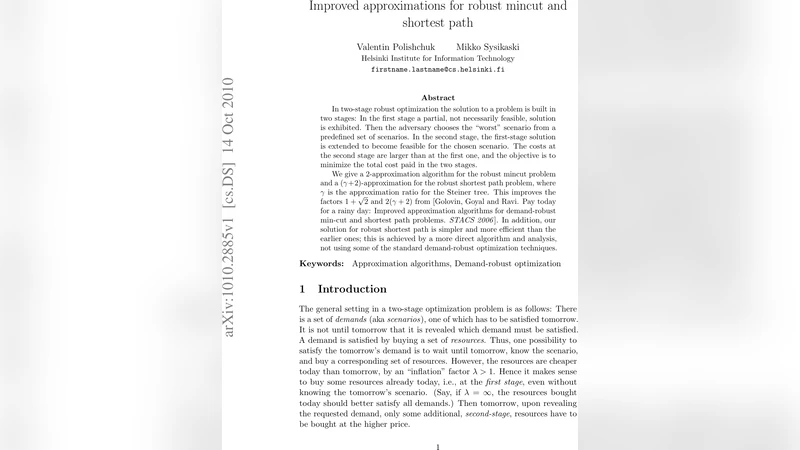
In two-stage robust optimization the solution to a problem is built in two stages: In the first stage a partial, not necessarily feasible, solution is exhibited. Then the adversary chooses the “worst” scenario from a predefined set of scenarios. In the second stage, the first-stage solution is extended to become feasible for the chosen scenario. The costs at the second stage are larger than at the first one, and the objective is to minimize the total cost paid in the two stages. We give a 2-approximation algorithm for the robust mincut problem and a ({\gamma}+2)-approximation for the robust shortest path problem, where {\gamma} is the approximation ratio for the Steiner tree. This improves the factors (1+\sqrt2) and 2({\gamma}+2) from [Golovin, Goyal and Ravi. Pay today for a rainy day: Improved approximation algorithms for demand-robust min-cut and shortest path problems. STACS 2006]. In addition, our solution for robust shortest path is simpler and more efficient than the earlier ones; this is achieved by a more direct algorithm and analysis, not using some of the standard demand-robust optimization techniques.
💡 Research Summary
The paper studies two classic network design problems—minimum cut and shortest‑path—under the two‑stage robust optimization framework. In this model a decision maker first selects a partial (possibly infeasible) solution; an adversary then reveals the worst‑case scenario from a predefined scenario set; finally the decision maker augments the first‑stage solution to become feasible for the revealed scenario, paying higher second‑stage costs. The objective is to minimize the total cost incurred across both stages.
For the robust minimum‑cut problem the authors improve upon the previous (1 + √2)‑approximation of Golovin, Goyal and Ravi (STACS 2006) by presenting a simple 2‑approximation algorithm. The algorithm computes upper bounds on the min‑cut values for all demand pairs (using a Gomory‑Hu tree) and selects in the first stage the cut that has the largest such bound. When the adversary chooses a scenario, the remaining graph is cut using a standard min‑cut routine. The analysis shows that the sum of the first‑stage cut cost and the second‑stage augmentation cost never exceeds twice the optimal robust cost. The running time is dominated by the construction of the Gomory‑Hu tree, i.e., O(n·m log n), which is polynomial.
For the robust shortest‑path problem the authors achieve a (γ + 2)‑approximation, where γ is the approximation ratio of the underlying Steiner‑tree algorithm. The method is remarkably straightforward: in the first stage a (γ‑approximate) Steiner tree spanning all demand vertices is built; the tree edges are then used to define tentative paths from the source to each demand vertex. In the second stage the adversary selects a particular demand vertex; the decision maker simply follows the pre‑computed tree path to that vertex, incurring at most an additional cost of 2 (the factor accounting for the higher second‑stage price). Consequently the total cost is bounded by γ·OPT + 2·OPT = (γ + 2)·OPT. This approach avoids the more involved “demand‑robust” techniques previously required, leading to a simpler implementation and faster execution.
The paper’s contributions are twofold: (1) it tightens the approximation guarantees for robust min‑cut and shortest‑path, and (2) it demonstrates that, for these problems, the classic robust optimization machinery (scenario decomposition, cost scaling, etc.) can be replaced by more direct combinatorial constructions without sacrificing performance. The results broaden the practical applicability of robust network design, offering algorithms that are both theoretically sound and computationally efficient.
Comments & Academic Discussion
Loading comments...
Leave a Comment