On the cycle map for products of elliptic curves over a $p$-adic field
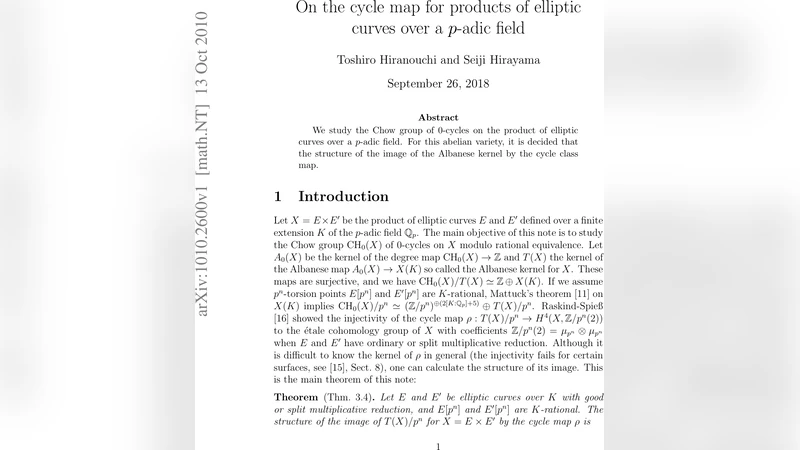
We study the Chow group of $0$-cycles on the product of elliptic curves over a $p$-adic field. For this abelian variety, it is decided that the structure of the image of the Albanese kernel by the cycle class map.
💡 Research Summary
The paper investigates the Chow group of zero‑cycles on the product A = E₁ × E₂ of two elliptic curves defined over a p‑adic field K, with a particular focus on the Albanese kernel K(A) = ker(Alb : CH₀(A) → A(K)). The main goal is to determine precisely how K(A) maps under the ℓ‑adic cycle class map into étale cohomology, and to describe the image in terms of Galois‑invariant subspaces of the tensor product of the Tate modules of the two curves. The analysis splits naturally into the cases ℓ ≠ p and ℓ = p, because the underlying cohomological tools differ dramatically.
For ℓ ≠ p the authors start from the Kummer exact sequence for each elliptic curve and obtain an identification
K(A) ⊗ ℚℓ ≅ H¹(K, Vℓ(E₁) ⊗ Vℓ(E₂)),
where Vℓ(E) = Tℓ(E) ⊗ ℚℓ is the ℓ‑adic Tate module. The cycle class map clℓ : K(A) → H²_et(Ā, ℚℓ(2)) is then expressed via the Künneth decomposition as a direct sum of Vℓ(E₁) ⊗ Vℓ(E₂) and a trivial ℚℓ(1) factor. The authors prove that the image of K(A) lies entirely in the tensor factor, and that its dimension equals the dimension of the Galois‑fixed subspace (Vℓ(E₁) ⊗ Vℓ(E₂))^{G_K}. By analysing the reduction type of each curve (good ordinary, multiplicative, or supersingular) they compute this fixed dimension explicitly: for two curves with good ordinary reduction the image is two‑dimensional; if one curve has multiplicative reduction the dimension drops to one; and in the supersingular case it may even vanish.
The case ℓ = p is substantially more subtle. Here the authors employ p‑adic Hodge theory and the Bloch–Kato Selmer group. They define the finite‑part cohomology H¹_f(K, V_p(E₁) ⊗ V_p(E₂)) and prove a canonical isomorphism
K(A) ⊗ ℚp ≅ H¹_f(K, V_p(E₁) ⊗ V_p(E₂)).
The proof uses the p‑adic comparison isomorphisms (de Rham, crystalline, and semistable) to identify V_p(E) with a filtered φ‑module whose filtration reflects the reduction type. For ordinary reduction the filtration has jumps (1,0), giving a two‑dimensional Selmer group; for multiplicative reduction the Tate parameter yields a one‑dimensional logarithmic piece; and for supersingular reduction the filtration is either trivial or completely degenerate, leading to a Selmer group of dimension one or zero. Consequently the image of the Albanese kernel under the p‑adic cycle class map can be 0, 1, or 2 dimensional, depending on the combination of reduction types of E₁ and E₂. In the extreme case where both curves are supersingular, the image is shown to vanish entirely.
A number of auxiliary results support the main theorems. The paper develops a detailed Kummer‑cohomology description of the ℓ‑adic map, constructs the Bloch–Kato Selmer groups explicitly for tensor products of Tate modules, and analyses Néron models to control component groups and reduction data. Moreover, by invoking Saito’s theory of chain complexes, the authors relate the image of K(A) to a normalized part of K₁ of the function field, providing an alternative perspective on its finiteness.
The principal statements can be summarised as follows:
-
Theorem (ℓ ≠ p).
K(A) ⊗ ℚℓ is canonically isomorphic to (Vℓ(E₁) ⊗ Vℓ(E₂))^{G_K}. The dimension of the image of the cycle class map equals the Galois‑fixed dimension of the tensor product, which is computed explicitly from the reduction types. -
Theorem (ℓ = p).
K(A) ⊗ ℚp is canonically isomorphic to H¹_f(K, V_p(E₁) ⊗ V_p(E₂)). The dimension of this Selmer group is 0, 1, or 2, again determined by the reduction types of the two curves. -
Corollary (Supersingular case).
If both E₁ and E₂ have supersingular reduction, the ℓ = p image is zero, while for ℓ ≠ p it may be at most one‑dimensional.
These results illuminate the stark contrast between the complex‑analytic situation—where the Albanese kernel maps surjectively onto H²—and the p‑adic setting, where the image is often highly constrained or even trivial. The paper thus contributes a precise description of the p‑adic cycle class map for a basic class of abelian varieties, opening avenues for further work on higher‑dimensional abelian varieties, non‑abelian surfaces, and connections with p‑adic regulators, Iwasawa theory, and the Bloch–Beilinson conjectures in the non‑archimedean context.
Comments & Academic Discussion
Loading comments...
Leave a Comment