Conservation Law of Utility and Equilibria in Non-Zero Sum Games
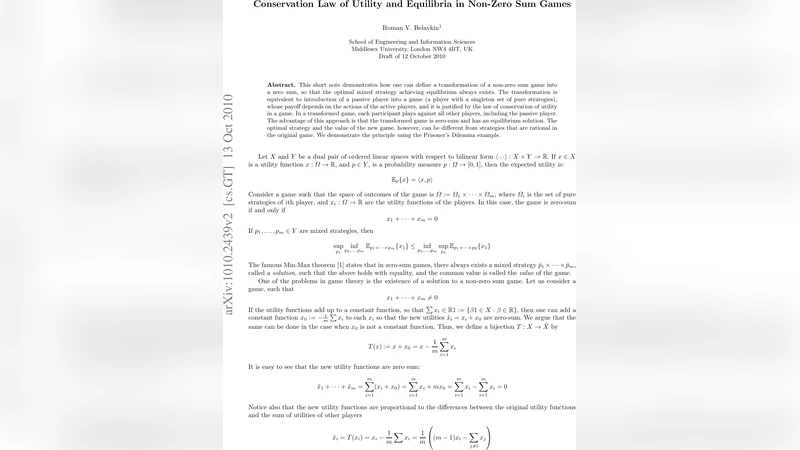
This short note demonstrates how one can define a transformation of a non-zero sum game into a zero sum, so that the optimal mixed strategy achieving equilibrium always exists. The transformation is equivalent to introduction of a passive player into a game (a player with a singleton set of pure strategies), whose payoff depends on the actions of the active players, and it is justified by the law of conservation of utility in a game. In a transformed game, each participant plays against all other players, including the passive player. The advantage of this approach is that the transformed game is zero-sum and has an equilibrium solution. The optimal strategy and the value of the new game, however, can be different from strategies that are rational in the original game. We demonstrate the principle using the Prisoner’s Dilemma example.
💡 Research Summary
The paper tackles a fundamental difficulty in non‑zero‑sum games: the possible absence of a mixed‑strategy Nash equilibrium or the existence of multiple equilibria that are hard to select. The author proposes a systematic transformation that converts any finite non‑zero‑sum game into a zero‑sum game by introducing a “passive player.” This passive player possesses a singleton set of pure strategies; its payoff is defined as a function of the active players’ actions so that the total utility of the system is conserved. Concretely, if the original payoff to player i under action profile x is u_i(x) and there are n active players, the transformed payoff becomes v_i(x)=u_i(x)−(1/n)∑_{j=1}^{n}u_j(x). By construction, the sum of all v_i(x) equals zero for every x, satisfying the zero‑sum condition.
The transformation rests on an analogue of the physical law of conservation of energy, here termed the “conservation of utility.” The passive player does not make strategic choices; instead, it acts as a bookkeeping device that redistributes the excess utility among the active players, ensuring that the overall utility flow is balanced. Once the game is zero‑sum, the classic minimax theorem and the existence theorem for mixed‑strategy Nash equilibria apply directly, guaranteeing at least one equilibrium in the transformed game.
To illustrate the method, the author applies it to the Prisoner’s Dilemma. In the original game the unique Nash equilibrium is (Defect, Defect), while the socially optimal outcome is (Cooperate, Cooperate). After the transformation, each player’s payoff is adjusted by subtracting half of the total payoff, yielding a new zero‑sum matrix. Solving this matrix reproduces the (Defect, Defect) equilibrium, showing that the transformation does not alter the equilibrium profile but does change the game’s value and the interpretation of strategies.
The key insight is that the equilibrium guaranteed in the transformed game may differ from strategies that are “rational” or socially desirable in the original setting. The passive player’s utility redistribution can distort incentives, potentially discouraging cooperation that would be optimal in the untransformed game. Consequently, while the transformation provides a powerful theoretical tool for ensuring equilibrium existence, it raises questions about the normative relevance of the resulting strategies.
The paper concludes that any finite non‑zero‑sum game can be embedded in a zero‑sum framework through a utility‑conserving transformation, thereby extending the reach of zero‑sum solution concepts. However, the author cautions that the practical applicability of this approach depends on how one justifies the passive player’s payoff function and whether the transformed equilibrium aligns with the original game’s economic or social objectives. Future work is suggested to explore alternative passive‑player constructions, to assess the impact on welfare measures, and to investigate extensions to games with continuous strategy spaces or dynamic settings.
Comments & Academic Discussion
Loading comments...
Leave a Comment