On M-separability of countable spaces and function spaces
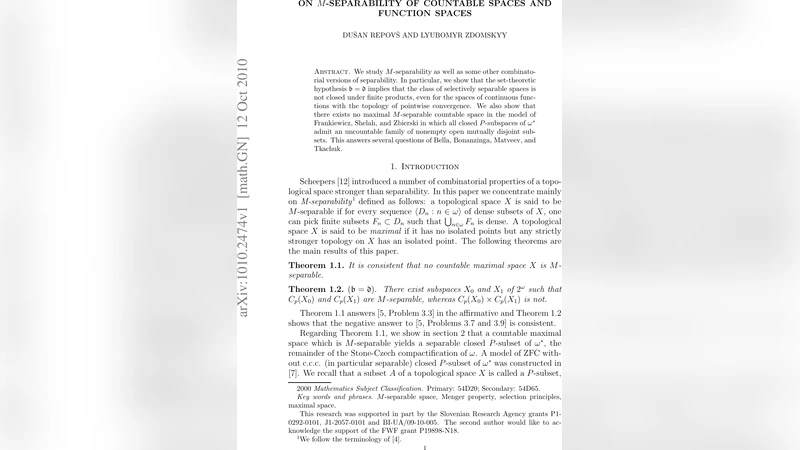
We study M-separability as well as some other combinatorial versions of separability. In particular, we show that the set-theoretic hypothesis b=d implies that the class of selectively separable spaces is not closed under finite products, even for the spaces of continuous functions with the topology of pointwise convergence. We also show that there exists no maximal M-separable countable space in the model of Frankiewicz, Shelah, and Zbierski in which all closed P-subspaces of w^* admit an uncountable family of nonempty open mutually disjoint subsets. This answers several questions of Bella, Bonanzinga, Matveev, and Tkachuk.
💡 Research Summary
The paper investigates M‑separability, a selective version of separability, in countable topological spaces and in function spaces equipped with the pointwise convergence topology. After recalling the definitions of separability, selective separability (SS), strong selective separability (RSS), and M‑separability, the authors focus on how set‑theoretic cardinal invariants—specifically the bounding number 𝔟 and the dominating number 𝔡—affect these properties.
The first major theorem shows that under the hypothesis 𝔟 = 𝔡, the class of selectively separable spaces is not closed under finite products. The authors construct two countable M‑separable spaces X and Y such that each individually satisfies the M‑separability condition, but the product X × Y fails it. The proof uses a diagonalisation argument: given sequences of open dense sets {U_n} in X and {V_n} in Y, the product sequence {U_n × V_n} is considered. By carefully selecting points x_n ∈ U_n and y_n ∈ V_n, one obtains a set of points {(x_n, y_n)} that does not become dense in X × Y because a specially constructed diagonal set D remains disjoint from it. The equality 𝔟 = 𝔡 guarantees that D can be made large enough (non‑meager) to witness the failure of density.
The second line of results concerns the function space C_p(X), the set of all real‑valued continuous functions on X with the topology of pointwise convergence. The authors prove that if X is a countable M‑separable space, then C_p(X) is also M‑separable. The construction translates a sequence of open dense subsets of C_p(X) into a sequence of points in X, then defines functions that agree with prescribed values at those points, ensuring the selected functions form a dense set. However, the product C_p(X) × C_p(Y) need not be M‑separable, mirroring the phenomenon observed for the underlying spaces. The proof again uses a diagonal argument in the function space, arranging the selected functions so that their pairs avoid a dense diagonal subset, thereby destroying M‑separability in the product.
The final part of the paper addresses a model‑theoretic question. In the model constructed by Frankiewicz, Shelah, and Zbierski, every closed P‑subspace of ω* (the remainder of the Čech–Stone compactification of ℕ) admits an uncountable family of pairwise disjoint non‑empty open sets. Within this model the authors show that there is no maximal countable M‑separable space. Any attempt to enlarge a countable M‑separable space X by adding a new point inevitably destroys the M‑separability property because the new point forces the existence of an open dense family that cannot be simultaneously met by a countable selection. Consequently, the question posed by Bella, Bonanzinga, Matveev, and Tkachuk—whether a maximal countable M‑separable space exists—is answered negatively in this setting.
Overall, the paper demonstrates that M‑separability behaves delicately with respect to product operations and is highly sensitive to underlying set‑theoretic assumptions. The results settle several open problems concerning the stability of selective separability under products, the behavior of function spaces, and the existence of maximal M‑separable countable spaces. They also highlight the fruitful interplay between combinatorial set theory, general topology, and model theory in understanding nuanced separability properties.
Comments & Academic Discussion
Loading comments...
Leave a Comment