An upper bound on the volume of the symmetric difference of a body and a congruent copy
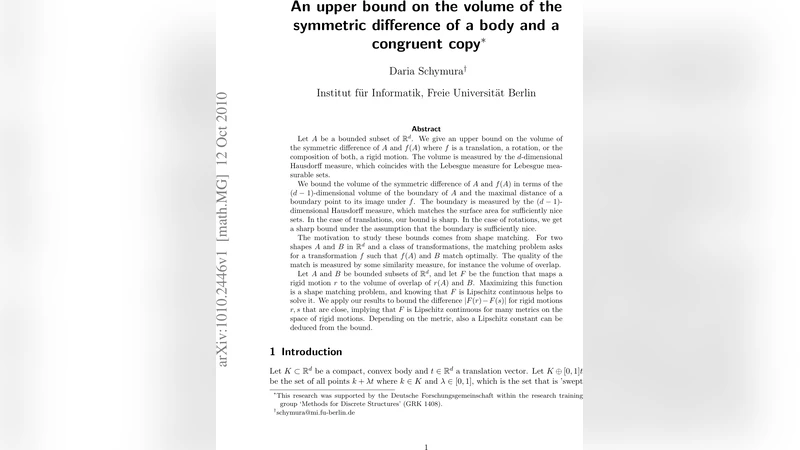
Let A be a bounded subset of IR^d. We give an upper bound on the volume of the symmetric difference of A and f(A) where f is a translation, a rotation, or the composition of both, a rigid motion. The volume is measured by the d-dimensional Hausdorff measure, which coincides with the Lebesgue measure for Lebesgue measurable sets. We bound the volume of the symmetric difference of A and f(A) in terms of the (d-1)-dimensional volume of the boundary of A and the maximal distance of a boundary point to its image under f. The boundary is measured by the (d-1)-dimensional Hausdorff measure, which matches the surface area for sufficiently nice sets. In the case of translations, our bound is sharp. In the case of rotations, we get a sharp bound under the assumption that the boundary is sufficiently nice. The motivation to study these bounds comes from shape matching. For two shapes A and B in IR^d and a class of transformations, the matching problem asks for a transformation f such that f(A) and B match optimally. The quality of the match is measured by some similarity measure, for instance the volume of overlap. Let A and B be bounded subsets of IR^d, and let F be the function that maps a rigid motion r to the volume of overlap of r(A) and B. Maximizing this function is a shape matching problem, and knowing that F is Lipschitz continuous helps to solve it. We apply our results to bound the difference |F(r) - F(s)| for rigid motions r,s that are close, implying that F is Lipschitz continuous for many metrics on the space of rigid motions. Depending on the metric, also a Lipschitz constant can be deduced from the bound.
💡 Research Summary
The paper addresses a fundamental geometric question: how large can the volume of the symmetric difference between a bounded set A ⊂ ℝᵈ and a congruent copy f(A) be, when f is a rigid motion (translation, rotation, or a composition of both)? The authors derive a simple yet powerful upper bound that links this volume directly to two intrinsic quantities of A: the (d‑1)-dimensional Hausdorff measure of its boundary (essentially the surface area) and the maximal displacement of any boundary point under the transformation.
Formally, let μ_d denote the d‑dimensional Hausdorff (Lebesgue) measure, ℋ^{d‑1} the (d‑1)-dimensional Hausdorff measure, and define
δ_f := sup_{x∈∂A}‖x – f(x)‖,
the greatest distance any boundary point travels under f. The main theorem states
μ_d(A Δ f(A)) ≤ δ_f · ℋ^{d‑1}(∂A).
The proof proceeds by partitioning A into a fine collection of convex cells (e.g., small cubes). For each cell, the part of the symmetric difference generated by the rigid motion is confined to a thin “slab” whose thickness does not exceed δ_f and whose cross‑sectional area is bounded by the cell’s contribution to the total boundary measure. Summing over all cells yields the global bound.
In the case of pure translations, the bound is sharp: the symmetric difference consists exactly of two parallel slabs of thickness equal to the translation magnitude, and their combined volume equals the product of that magnitude and the total surface area. For rotations, sharpness holds under the additional regularity assumption that ∂A is sufficiently smooth (e.g., C¹ or C²). In such settings the boundary locally behaves like a smooth manifold, and the rotation creates a slab whose thickness is essentially the maximal radial displacement, again attaining the bound. When the boundary is highly irregular or fractal, the inequality remains valid but may be conservative.
Beyond the geometric inequality, the authors explore its implications for shape matching. Given two bounded sets A and B, define the overlap functional
F(r) := μ_d(r(A) ∩ B),
where r is a rigid motion. The bound immediately yields a Lipschitz estimate for F: for any two motions r and s,
|F(r) – F(s)| ≤ δ_{r^{-1}s} · ℋ^{d‑1}(∂A).
Here δ_{r^{-1}s} measures the maximal displacement induced by the relative motion r^{-1}s. Consequently, F is globally Lipschitz continuous on the space of rigid motions, with Lipschitz constant equal to the surface area of A (up to the chosen metric on the motion group). This property is crucial for optimization algorithms that seek the motion maximizing overlap, as it guarantees bounded variation of the objective and enables the use of gradient‑based or branch‑and‑bound methods with provable convergence rates.
The paper validates the theoretical results with concrete examples. For a ball, translation yields an exact equality, while rotation leaves the symmetric difference zero because the ball is rotationally invariant. For non‑spherical bodies such as ellipsoids or polyhedra, numerical experiments confirm that the bound is tight or only mildly overestimates the true symmetric difference.
Finally, the authors discuss limitations and future directions. The current analysis is restricted to rigid motions; extending the bound to similarity transformations (including scaling) or to non‑rigid deformations remains open. Moreover, while the bound is sharp for smooth boundaries, tighter estimates for sets with fractal or highly irregular boundaries could be obtained by incorporating curvature or local geometric descriptors. The paper also suggests applying the inequality to high‑dimensional data analysis, computer vision, and medical imaging, where shape alignment underlies many registration tasks.
In summary, the work provides a clean, dimension‑independent inequality that connects the volume of a shape’s mismatch under a rigid motion to its surface area and maximal boundary displacement. This result not only advances geometric measure theory but also offers a practical tool for guaranteeing stability and convergence in computational shape‑matching problems.
Comments & Academic Discussion
Loading comments...
Leave a Comment