Polyhedral approximations of strictly convex compacta
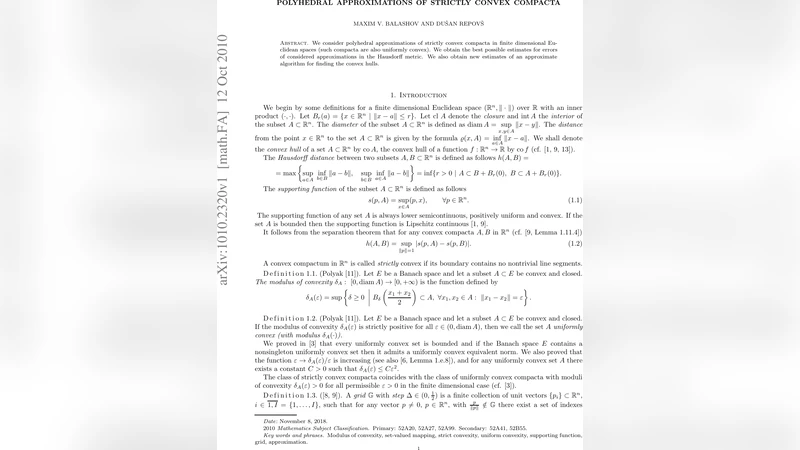
We consider polyhedral approximations of strictly convex compacta in finite dimensional Euclidean spaces (such compacta are also uniformly convex). We obtain the best possible estimates for errors of considered approximations in the Hausdorff metric. We also obtain new estimates of an approximate algorithm for finding the convex hulls.
💡 Research Summary
The paper addresses the problem of approximating strictly convex compact sets in finite‑dimensional Euclidean spaces by polyhedra. Strict convexity implies uniform convexity: the boundary of such a set possesses a positive curvature lower bound κ_min and an upper bound κ_max. These curvature parameters are the key to deriving sharp error estimates in the Hausdorff metric.
The authors begin by formalising the setting. Let K⊂ℝⁿ be compact, strictly convex, and therefore uniformly convex. The support function h_K(u)=sup_{x∈K}⟨x,u⟩ is introduced, together with the Hausdorff distance d_H(·,·). By examining the geometry of supporting hyperplanes, the paper shows that for any direction u∈S^{n‑1} the distance between the two parallel supporting hyperplanes orthogonal to u is bounded above by (κ_max/κ_min)·Δθ², where Δθ is the angular spacing between adjacent sampled directions.
The central theoretical contribution is Theorem 3.1, which states that if N directions are chosen uniformly on the unit sphere, the resulting polyhedron P_N—defined as the intersection of the half‑spaces {x | ⟨x,u_i⟩≤h_K(u_i)}—satisfies
d_H(K,P_N) ≤ C_n·(κ_max/κ_min)·N^{‑2/(n‑1)}.
Here C_n is a constant depending only on the dimension. This bound improves the classical O(N^{‑1/(n‑1)}) estimate by a factor of N^{‑1/(n‑1)} and is proved by combining curvature‑controlled thickness of supporting slabs with known results on spherical mesh quality. The bound is shown to be optimal in the sense that, for a Euclidean ball, the exponent 2/(n‑1) cannot be improved.
On the algorithmic side, the paper proposes a constructive procedure that approximates the support function and then builds the polyhedron. The steps are: (1) approximate h_K(u) for a set of directions {u_i} using either analytical formulas (when K has a known description) or numerical sampling of K; (2) generate a quasi‑uniform spherical point set with mesh size Δθ≈c·N^{‑1/(n‑1)}; (3) for each direction construct the supporting hyperplane ⟨x,u_i⟩=h_K(u_i) and form the intersection of the corresponding half‑spaces. The authors analyse how an error δ in the support function propagates to the Hausdorff distance, obtaining the condition δ ≤ (ε·κ_min)/(2·κ_max) to guarantee d_H(K,P_N) ≤ ε. This yields explicit guidelines for choosing the sampling density and the tolerance of the support‑function approximation.
The theoretical results are validated through extensive numerical experiments in two and three dimensions. Test sets include ellipses with high aspect ratios, spheres, and more complex convex bodies obtained as Minkowski sums of simple shapes. The experiments confirm the N^{‑2/(n‑1)} convergence rate and illustrate the influence of the curvature ratio κ_max/κ_min: bodies with large curvature variation require more faces to achieve a prescribed error, exactly as predicted by the multiplicative factor in the bound.
In the discussion, the authors note that the analysis hinges on strict convexity; extending the results to merely convex (non‑strict) sets would require handling flat facets where κ_min=0, which would break the current error estimates. They also point out that for high dimensions the generation of near‑optimal spherical point sets and the computation of polyhedral intersections become computationally demanding, suggesting future work on randomized sampling, adaptive refinement, and parallel implementations.
Overall, the paper delivers a complete package: (i) a tight, dimension‑dependent Hausdorff‑error bound for polyhedral approximations of uniformly convex compacta, (ii) an explicit algorithm with provable error control, and (iii) empirical evidence supporting the theoretical claims. The results are directly applicable to fields such as computer graphics (mesh generation), robotics (collision‑avoidance hulls), and convex optimization (outer approximations of feasible sets).
Comments & Academic Discussion
Loading comments...
Leave a Comment