Quantum molecular dynamics simulations of lithium melting using Z-method
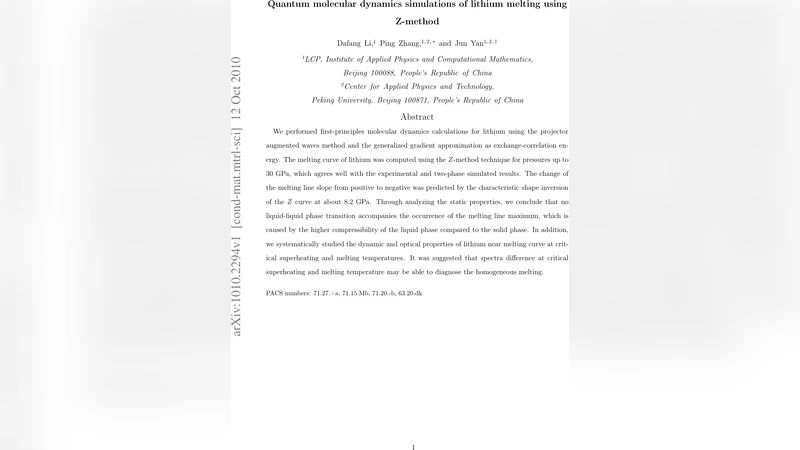
We performed first-principles molecular dynamics calculations for lithium using the projector augmented waves method and the generalized gradient approximation as exchange-correlation energy. The melting curve of lithium was computed using the \textit{Z}-method technique for pressures up to 30 GPa, which agrees well with the experimental and two-phase simulated results. The change of the melting line slope from positive to negative was predicted by the characteristic shape inversion of the \textit{Z} curve at about 8.2 GPa. Through analyzing the static properties, we conclude that no liquid-liquid phase transition accompanies the occurrence of the melting line maximum, which is caused by the higher compressibility of the liquid phase compared to the solid phase. In addition, we systematically studied the dynamic and optical properties of lithium near melting curve at critical superheating and melting temperatures. It was suggested that spectra difference at critical superheating and melting temperature may be able to diagnose the homogeneous melting.
💡 Research Summary
This paper presents a comprehensive first‑principles molecular dynamics (FPMD) investigation of lithium (Li) melting under pressures up to 30 GPa, employing the projector‑augmented‑wave (PAW) method together with the generalized‑gradient approximation (GGA‑PBE) for exchange‑correlation. The authors adopt the Z‑method—a homogeneous‑melting technique that determines both the critical superheating temperature (Tls) and the true melting temperature (Tm) from a single constant‑volume simulation—to construct the Li melting curve. By systematically varying the simulation cell volume, they generate a series of Z‑curves; each curve exhibits a characteristic “Z” shape, with the upper branch representing the superheated solid and the lower branch the equilibrated liquid. The intersection of these branches yields Tls, while the inflection point provides Tm.
The computed melting line shows excellent agreement with available diamond‑anvil‑cell (DAC) measurements and two‑phase coexistence simulations. Notably, at approximately 8.2 GPa the Z‑curve undergoes an inversion, marking a change in the slope of the melting line from positive to negative. This inversion is traced to the relative compressibility of the liquid versus the solid: as pressure rises, the liquid contracts more rapidly, causing its volume to become smaller than that of the solid at the same temperature, thereby producing a negative Clapeyron slope.
Static structural analyses—including radial distribution functions g(r) and static structure factors S(q)—reveal that the liquid phase maintains a higher compressibility across the pressure range. No evidence of a liquid‑liquid phase transition (LLPT) is found near the melting‑line maximum; the electronic density of states evolves smoothly with pressure, and no discontinuities appear in the bonding environment. Consequently, the melting‑line maximum is attributed solely to the differential compressibility rather than to an underlying LLPT.
Dynamic properties are examined via mean‑square displacement (MSD) and velocity autocorrelation functions (VACF). At Tls the system exhibits enhanced diffusion (larger MSD) yet retains remnants of solid‑like vibrational peaks in the VACF, confirming that the system is in a homogeneous superheated state rather than a fully equilibrated liquid. Upon reaching Tm, diffusion coefficients increase sharply and VACF decays monotonically, indicating complete melting.
Optical properties are calculated using the Kubo‑Greenwood formalism. The authors compare the frequency‑dependent electrical conductivity and reflectivity at Tls and Tm. The superheated solid displays a pronounced low‑frequency Drude peak and higher reflectivity, whereas the melted liquid shows a weakened Drude response and a shift of spectral weight to higher frequencies. These spectral differences suggest a practical diagnostic: time‑resolved optical measurements could distinguish homogeneous superheating from actual melting in high‑pressure experiments.
In the discussion, the authors emphasize that the Z‑method efficiently captures both superheating limits and melting points within a single simulation, reducing computational cost relative to traditional two‑phase coexistence approaches. They argue that the method’s ability to resolve subtle changes in compressibility and electronic structure makes it especially suitable for light alkali metals, where quantum effects and anharmonicity are pronounced.
The paper concludes that the melting‑line maximum of Li originates from the higher compressibility of the liquid phase, not from a hidden LLPT, and that the Z‑method provides a reliable, cost‑effective route to map melting curves under extreme conditions. Future work is proposed to extend the approach to larger supercells, longer simulation times, and to validate the predicted optical signatures experimentally via ultrafast pump‑probe spectroscopy in diamond‑anvil cells.
Comments & Academic Discussion
Loading comments...
Leave a Comment