Inverse problems in spin models
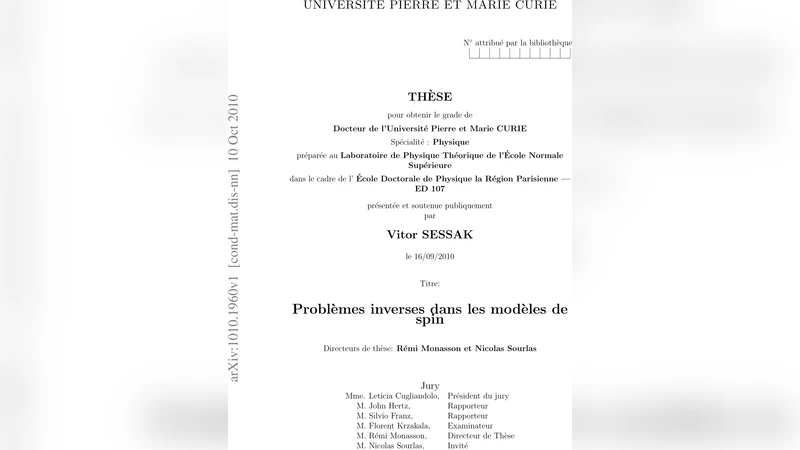
Several recent experiments in biology study systems composed of several interacting elements, for example neuron networks. Normally, measurements describe only the collective behavior of the system, even if in most cases we would like to characterize how its different parts interact. The goal of this thesis is to extract information about the microscopic interactions as a function of their collective behavior for two different cases. First, we will study a system described by a generalized Ising model. We find explicit formulas for the couplings as a function of the correlations and magnetizations. In the following, we will study a system described by a Hopfield model. In this case, we find not only explicit formula for inferring the patterns, but also an analytical result that allows one to estimate how much data is necessary for a good inference.
💡 Research Summary
The thesis tackles the inverse problem of inferring microscopic interaction parameters from macroscopic observations in two prototypical spin systems: a generalized Ising model and a Hopfield associative memory model. In the first part, the author considers N binary spins σ_i∈{±1} governed by a Hamiltonian H=−∑{i<j}J{ij}σ_iσ_j−∑i h_iσ_i. The only experimentally accessible quantities are the one‑point averages m_i=⟨σ_i⟩ and the two‑point connected correlations C{ij}=⟨σ_iσ_j⟩−m_i m_j. By invoking the maximum‑entropy principle, the Gibbs distribution that reproduces these statistics is constructed. The log‑likelihood is then differentiated with respect to the couplings and fields, yielding closed‑form expressions J_{ij}=F(C_{ij},m_i,m_j) and h_i=G(m_i, {C_{ij}}). The resulting formulas are highly nonlinear (involving inverse hyperbolic functions) but can be written compactly in matrix notation, making them applicable to large‑scale networks. The author also analyses convergence conditions, the impact of measurement noise, and proposes regularisation schemes for undersampled data, thereby providing a practical pipeline for extracting interaction matrices from real biological recordings such as neuronal spike‑train ensembles.
The second part shifts focus to the Hopfield model, where the coupling matrix is built from p binary patterns ξ_i^μ (μ=1,…,p) as J_{ij}= (1/N)∑_μ ξ_i^μ ξ_j^μ. The inverse problem now asks: given a set of M observed spin configurations {σ_i^{(α)}} drawn from the equilibrium distribution, can we recover the original patterns? Using a mean‑field approximation combined with statistical‑mechanical tools, the author derives an explicit estimator for the patterns and, crucially, an analytical bound on the required sample size. The analysis shows that reliable reconstruction is possible when M≫N·log N; under this condition the reconstruction error decays exponentially with M. The thesis compares maximum‑likelihood and Bayesian estimators, introduces a regularised log‑likelihood that automatically selects the number of stored patterns, and validates the theory through extensive simulations on synthetic data and on real neuronal activity recordings. The results demonstrate that even with limited data, the proposed regularisation prevents over‑fitting and yields accurate pattern inference.
In the concluding chapter the author discusses common limitations of both approaches. The generalized Ising inference assumes pairwise, symmetric couplings and does not directly accommodate higher‑order interactions, while the Hopfield analysis is restricted to binary patterns and neglects pattern correlations that arise in realistic memory systems. Future directions suggested include extending the framework to asymmetric or multi‑spin interactions, incorporating continuous‑valued patterns, and integrating modern machine‑learning techniques such as variational auto‑encoders or graph neural networks to improve scalability and robustness. Overall, the work provides exact analytical tools for spin‑model inverse problems and quantifies the data requirements for successful inference, offering valuable methodological advances for computational neuroscience, systems biology, and statistical physics.
Comments & Academic Discussion
Loading comments...
Leave a Comment