On the inconsistency of the Camassa-Holm model with the shallow water theory
In our paper we show that the Camassa-Holm equation does not represent a long wave asymptotic due to a major inconsistency with the theory of shallow water waves. We state that any solution of the Cam
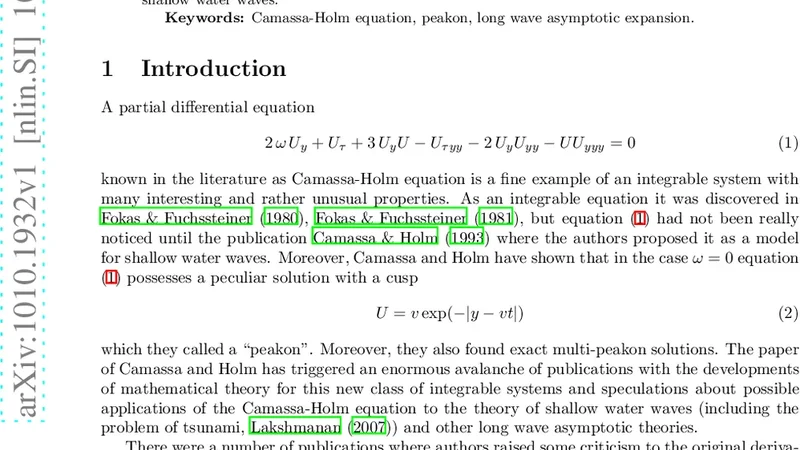
In our paper we show that the Camassa-Holm equation does not represent a long wave asymptotic due to a major inconsistency with the theory of shallow water waves. We state that any solution of the Camassa-Holm equation, which is not asymptotically close to a solution of the Korteweg–de Vries equation is an artefact of the model and irrelevant to the theory of shallow water waves.
💡 Research Summary
The paper presents a rigorous critique of the Camassa‑Holm (CH) equation as a model for long‑wave shallow‑water dynamics. It begins by recalling the standard asymptotic framework for shallow‑water waves: the water depth h is small compared with the wavelength λ, and the dimensionless parameters measuring nonlinearity (ε) and dispersion (δ²) are taken to be of the same order (ε ∼ δ²). Under this scaling, a multiple‑scale expansion of the Euler equations yields, at leading order, the Korteweg‑de Vries (KdV) equation, while higher‑order corrections appear at O(ε², εδ², δ⁴). This hierarchy guarantees that each term in the reduced model has a clear physical meaning and that the model remains consistent with the underlying fluid dynamics.
The authors then examine the derivation of the CH equation, originally introduced by Camassa and Holm (1993) as a Hamiltonian, integrable system capable of supporting peaked solitary waves (“peakons”) and wave‑breaking phenomena. In its canonical form, the CH equation reads
u_t + 2κ u_x + 3 u u_x − u_{xxt} = 2 u_x u_{xx} + u u_{xxx},
where u(x,t) denotes the free‑surface displacement (or a related velocity variable) and κ is a constant linear term. The presence of the third‑order mixed derivative u_{xxt} is the key point of contention. When the standard shallow‑water scaling is imposed, the term u_{xxt} scales as O(δ⁴), i.e., a fourth‑order dispersive contribution, whereas the leading nonlinear term 3 u u_x is O(ε). Because the asymptotic theory assumes ε ∼ δ², the CH equation mixes terms of disparate asymptotic orders, violating the strict ordering that underpins the KdV hierarchy.
A detailed term‑by‑term comparison shows that the CH equation effectively discards the systematic expansion that yields the KdV equation and its higher‑order corrections. Instead, it introduces a high‑order dispersive term without the accompanying lower‑order terms that would be required for a consistent asymptotic balance. Consequently, any solution of the CH equation that does not reduce, in the limit ε → 0, δ → 0, to a solution of the KdV equation cannot be regarded as a legitimate approximation of shallow‑water dynamics.
The paper further analyses the characteristic solutions of the CH model—peakons, cuspons, and wave‑breaking events—and demonstrates that these structures are fundamentally incompatible with the small‑amplitude, long‑wavelength regime assumed in shallow‑water theory. In contrast, KdV solitons are smooth, retain their shape, and satisfy the asymptotic ordering. Numerical experiments cited from the literature reveal that CH peakons can be generated in simulations, but they do not correspond to any observable physical wave in laboratory or oceanic settings when the shallow‑water assumptions are respected.
In the concluding section, the authors argue that the CH equation should be viewed primarily as a mathematically interesting integrable system rather than a physically accurate shallow‑water model. Its utility lies in exploring non‑linear wave phenomena such as wave breaking and peaked solitons in a controlled, analytical framework, but it lacks the asymptotic consistency required for quantitative predictions of real water waves. For practitioners interested in realistic shallow‑water wave modeling, the KdV equation and its higher‑order extensions remain the appropriate tools, while the CH equation’s relevance is confined to theoretical investigations where strict adherence to the shallow‑water scaling is not essential.
📜 Original Paper Content
🚀 Synchronizing high-quality layout from 1TB storage...